

A local roofing company was getting maybe three inquiries a month from its website while a competitor across town pulled ten times that. Same city, same services, roughly the same business age. The difference came down to one thing a content gap analysis would have caught in an afternoon: the competitor had 40 pages answering the exact questions homeowners typed into Google before hiring a roofer, and this business had a homepage and a contact form. This article walks through what a content gap is, why it costs you leads, and how to find and close the ones that matter most for a small business.

What is a content gap analysis (definition and plain-English overview)
A content gap analysis compares what your target audience searches for against what your website publishes, then measures both against competitors. The “gap” is anything your audience wants that you don’t provide: a topic you never covered, a keyword your competitors rank for that you don’t, or a page that answers the wrong version of a question.
Think of it as a content audit with a competitor lens bolted on. A standard content audit looks inward at your own pages. A content gap analysis adds the outside view, and it’s worth understanding how marketers approach content gap analysis before diving into your own. It’s a step every content strategy should include before new pages get written, since it shows you the missing content that’s sending clicks to someone else.
Most gaps sort into four buckets: topic gaps, keyword gaps, search intent gaps, and quality gaps. Google’s own guidance on creating helpful, people-first content explains why intent and originality matter as much as raw keyword coverage. That’s exactly where thin pages fall short. You’re finding places where searchers have a need, and your site stays silent. If you’re working through this for the first time, our practical SEO marketing guide for small businesses walks through the fundamentals before you get into competitor comparisons.
Why content gap analysis matters and the business outcomes it drives
Every ranking keyword you don’t have is a lead going somewhere else. When a competitor ranks for “commercial HVAC maintenance cost,” and you don’t, the buyer researching that exact question never lands on your site. That buyer never becomes a qualified lead.
Buyers rarely search once and buy. They move through a journey: broad questions first, then narrower ones, then comparison and pricing questions. If your content only covers the final “book now” stage, you’ve handed every earlier touchpoint to competitors, who then own the relationship by the time the buyer is ready. The mechanism is simple: search intent shifts as buyers move down the funnel, so a site covering only one stage stays invisible for every query that comes before it.
Ahrefs’ own research into search demand, documented in their study of how people use Google, points to how much traffic sits in these informational and mid-funnel queries. Closing content gaps can improve search visibility across that whole journey and support stronger content performance overall, a pattern reflected in content marketing benchmark data showing how consistent, intent-driven publishing correlates with stronger lead generation. Potential outcomes include more organic traffic, more of the right audience, and steadier lead flow that depends less on ad spend.

Signs it’s time to run a content gap analysis
You don’t need a formal audit to sense a gap. A few patterns tend to show up first:
- Your organic traffic has flatlined or slipped while you keep publishing. New posts aren’t moving the needle, often because the content doesn’t match search intent.
- Competitors consistently outrank you on terms you’d expect to win locally. That’s a keyword gap staring you in the face.
- Your best pages get impressions but few clicks in Google Search Console. You’re on page two for keywords your competitors rank for on page one.
- Prospects keep asking questions your site doesn’t answer. If your sales calls repeat the same five questions, those are missing content pages waiting to be written.
- You’ve never done a content audit. If you can’t say which pages drive leads and which are dead weight, you have underperforming content you can’t see.
What often happens with stalled sites is rarely a penalty or a technical failure. It can be a slow erosion as competitors publish the content opportunities you left open. The longer you wait, the more ground there may be to recover, which is why it often makes sense to run a full SEO audit for your small business before the gap widens further.
How to do a content gap analysis step by step
Here’s how to do a content gap analysis without drowning in data:
- List your core topics and services. Map what your business actually sells to the questions buyers ask before buying.
- Pick 3-5 real competitors. Not national brands, direct competitors who rank for the searches you want. This is your competitor analysis shortlist.
- Pull ranking keywords. Export your keywords from Google Search Console, then compare against competitors using a keyword gap tool. Look for keywords your competitors rank for that you have zero presence on.
- Sort gaps by type. Tag each as a topic gap, keyword gap, or intent gap so you know whether you need a new page or a rewrite.
- Run a quick SERP analysis on the top opportunities. Reading the pages currently ranking helps confirm search intent before you write.
- Prioritize opportunities. Score each gap by search volume, relevance to your services, and difficulty, then start with the quick wins.
That last step is where most content plans succeed or stall. Chasing every gap at once burns time. Closing the highest-value ones first can build momentum you can measure.

Analyzing competitors to find keywords and topics they rank for
Competitor analysis is where the gap analysis earns its keep. The goal is simple: find the keywords your competitors rank for that you don’t, then figure out which are worth chasing.
Start by identifying who actually competes with you in search results, which isn’t always who competes with you for business. A boutique agency might outrank you on informational queries while a directory site pulls in your “near me” traffic. Both are worth studying.
Then look at their content structure. Which topic gaps have they filled? Do they cover the full buyer’s journey, or just the bottom? Many small business owners assume a competitor wins because of domain age or backlinks. More often, the real issue is coverage: they published pages that answer questions you ignored, and Google tends to reward the site that best satisfies the search rather than the oldest one.
Pay attention to format too. If competitors rank with cost guides, comparison pages, and FAQs while you only have service pages, that’s a structural gap, and often a user experience gap as well, since visitors can’t find the answer format they expect. This is also where technical SEO support matters, and coordinating those competitor-driven content fixes across a small team is exactly the kind of work that keeps strategy and publishing aligned so nothing stalls. If this feels like more than you can manage alone, working with a small business marketing consultant can help translate these gaps into an actual publishing plan.
Tools used for content gap analysis
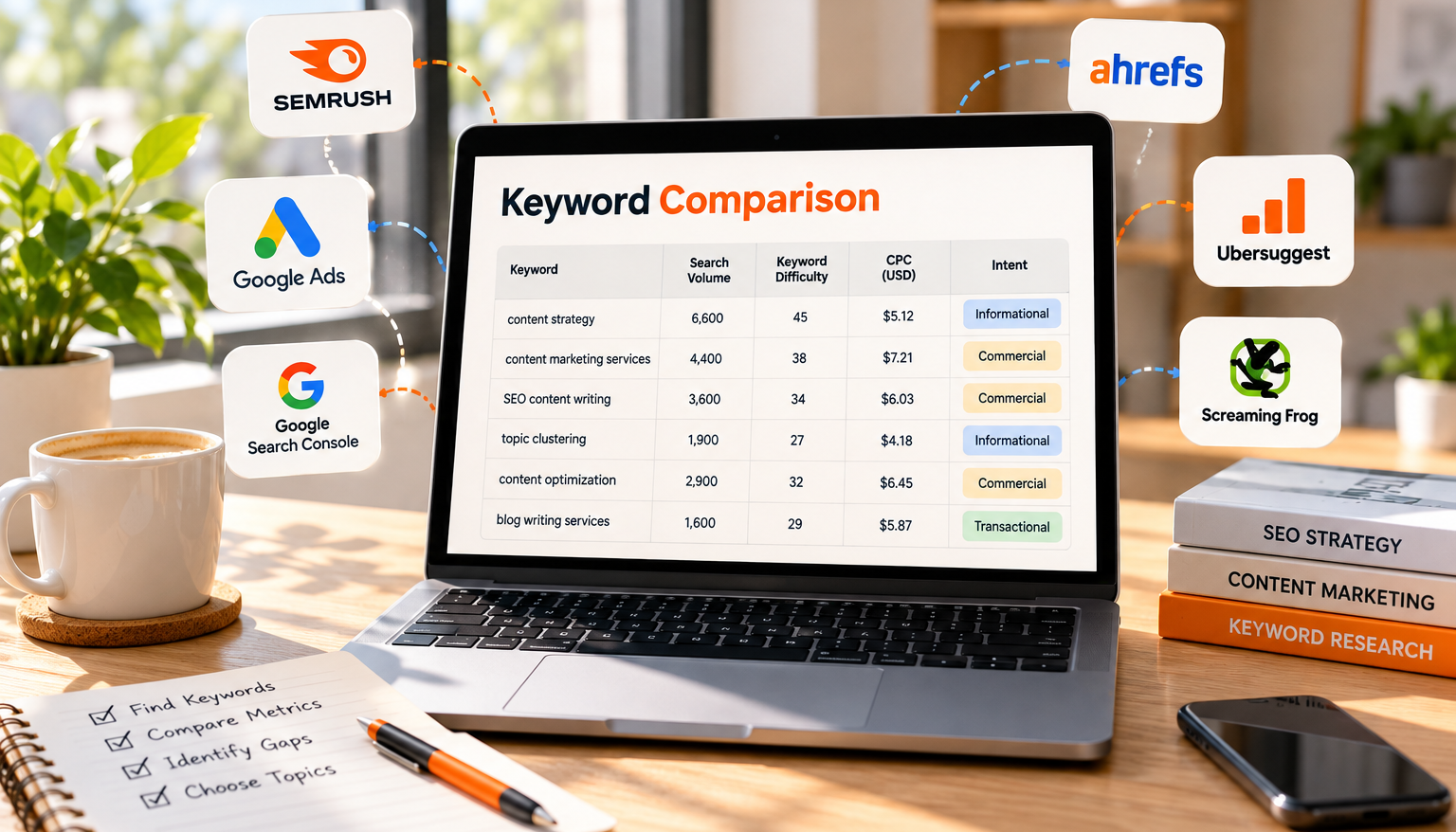
You don’t need a big stack, but the right tools can cut the work from days to hours. Content gap analysis tools generally fall into three groups:
- Dedicated gap tools. Ahrefs’ Content Gap and Semrush’s Keyword Gap compare your ranking keywords against several competitors side by side. These are often a fast way to surface a keyword gap at scale.
- Free ranking data. Google Search Console shows every query you already rank for, including page-two terms worth improving. It’s the backbone of any budget-friendly content gap analysis.
- On-page and SERP checks. Free tools like an on-page SEO analyzer help you audit whether your existing content matches intent, and Vineet Kukreti offers a free on-page analyzer and SERP snippet preview built for non-technical owners who want to check pages without paid software.
Many assume you must buy Ahrefs or Semrush to do this properly. In reality, Search Console plus manual competitor reading can get a small business much of the insight at no cost. Paid tools may speed up the process, but they don’t unlock a secret you couldn’t find otherwise.
A simple content gap analysis example for a small business
Here’s a content gap analysis example grounded in a common pattern. Picture a two-location dental practice. Their site has pages for “teeth whitening” and “dental implants” but nothing on “how much do dental implants cost” or “dental implants vs dentures.”
A quick keyword gap check against two competitors shows both rank on page one for those exact comparison and cost queries, each pulling steady local search traffic. The practice ranks nowhere for them. That’s a clear intent gap: they cover the service but not the questions people ask before booking.
The fix is small. Two new pages, one cost guide and one comparison page, each answering the searcher’s real question with pricing ranges and honest tradeoffs. Pages like these can start ranking within a few months and help feed the practice qualified leads it was invisible for before.
That’s the point worth remembering. This wasn’t about producing 50 articles for a bigger content marketing footprint. It was about closing two specific gaps tied directly to business outcomes. For most small business SEO efforts, a focused content strategy tends to beat volume.
Content gap analysis for AI search and GEO visibility (ChatGPT, Claude, Perplexity)
Content gaps now cost you visibility in a second place: AI search. When someone asks ChatGPT, Claude, or Perplexity for a local recommendation or a “how much does X cost” answer, those tools pull from content that clearly and thoroughly covers the topic. A gap in your content is a gap in your GEO visibility too.
The root cause is similar to Google’s. These systems tend to favor pages that demonstrate information gain, meaning content that adds something beyond what everyone else has already published. Thin, me-too pages often get overlooked by AI engines the same way they can slide down the SERPs, which is why content marketing built around genuine expertise tends to outperform volume-first tactics.
Practical implications for your content strategy: keep content freshness high, answer questions directly, and structure pages so a machine can extract a clean answer. An llms.txt file and well-organized FAQ sections help AI tools understand what you cover. Vineet Kukreti’s free AI search visibility checker and llms.txt generator let non-technical owners test how their pages surface in AI search before committing to a full content plan. Closing gaps for AI and traditional search visibility is increasingly the same job.

If you’re publishing content but still watching competitors capture the searches that should be yours, a focused review of where your coverage falls short often reveals more opportunity than another round of guesswork. With Vineet Kukreti, you can get a straight assessment of your content gaps and a clear plan for which pages to prioritize first, with one accountable expert doing the work rather than an agency handing you reports. If you’d rather talk it through first, you can book a free SEO consultation to walk through your specific situation. Results vary based on competition, website condition, industry factors, and implementation, but knowing exactly where your content gaps sit is a practical first step.
FAQs
Q1. Can ChatGPT actually do a content gap analysis for my site?
A1.
ChatGPT can compare topic lists or summarize competitor pages you paste in, but it can’t crawl live rankings or pull real keyword data on its own. Pair it with exported data from Ahrefs, Semrush, or Google Search Console so the analysis is grounded in actual search performance, not assumptions.
Q2. What are the main types of content gaps I should look for?
A2.
The four common types are topic gaps (subjects you haven’t covered at all), keyword gaps (terms competitors rank for that you don’t), intent gaps (you cover a topic but not how searchers expect), and quality or originality gaps (thin, outdated, or repetitive content). Most small business sites have a mix of the first three.
Q3. Is content gap analysis worth doing if I only have a handful of blog posts?
A3.
Yes, even with 10-20 pages, you can usually spot obvious missing topics by comparing your site against 3-5 direct competitors. The exercise matters more for what it reveals about search intent than the volume of content you already have.
Q4. What if my competitors just have bigger content teams and budgets, can gap analysis still help a small business?
A4.
A gap analysis doesn’t require matching their output; it’s about finding the specific topics where searchers have unmet needs, which is often a handful of pages, not hundreds. A local service business closing 5-10 well-targeted gaps can outrank a competitor’s larger, unfocused content library.
Q5. How is content gap analysis different from a general competitor analysis?
A5.
Competitor analysis looks at the whole business, pricing, branding, positioning, while content gap analysis focuses narrowly on what topics, keywords, or formats a competitor’s content covers that yours doesn’t. Think of gap analysis as one input into a broader competitor review, not a replacement for it.
Q6. What tools do I actually need to run this analysis?
A6.
Ahrefs’ Content Gap tool and Semrush’s Keyword Gap tool are built specifically for comparing your site’s ranking keywords against competitors’ side by side. For a small business budget, Google Search Console plus a free tool like an on-page SEO analyzer can cover the basics before you invest in paid software.
Q7. How often should I redo a content gap analysis?
A7.
Every 6-12 months is typical, since competitors publish new content and search intent shifts over time. If you notice a competitor consistently outranking you on new terms, that’s a signal to run one sooner rather than waiting for the scheduled review.
Q8. What does a content gap actually look like in practice?
A8.
A common example: a plumbing company’s site covers ’emergency plumber’ services but has no page for ‘water heater installation cost,’ even though that’s a high-volume local search competitors rank for. Closing that single gap with one well-optimized page can capture leads the business was missing entirely.

Vineet Kukreti is an experienced SEO and project management expert with over 10 years of success helping small businesses grow. He has led SEO campaigns that improved Google rankings, increased website traffic, and strengthened local visibility. As a project manager, Vineet brings structure and efficiency to digital operations, ensuring smooth execution and measurable results. His combined expertise in SEO and business operations makes him a trusted partner for growth-focused businesses.