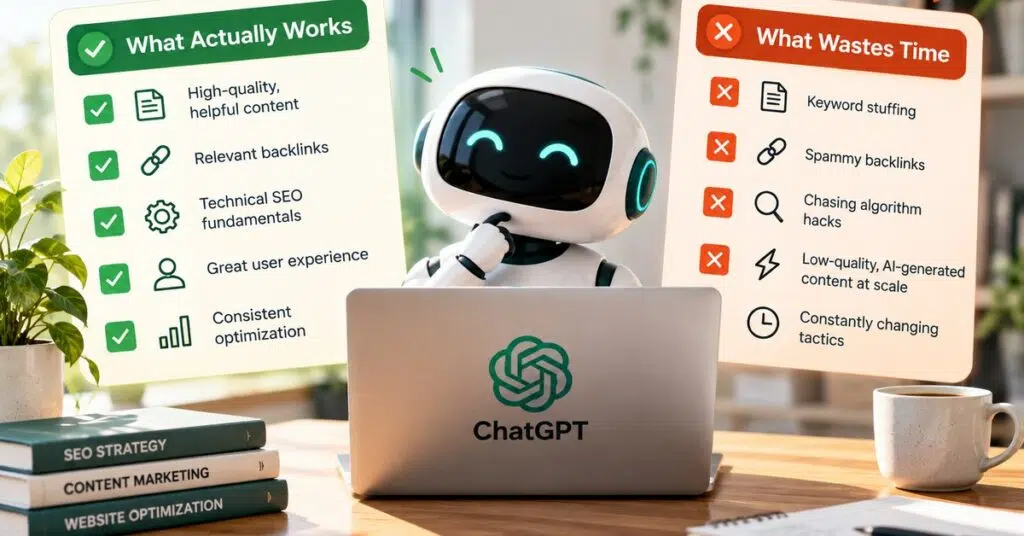
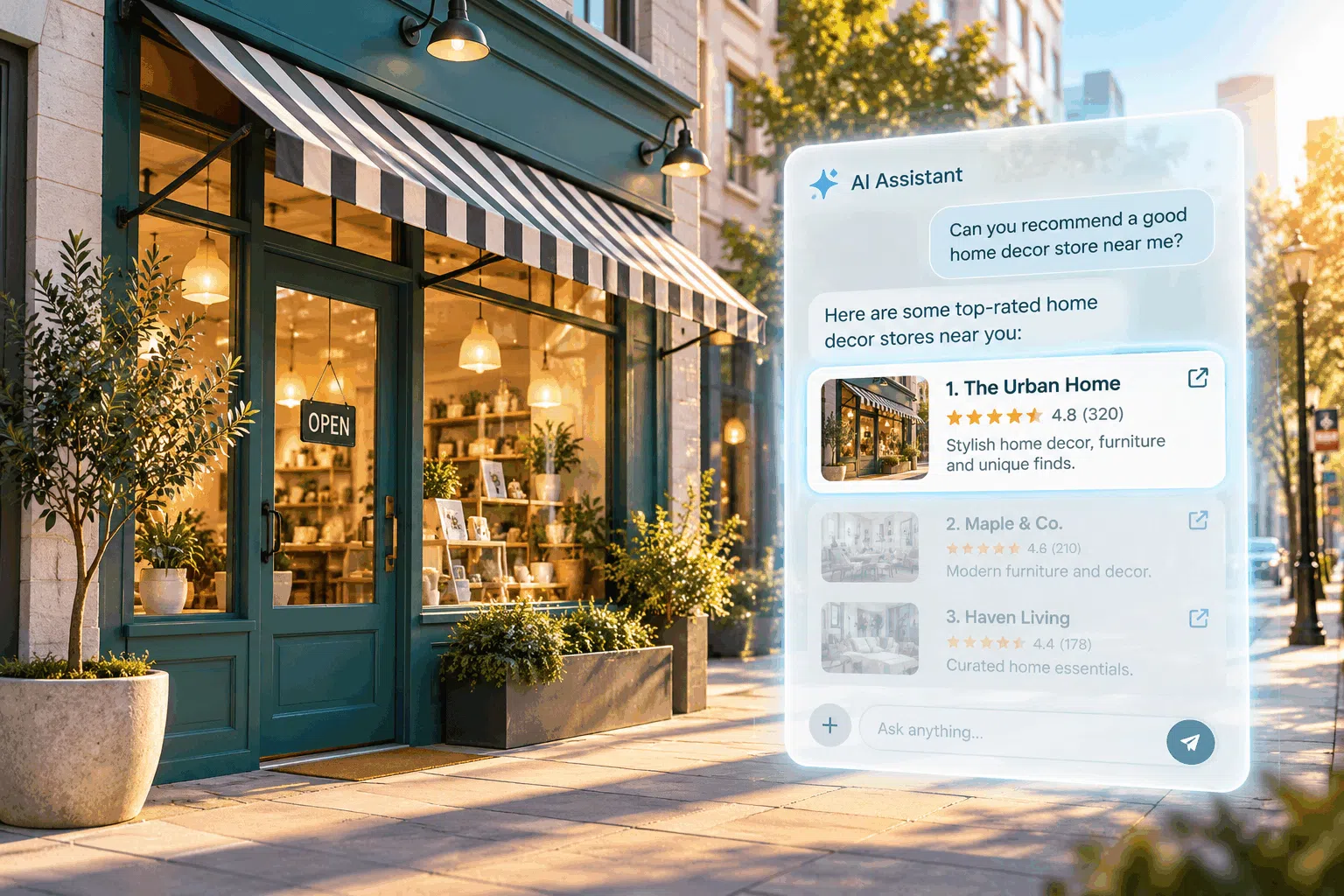
Ask ChatGPT to recommend a plumber in your city, and it names three or four businesses. If yours isn’t one of them, you don’t exist in that answer. The customer never clicks a single search result. That’s the shift ChatGPT SEO is built around: getting your business pulled into AI-generated answers, not just ranked on a page. This article breaks down what genuinely moves the needle, what wastes a busy owner’s time, and how it connects to the search work you’re probably already doing.
What ChatGPT SEO actually means (and what it doesn’t)
Most owners hear “ChatGPT SEO” and picture a new ranking trick. Really, it’s about eligibility and clarity. You’re making content easy for an AI system to read, trust, and quote back to a user. This discipline goes by several names, including generative engine optimization and answer engine optimization, but the goal stays the same: you want your business named inside the answer. If you’re unsure where your own site stands, you can check whether ChatGPT and other AI engines can see your site before changing anything else.
What it isn’t: a replacement for Google rankings. It also isn’t about gaming a chatbot with keyword-stuffed pages. Language models pull from indexed web content and prioritize sources that answer a question directly and credibly. If your page buries the answer under three paragraphs of fluff, the model skips it.
OpenAI is fairly open about how its search features retrieve and attribute content. Their documentation on OpenAI’s bots and crawlers explains which crawlers access your site and why, and a closer look at how ChatGPT search retrieves and cites web sources shows just how much weight is placed on clear, citable answers. Start there before you change a word of copy, because access comes first.
How ChatGPT finds, retrieves, and cites web content
ChatGPT doesn’t memorize your website. When a user asks a question that triggers search, the system sends a crawler out, pulls relevant pages, and builds an answer with citations. Three things have to line up for your business to appear.
First, OpenAI’s OAI-SearchBot has to reach your pages. Second, your content has to clearly match the search intent behind the question. Third, your page has to state the answer plainly enough for the model to lift it.
A large share of this retrieval leans on existing indexes, which is why Bing indexing matters so much for ai search visibility. ChatGPT’s search layer has historically drawn on Bing’s index, so a page Bing can’t find is a page ChatGPT struggles to cite. Submitting your site through Bing Webmaster Tools is a free, direct way to improve ai crawling and indexing coverage. The same clean structure also makes pages easier to lift for featured snippets.
AI systems tend to favor structured, answerable content: clear headings, short direct statements, and sections that map to real questions. Vague, meandering pages rarely get quoted.
ChatGPT SEO vs traditional SEO: what’s the same, what’s different
Here’s the part that surprises people: most of the work overlaps. Traditional SEO and ChatGPT SEO both reward crawlable sites, clear structure, authoritative content, and genuine topic depth. If your keyword research, on-page optimization, and technical health are solid, you’re already most of the way there.
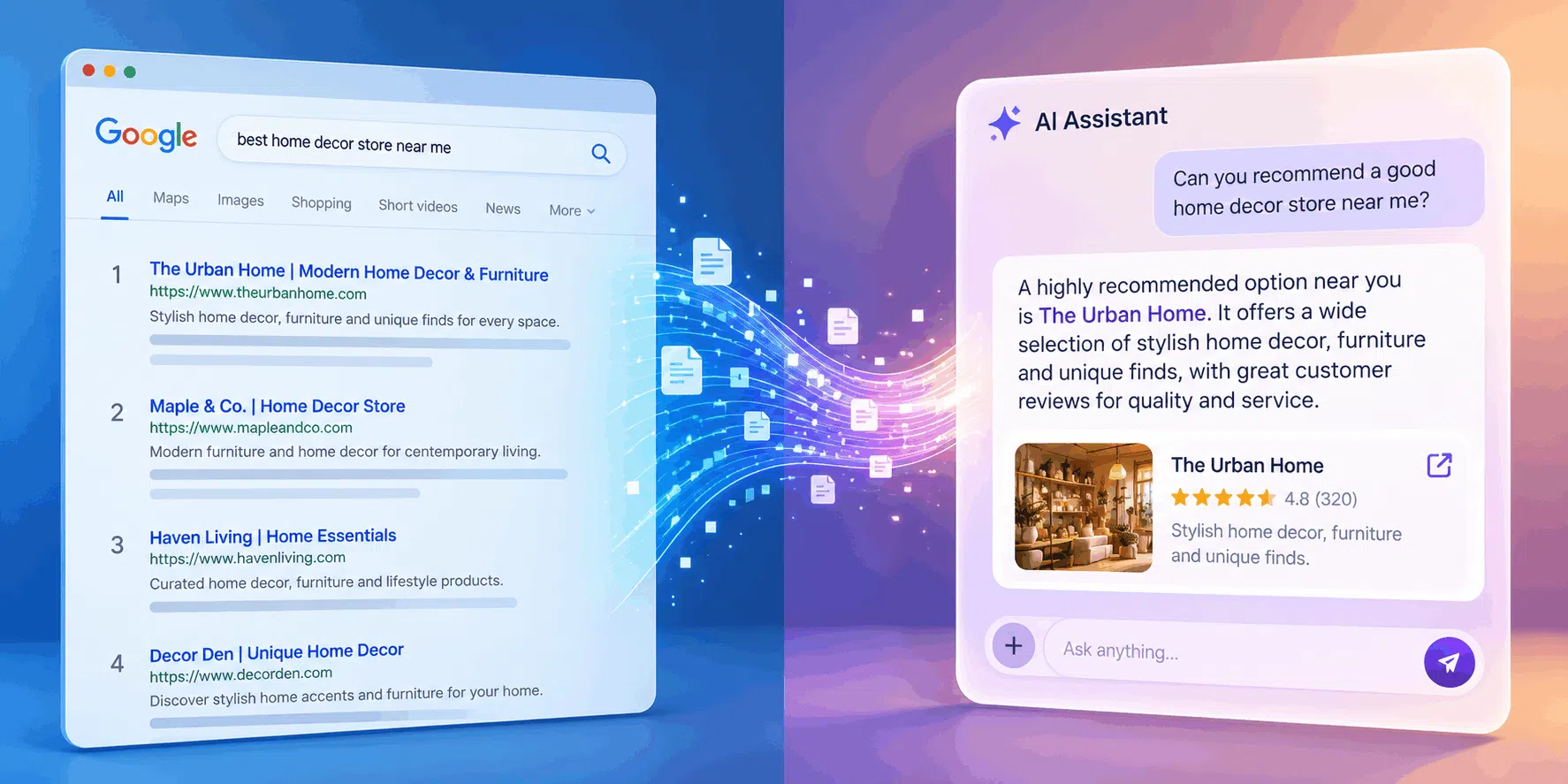
The difference is the finish line. Traditional SEO competes for a ranked position on a results page, shaped by backlink analysis, site speed, and keyword targeting. ChatGPT optimization, by contrast, competes to be the source a model chooses to quote. It leans harder on clear topic authority, entity SEO, and content that answers a specific question in one or two sentences. Treat ChatGPT optimization as a complement to ranking factors you already track, not a separate discipline. For a deeper dive into how these pieces fit together, our guide to AI search optimization and GEO strategy lays out the full framework.
Many assume each needs its own strategy and budget. In reality, ChatGPT SEO optimization is a layer on top of the foundation, not a parallel track. This is also where ChatGPT SEO optimization tends to pay off fastest for owners who’ve already done the basics. The same page that earns strong Google rankings tends to be the page an AI engine pulls from, since both systems hunt for the cleanest, most direct answer to a question.
Why AI search visibility matters for businesses now
AI search is no longer a novelty. More people ask ChatGPT, Perplexity, and Google’s AI Overviews for recommendations before they ever type into a search bar. For a local service business, that’s a new front door, and right now most competitors haven’t noticed it exists.
Being early here can be an advantage. AI platforms cite a short list of sources, often three to five, so there’s far less room than a ten-result page gives you. The business that shows up as a named recommendation captures attention the others never see.
There’s a catch worth saying out loud. AI search visibility and website traffic aren’t the same thing. An AI engine frequently answers the question without sending a click, so your online visibility can grow while analytics stay flat. The value shows up as brand mentions, trust, and the customer who searches your name later. Treat it as one channel in a broader content strategy, not a traffic faucet you can turn on.
Creating conversational, question-led content AI can use
AI tools tend to pull from content that sounds like an answer to a real question. Picture a roofing company whose service page says “Quality roofing solutions for discerning homeowners.” That kind of page is unlikely to get cited, and the owner wonders why competitors keep showing up instead. A page that says “Metal roofs typically last 40 to 70 years, compared to 15 to 20 for asphalt shingles” is far more quotable.
That’s the core of conversational content: write the way people actually ask, then answer plainly.
Practical moves that work:
- Turn common customer questions into H2 headings, then answer each in the first two sentences.
- Use plain language a non-expert would understand.
- Add specific numbers, timeframes, and local details instead of adjectives.
- Group related pages into topic clusters so you own a subject, not just a keyword.
This works because language models predict the clearest, most relevant text to satisfy a query. AI-written content that rambles gives them little to grab. Direct answers give them a quotable line, which can help your brand get named. If you’re drafting this kind of content with AI assistance, the ChatGPT and Claude prompt library for SEO has ready-made prompts built around this exact question-led structure.
AI systems don’t just ask “does this page mention roofing?” They ask, “Can I trust this source enough to repeat it?” That’s where E-E-A-T signals come in. Experience, Expertise, Authoritativeness, and Trustworthiness are the signals both Google and AI engines use to decide whether your content is worth citing.
Models are trained to avoid repeating unreliable sources. A page with a named author, real credentials, clear contact details, and genuine insight reads as trustworthy. A faceless page of generic tips doesn’t.
Authoritative citations work two ways: link out to credible sources to back your claims, and earn brand mentions across the web so AI systems see your business referenced consistently. Those brand mentions don’t always need to be links. Being named in directories, local press, and industry discussions builds the entity signals that help an AI connect your name to your expertise.
Small business SEO here isn’t about volume, and winning authoritative citations matters more than chasing a high count of low-quality mentions. It’s about being a consistent, verifiable, named entity that AI engines recognize and feel safe quoting.
Technical foundations: crawl access, Bing indexing, structured data
None of the content work matters if the machines can’t reach your pages. Crawl access is step one. Check your robots.txt file and your CDN or firewall settings to confirm you aren’t accidentally blocking OAI-SearchBot or other AI crawlers. Many sites block bots by default without the owner ever knowing, and Google Search Central’s own explanation of how robots.txt controls search and AI crawler access is a useful reference for understanding what these rules actually do.
Next, bing indexing. Because ChatGPT’s search has leaned on Bing’s index, a page Bing hasn’t crawled is largely invisible to that answer engine. Verify your site in Bing Webmaster Tools and submit a sitemap.
Then structured data. Adding schema markup, like LocalBusiness, FAQ, and Article schema, helps both traditional search and AI systems understand what a page is about. Structured data removes guesswork. It tells the machine exactly what your business is, where it operates, and what each page answers.
For small businesses unsure where the gaps are, a focused technical SEO audit, like the crawl and indexing checks Vineet Kukreti runs for local service sites, can help surface blocked crawlers and missing structured data before they quietly cost you visibility.
Using ChatGPT as a tool for SEO tasks (research, drafting, on-page)
There’s a second, simpler side to all this: using ChatGPT itself to do SEO work. It’s a strong assistant, not a strategist, and the difference matters.
Where it genuinely helps:
- Keyword research and clustering: feed it your service list and ask it to group related search intent into topic clusters.
- Content creation support: draft outlines, first drafts, and FAQ sections you then edit with real expertise, since content creation still needs a human pass before it publishes.
- On-page optimization: generate meta descriptions, title tags, and header structures to review and refine.
- Competitive analysis: summarize a competitor’s page structure and spot gaps in your own.
Good ChatGPT SEO prompts are specific; strong ChatGPT SEO prompts name the audience and format you want. Instead of “write SEO content,” try “draft an FAQ for a plumbing service page targeting homeowners who searched for burst pipe repair, with direct two-sentence answers.”
The limit is honesty and accuracy. AI-written content published without editing tends toward generic commodity content, which Google’s guidance warns against and which AI engines are less likely to cite. Use ChatGPT to speed up the work. Don’t let it replace your judgment.
A simple starting checklist for small businesses
You don’t need to boil the ocean. Start with the pages that already drive leads, then widen out. Here’s a sequence that respects a busy owner’s time.
- Confirm crawl access. Check robots.txt and CDN settings so AI crawlers and search bots aren’t blocked.
- Verify Bing indexing. Submit your site and sitemap through Bing Webmaster Tools.
- Add structured data. Apply schema markup to your homepage, service pages, and contact page.
- Rewrite your top three pages with question-led headings and direct, first-sentence answers.
- Strengthen E-E-A-T signals. Add a real author bio, credentials, reviews, and clear contact details.
- Build brand mentions through local directories, your Google Business Profile, and industry listings.
- Set up measuring citations. Track whether ChatGPT, Perplexity, and AI Overviews name your business for your core queries.
Measuring citations is new ground, so tools here are still rough. A free AI search visibility checker gives you a baseline, and Vineet Kukreti offers one alongside an llms.txt generator for owners who want to test their standing before investing further.

How llms.txt and AI crawler access fit into ChatGPT SEO
The newest piece of this puzzle is a file called llms.txt. It’s a proposed standard, similar in spirit to robots.txt, that gives AI systems a clean, plain-text summary of your most important content and how you’d like it used. Think of it as a curated map handed directly to the models, the same way you’d brief a new employee on where to find what matters instead of letting them dig through every filing cabinet.
Here’s the honest part: llms.txt is not yet universally supported, and not every AI engine reads it today. Adoption is early. But the effort is low, and it signals clear intent while standards settle.
What matters more right now is the broader question of crawl access. If OAI-SearchBot and similar crawlers can’t reach your pages, no file saves you. Confirm access first, then add an llms.txt file as a clean next step.
This is where ChatGPT SEO optimization meets practical setup. A well-structured llms.txt, correct crawl access, and solid structured data form the technical base that lets your conversational content get found and quoted in the first place. If you’d rather have a professional walk through this setup with you, you can book an SEO consultation to get a second set of eyes on where the gaps are.
If AI engines are naming your competitors instead of you, the fix usually starts with a clear-eyed look at crawl access, structured data, and how your content answers real questions. For small businesses that want to put ChatGPT SEO on a sustainable footing, Vineet Kukreti works with a limited number of owners at a time on exactly this kind of SEO strategy. If you want to find out where your AI search visibility stands, book a focused SEO review and see what’s holding you back.
FAQs
Q1. What exactly is ChatGPT SEO?
A1.
ChatGPT SEO is the practice of structuring your website and content so ChatGPT (and similar AI tools) can find, understand, and cite your business in its generated answers. It’s sometimes called Generative Engine Optimization (GEO), and it sits alongside traditional SEO rather than replacing it.
Q2. Does ChatGPT actually crawl my website?
A2.
Yes, OpenAI uses a crawler called OAI-SearchBot to discover and index web content for ChatGPT’s search features. If your robots.txt file or CDN settings block this crawler, your site won’t be eligible to appear in ChatGPT’s answers regardless of how good your content is.
Q3. Is optimizing for ChatGPT actually worth it, or is it hype?
A3.
For most small businesses, it’s worth doing as an extension of existing SEO rather than a separate budget line, the same things that help you rank in Google (clear structure, authoritative content, crawlable pages) also help AI tools cite you. It’s not worth abandoning your core SEO strategy to chase it, since AI referral traffic is still a fraction of organic search traffic for most local businesses.
Q4. How is ChatGPT SEO different from ranking in Google?
A4.
Traditional SEO competes for a ranked position on a results page using backlinks, keywords, and site speed. ChatGPT SEO instead competes to be ‘pulled into’ a generated answer, which depends more on clear topic authority and well-structured, directly answerable content than on backlink volume alone.
Q5. What if ChatGPT never sends my business any traffic?
A5.
That’s a realistic possibility, since AI answer engines often satisfy the user’s question without a click-through, similar to Google’s AI Overviews. Even without direct traffic, being cited by name builds brand visibility and trust signals, which is why it’s worth pursuing only as a complement to lead-generating channels like Google Business Profile and local search.
Q6. Will ChatGPT SEO replace the need for traditional SEO?
A6.
No, the two are complementary, not interchangeable; traditional SEO still drives most measurable website visits and leads for small businesses. AI visibility works best built on top of a technically sound, already-indexed site, not as a standalone strategy.
Q7. What kind of content does ChatGPT prefer to cite?
A7.
Google’s own guidance on AI content emphasizes E-E-A-T (Experience, Expertise, Authoritativeness, Trustworthiness) and warns against generic ‘commodity content’ that just restates common knowledge. Content with original insight, clear headings, and direct answers to specific questions is more likely to be surfaced.
Q8. Do I need to rewrite my entire website for ChatGPT SEO?
A8.
No, the priority is fixing crawler access (robots.txt, llms.txt), then restructuring key pages with clear headings and direct answers rather than rewriting everything at once. Most small business sites can start with their highest-traffic or most lead-relevant pages first.

Vineet Kukreti is an experienced SEO and project management expert with over 10 years of success helping small businesses grow. He has led SEO campaigns that improved Google rankings, increased website traffic, and strengthened local visibility. As a project manager, Vineet brings structure and efficiency to digital operations, ensuring smooth execution and measurable results. His combined expertise in SEO and business operations makes him a trusted partner for growth-focused businesses.