

A local HVAC company I spoke with was spending $2,400 a month on Google Ads. They turned the ads off for one week to test something. Their phone stopped ringing almost entirely. That is the trap most small businesses fall into: renting visibility instead of owning it. Done right, SEO marketing for small business builds an asset that can keep generating qualified leads long after you stop paying per click. This article walks through how search engines work, how to find keywords, how to turn traffic into customers, and how to set realistic expectations.

What SEO is and how search engines work
Search engine optimization is the practice of shaping your website so it appears when people search for what you sell. To do that well, you need a basic grasp of how search engines work. Google crawls the web with automated bots, indexes the pages it finds, then ranks them based on hundreds of signals when someone types a query. The pages that best match the searcher’s intent, load quickly, and earn trust from other sites tend to surface first.
Behind the scenes, the algorithm tries to serve the result most likely to satisfy the person searching. That is why relevant, quality content beats keyword tricks. Google publishes plain guidance on this in its Search Essentials documentation, which spells out what it rewards and what it penalizes. Beginners who want a structured walkthrough can also work through Google’s SEO Starter Guide, which covers the fundamentals in plain language.
Many owners assume ranking is about gaming the system. In reality, effective SEO marketing for small business works when your site clearly answers a real question better than the competition. The three pillars you’ll keep hearing about- on-page seo, off-page seo, and technical SEO- all exist to help search engines understand and trust your pages. Get those aligned with genuine search intent, and search visibility tends to follow. If you’d rather have an expert handle the strategy, professional SEO services for small businesses can align these pillars for you.
Keyword research and targeting the right search terms
Keyword research is where most small business SEO campaigns are won or lost. Chasing a broad term like “plumber” puts you against national directories and franchises with huge budgets, which is a tough fight to win. Targeting “emergency plumber in Boise” or “water heater repair near me” puts you in front of someone ready to buy, in your service area, with far less competition.
These longer, specific phrases are called long-tail keywords, and they usually carry stronger search intent. Someone searching a five-word buyer phrase is closer to a decision than someone typing a single word. That is the whole point of choosing the right keywords: fewer clicks, but better business outcomes.
Start with free tools. Google Keyword Planner, Google autocomplete, and the “People also ask” boxes reveal what your customers type. Paid seo tools like Ahrefs or Semrush add volume and difficulty data when you’re ready, and choosing the right seo tools early keeps your research grounded. Ahrefs publishes a practical beginner’s guide to keyword research worth reading before you spend.
Group your findings by search intent: informational, commercial, and transactional. A solid seo strategy targets all three. But transactional keywords tied to local search deserve your first attention, because they tend to convert into qualified leads fastest. This is exactly where local SEO for small businesses pays off, since location-based buyer terms tend to convert quickest.

On-page vs off-page SEO and the mechanics of optimization
On-page SEO covers everything you control on your own site. Title tags, headings, URL structure, internal links, image alt text, and the content itself all tell search engines what a page is about. Here you place your target keywords naturally and match the page to search intent. Get the basics right, and you remove the friction that keeps good pages buried in search results.
Off-page SEO is about signals from outside your site, mainly links. When other reputable websites link to yours, search engines read that as a vote of confidence. A steady backlink strategy focused on authoritative links from relevant, trusted sources tends to carry far more weight than low-quality directory links. Building that backlink strategy patiently means quality beats quantity every time.
The reason this matters: Google can’t visit your business, so it uses these external signals as a proxy for reputation. Authoritative links function like references on a resume.
Then there’s technical SEO, the plumbing. Site speed, mobile-friendliness, crawlability, and clean site architecture all affect website performance and how easily search engines index your pages. Paying attention to Core Web Vitals performance metrics helps you measure and improve the speed and stability that Google cares about. Strong website performance also improves user experience, which indirectly supports rankings. Technical audits and fixes are exactly the kind of behind-the-scenes work Vineet Kukreti handles for owners without the time to untangle it.
Creating quality, relevant content for humans and search intent
Content is what earns organic traffic, but only when it’s written for people first. A page stuffed with keywords reads badly and tends to convert worse. Google’s systems are built to reward quality content that genuinely answers the question behind the search. That is why matching search intent matters more than hitting a keyword density target.
Before writing anything, ask what the searcher actually wants. Someone searching “how much does SEO cost” wants a straight answer with ranges, not a sales pitch. Someone searching “best SEO consultant near me” is comparing options. Your content strategy should map pages to these different intents, so each one satisfies its visitor.
This is where E-E-A-T comes in: experience, expertise, authoritativeness, and trust. Google favors content that shows real knowledge, and strong EEAT signals matter most for local businesses. That means specifics only an insider would know, real examples, clear pricing, and honest answers to common objections.
A repeatable content strategy also builds topical depth over time. When you publish related, well-linked articles around a theme, search engines are more likely to recognize you as a credible source on that subject. Traffic alone isn’t enough, though. Every piece of content should guide the reader toward a next step, or it’s just decoration that produces no business outcomes.

Benefits of SEO and why small businesses should invest
Paid ads stop working the moment you stop paying. That single fact explains why small business SEO is worth the patience. Organic growth can compound: a page that ranks well keeps bringing in visitors and leads month after month, with no per-click cost. Over a year, that can change the math on your entire marketing budget.
Search visibility also builds trust in a way ads can’t. Many people skip the sponsored results and click the organic listings, because they read those as more credible. The benefits tend to stack up for local businesses in particular:
- A strong presence in the local pack puts you in front of nearby buyers ready to act
- Customer reviews and a complete Google Business Profile drive phone calls and direction requests
- Content that answers real questions builds authority and drives lead generation over time
- Reduced dependence on paid advertising frees up cash flow
None of this happens overnight, and results vary based on competition, website condition, and industry factors. But for sustainable long-term growth, few channels match what search engine optimization can deliver dollar for dollar.
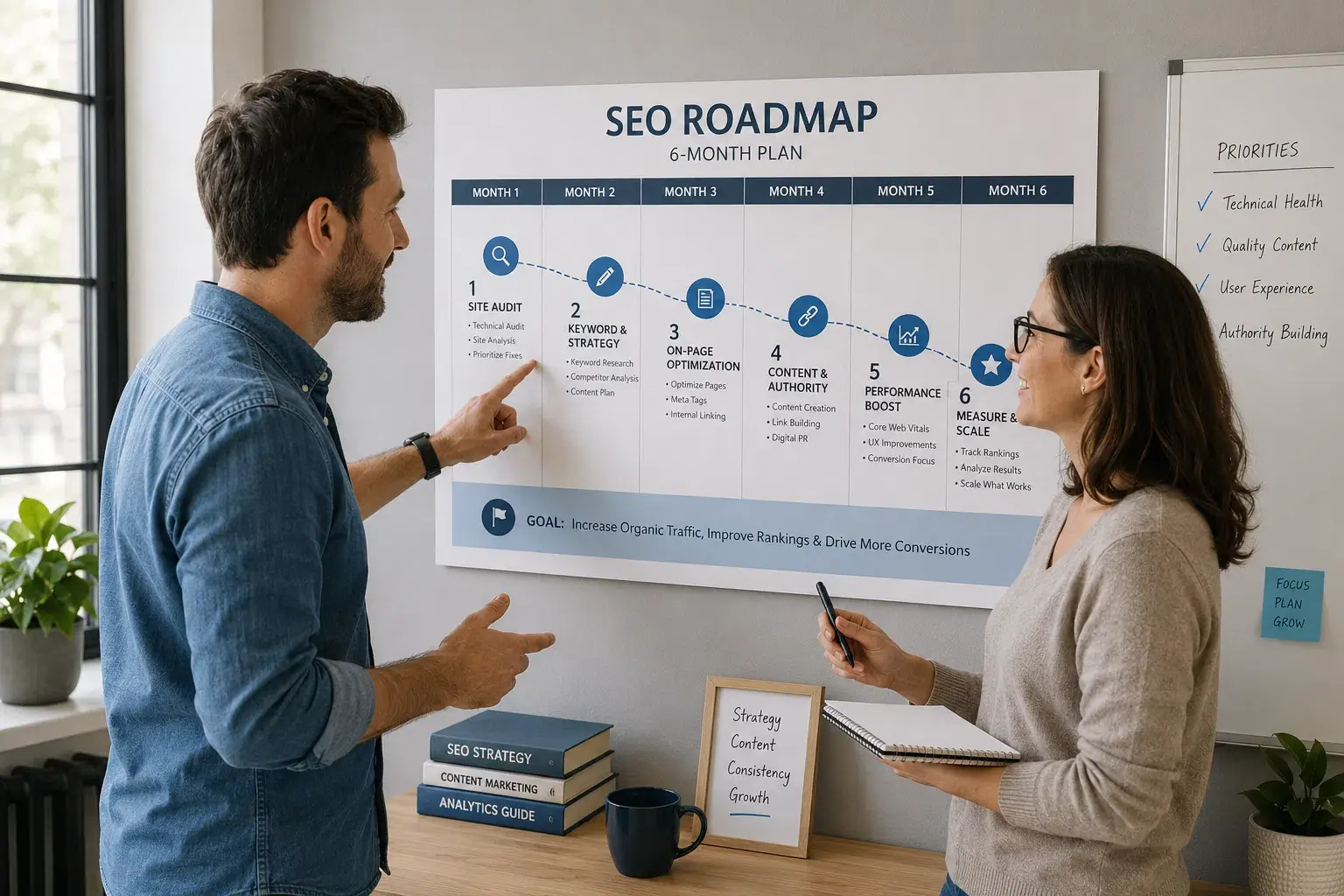
Getting started with SEO and setting realistic expectations
Start with the highest-impact, lowest-cost move: claim and fully optimize your Google Business Profile. Fill every field, add photos, pick accurate categories, and keep your NAP consistency intact across your website and every listing. NAP consistency, matching name, address, and phone across the web, is a direct local search ranking signal, and inconsistencies quietly hurt you. Google’s own instructions on how to verify and optimize your Google Business Profile are a good place to start this step. If you’ve done all this and still can’t be found, it’s worth understanding why your business isn’t showing up on Google before spending elsewhere.
Next, get listed accurately in relevant online directories, gather genuine customer reviews, and fix any obvious technical SEO issues like slow load times or broken pages. Then layer in keyword research and content.
Now the honest part. SEO takes time. Most small businesses see meaningful movement in three to six months, sometimes longer in competitive markets. Anyone promising overnight rankings is selling something. Rankings also can’t be guaranteed, because algorithms change and results depend on your competition and starting point.
One warning from the field: a retail client tried to do everything themselves. They later admitted it ate 12 to 15 hours a week they didn’t have, while the business stalled. If your time is better spent serving customers, working with a freelance seo consultant like Vineet Kukreti gives you a single point of contact and a real seo strategy without an agency retainer. When you’re stretched thin, it often makes more sense to hire a freelance SEO consultant than to juggle it all yourself. Set expectations early, and the process tends to feel far less frustrating.
Connecting SEO traffic to qualified leads and conversions
Here is where many campaigns quietly fail. A site can rank, pull in organic traffic, and still generate almost no revenue. Visibility without conversions creates little value. The goal isn’t more clicks. The goal is better business outcomes.
Conversion-focused SEO means every ranking page has a job: get the visitor to call, book, fill a form, or buy. That requires clear calls to action, fast load times, trust signals like reviews, and pages built around what the buyer needs to decide. A gorgeous homepage that hides the phone number can leak qualified leads every day.
The root cause of poor lead generation is often a mismatch between the keyword and the page. If you rank for a buying keyword but send visitors to a thin blog post, they tend to bounce. Send that same searcher to a focused service page with proof and a clear next step, and conversions are more likely to climb. If you’re unsure where your funnel is leaking, you can book a free SEO consultation to review your pages and next steps.
Track the right things. Instead of raw traffic, watch form submissions, calls, and Google Business Profile actions tied to search. Proper seo performance tracking connects effort to actual leads, and disciplined SEO performance tracking is the number that matters. When SEO is wired to conversions, organic traffic can become a more predictable source of qualified leads.
Optimizing for AI search visibility and being featured in AI answers
Search is changing shape. AI overviews, chat-based answer engines, and voice assistants increasingly answer questions directly instead of sending users to ten blue links. This shift makes some owners panic, but the fundamentals of AI search optimization overlap heavily with good SEO.
AI answer engines pull from content that is clear, well-structured, and trustworthy. To get featured, write concise answers to real questions, use plain headings, and back claims with specifics. Structured data, clean formatting, and strong E-E-A-T signals help AI systems understand and cite your content. There are a handful of practical steps to get featured in AI search results that build on this same foundation.
Many assume AI kills SEO. In reality, AI raises the bar on quality content and rewards the same clarity that already worked. A page that directly answers “what does local SEO cost” in a clean, quotable way stands a better chance of being surfaced by an AI answer than a rambling article.
For small businesses, the practical move is to keep publishing intent-driven content. Maintain search visibility across search results and AI surfaces, and keep your Google Business Profile accurate. Helping owners adapt content for AI search optimization is part of how Vineet Kukreti keeps clients visible as the landscape shifts, without chasing every algorithm rumor.
If your website is pulling in visitors but not turning them into inquiries, a strategic SEO review can help pinpoint where the opportunities are being missed. Vineet Kukreti works directly with a small number of clients on conversion-focused seo built around real business outcomes, not vanity metrics. When you’re ready, book a free discovery session to explore your options and talk through your growth.
FAQs
Q1. How can I start doing SEO on a limited budget?
A1.
Begin by claiming and fully optimizing your Google Business Profile with accurate NAP details, then target long-tail keywords using free tools like Google Keyword Planner. Pair that with consistent, relevant content, and you can build visibility before spending anything on tools or ads.
Q2. Should I hire an SEO consultant or just do it myself?
A2.
DIY SEO is cost-effective and gives you control, but it typically demands 10-15 hours weekly plus a steep learning curve to stay current. Hiring a freelance consultant makes sense when your time is better spent running the business, and you want strategy without a full agency retainer.
Q3. What's the difference between local SEO and general SEO?
A3.
Local SEO targets customers in a specific geographic area and leans heavily on your Google Business Profile and location-based keywords, which suits restaurants, law firms, and home service providers. General SEO focuses on broader ranking factors and is better for businesses serving customers regardless of location.
Q4. Is SEO dead in 2026 with AI search taking over?
A4.
No. Search behavior is shifting toward AI-powered answer engines and voice search, but SEO remains one of the most reliable ways to earn visibility, organic traffic, and leads. The tactics evolve, but the fundamentals of clear content and search intent still apply.
Q5. What if I've invested in SEO before and got reports but no results?
A5.
That usually points to a strategy problem, not an SEO problem; many providers report on vanity metrics like impressions instead of qualified leads and conversions. The fix is to tie SEO work directly to business outcomes and demand transparency about what’s actually being done.
Q6. How do I know if my SEO is working?
A6.
Track meaningful signals like organic rankings for buyer-intent keywords, Google Business Profile actions, and inquiries or sales generated from search, not just raw traffic. Traffic alone isn’t enough; visibility without conversions creates little value.

Vineet Kukreti is an experienced SEO and project management expert with over 10 years of success helping small businesses grow. He has led SEO campaigns that improved Google rankings, increased website traffic, and strengthened local visibility. As a project manager, Vineet brings structure and efficiency to digital operations, ensuring smooth execution and measurable results. His combined expertise in SEO and business operations makes him a trusted partner for growth-focused businesses.