
AI Search Visibility Checker
Can ChatGPT, Claude, Perplexity and Google AI actually see and cite your website? Find out in 20 seconds.
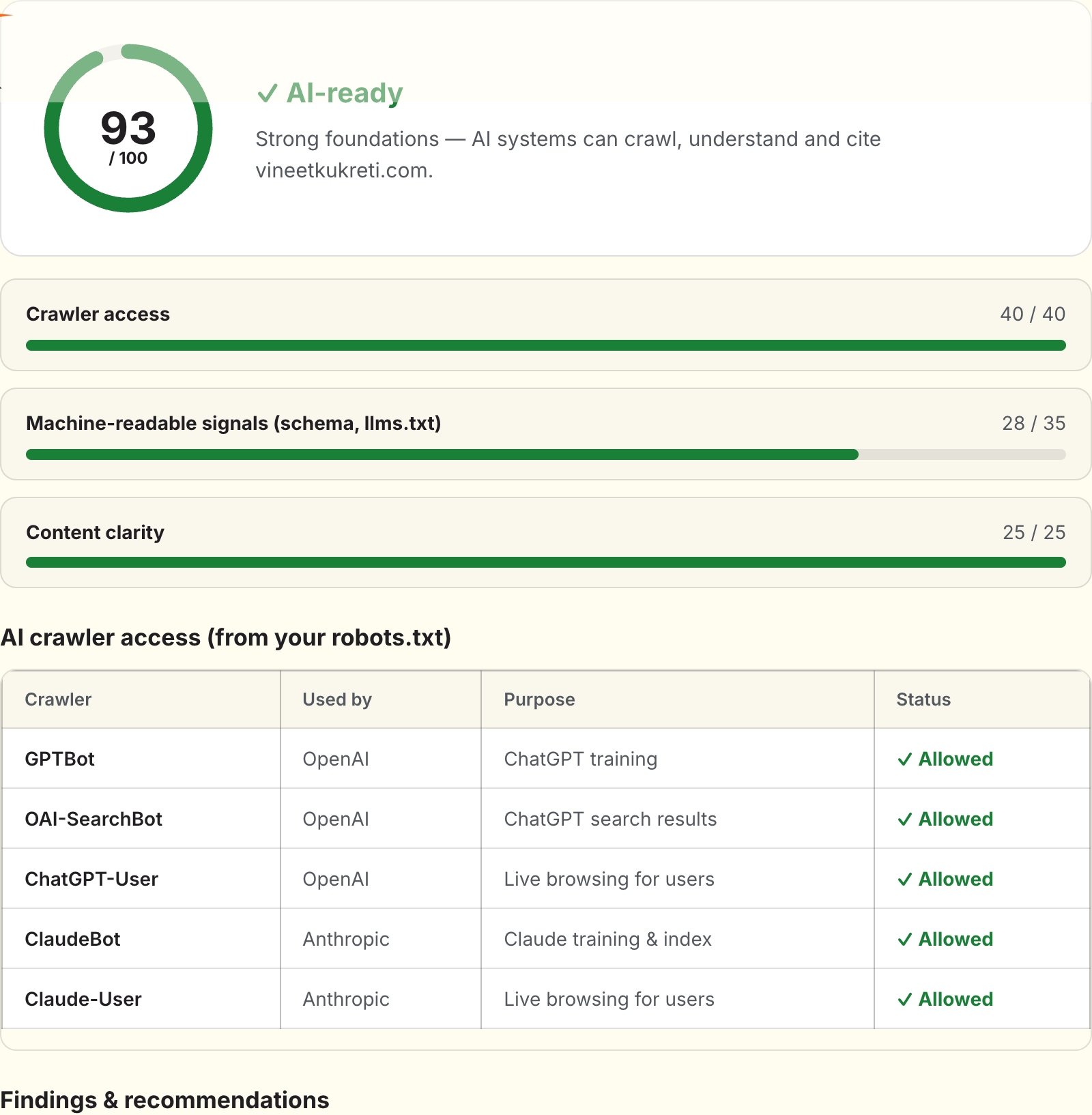
AI crawler access (from your robots.txt)
| Crawler | Used by | Purpose | Status |
|---|
Findings & recommendations
Want your business showing up in AI answers?
AI search is where your next clients are already looking. I'll show you exactly what to change. Free, no strings attached.
Book a free 30-min AI visibility audit →Why AI search visibility matters now
A growing share of buying decisions starts with a question to ChatGPT, Perplexity or Google's AI Overviews instead of a classic search. When someone asks "who's a good SEO consultant for small businesses?" or "best accounting software for freelancers?", the AI names a handful of companies, and everyone else is invisible. Which companies get named isn't luck: it depends on whether AI systems can crawl your site, understand your business as an entity, and trust your content enough to cite it.
Crawler access
Your robots.txt decides which AI systems may read your site at all. One inherited “Disallow” line can silently opt you out of AI search.
Machine-readable signals
llms.txt, JSON-LD structured data and Organization/Person schema: how AI systems confirm who you are before they cite you.
Content clarity
Clear titles, one strong H1, semantic HTML and enough visible text. AI can't quote what it can't parse.
Which AI crawlers does this tool check?
These are the ten crawlers that decide whether your content can appear in the major AI assistants. People rarely realize how many there are, or that each one can be allowed or blocked independently:
| Crawler | Company | What it powers |
|---|---|---|
| GPTBot | OpenAI | ChatGPT model training |
| OAI-SearchBot | OpenAI | ChatGPT search results |
| ChatGPT-User | OpenAI | Live browsing when a user asks ChatGPT to visit a site |
| ClaudeBot | Anthropic | Claude training & indexing |
| Claude-User | Anthropic | Live browsing for Claude users |
| PerplexityBot | Perplexity | Perplexity's answer engine |
| Google-Extended | Gemini model training | |
| Applebot-Extended | Apple | Apple Intelligence |
| CCBot | Common Crawl | Open dataset used to train many AI models |
| meta-externalagent | Meta | Meta AI training |
Traditional SEO vs. AI search optimization (GEO)
Classic SEO and AI visibility overlap, but they reward different things. This is why a site can rank on Google and still never get mentioned by ChatGPT:
| Traditional SEO | AI search (GEO) | |
|---|---|---|
| Goal | Rank a page in the top 10 results | Get cited or recommended inside one AI answer |
| Who reads your site | Googlebot | GPTBot, ClaudeBot, PerplexityBot + 7 more |
| Key signals | Keywords, links, Core Web Vitals | Entity clarity, schema, llms.txt, quotable direct answers |
| Content that wins | Comprehensive pages that earn clicks | Self-contained answers an AI can lift verbatim |
| Result of winning | Traffic to your site | Your name in the answer, with or without a click |
How to improve your AI search visibility
- Unblock the crawlers that matter. Review your robots.txt deliberately instead of inheriting whatever your CMS or a plugin decided. Blocking AI search crawlers opts you out of being cited.
- Publish an llms.txt. It takes an hour, and this tool will confirm it's live. You'll be ahead of the vast majority of the web.
- Add entity schema. Organization or Person JSON-LD with your name, logo and social profiles is how AI systems confirm who is behind the site.
- Answer questions directly. FAQ-style content with self-contained answers is disproportionately quoted in AI responses: mark it up with FAQPage schema.
Quick win: of the four steps above, llms.txt has the best effort-to-impact ratio right now: almost nobody has one, and the prompt library includes a ready-made prompt that writes yours for you.
Your on-page fundamentals feed your AI visibility too: run the free on-page SEO analyzer to check those in seconds. Prefer the whole thing done for you, with a strategy behind it? Let's talk.
Frequently asked questions
What is AI search visibility?
AI search visibility is whether AI assistants like ChatGPT, Claude, Perplexity and Google's AI Overviews can crawl your website, understand who you are, and cite you when answering questions your customers ask. It's sometimes called GEO (Generative Engine Optimization) or AEO (Answer Engine Optimization).
Should I block AI crawlers from my website?
For most businesses, no. Blocking AI crawlers means AI assistants can't cite you, so when a potential customer asks for recommendations in your niche, your competitors get mentioned instead. Blocking can make sense for publishers protecting paywalled content, but for a business trying to be found, being invisible to AI search is a cost, not a protection.
What is llms.txt and do I need one?
llms.txt is an emerging standard: a simple text file at yoursite.com/llms.txt that gives AI systems a clean, curated summary of who you are, what you offer and where your key pages live. Very few sites have one yet, which makes it an easy way to stand out. This tool checks whether yours exists.
If my site ranks on Google, can AI search engines see it too?
Not necessarily. Google's classic crawler (Googlebot) and AI crawlers are different bots with different rules: a robots.txt can allow Googlebot while blocking GPTBot or ClaudeBot. Sites also rely on JavaScript rendering that many AI crawlers don't execute. Ranking well on Google is a head start, not a guarantee.
What's a good AI visibility score?
75 or above means AI systems can crawl, understand and confidently cite your site. 50–74 usually means crawlers can get in but weak signals (no structured data, no entity schema, thin content) make you easy to skip. Below 50, AI assistants are answering your customers' questions using other sources.
How often should I re-check my AI visibility?
After any significant site change, and otherwise every couple of months. The AI search landscape is moving fast: new crawlers appear, standards like llms.txt evolve, and your competitors are catching up.