
Free On-Page SEO Analyzer
Get an instant SEO score for any page, with the exact fixes, in plain English.
✕
⚠
✓
Want these fixed for you?
I'll walk through your results and show you exactly what to fix first. Free, no strings attached.
Book a free 30-min SEO audit call →What this free SEO analyzer checks
This on-page SEO checker inspects the 17 elements that most influence how a page ranks on Google: the same checklist I work through at the start of every client audit. No jargon walls: every result explains what's wrong and exactly how to fix it, sorted so you always know what to tackle first.
Search snippet elements
Title tag length and quality, meta description, and whether Google can index the page at all: a stray noindex tag is more common than you'd think.
Content & structure
One clear H1, a logical heading outline, sufficient content depth, and descriptive anchor text instead of “click here”.
Technical signals
Canonical tag, HTTPS, mobile viewport, language attribute and favicon: the quiet checks that break rankings when they're wrong.
Schema & social
JSON-LD structured data, Open Graph and Twitter cards, so your page looks right in search results, social feeds and AI answers.
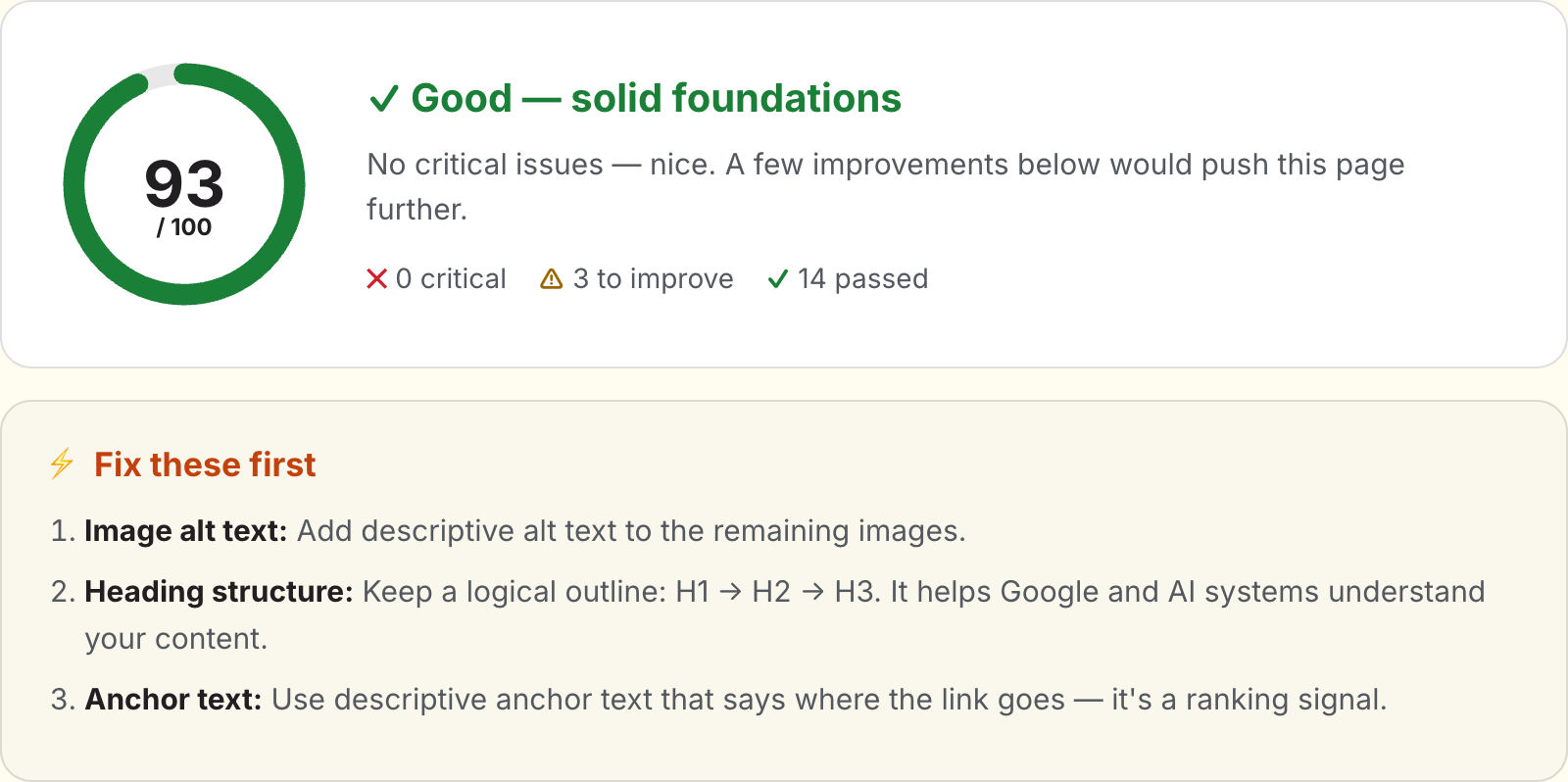
How to run a free SEO check in 30 seconds
- Paste any page URL: your homepage, a service page, a blog post, or a competitor's page, and hit Analyze.
- Read the score and the "Fix these first" list. Those two or three items are where the impact is; everything else can wait.
- Fix, re-run, repeat. Most on-page issues take minutes to fix in your CMS, and the score updates instantly on re-analysis.
What is a good SEO score?
Scores mean nothing without context, so here's how to read yours, and what to do at each level:
| Score | What it means | What to do |
|---|---|---|
| 80–100 | On-page foundations are solid. Rankings now depend on content quality, topical authority and links. | Shift your effort to content depth and earning links: the on-page box is ticked. |
| 60–79 | The page works, but weak signals are costing you positions you could win. | Work through the warnings: title and meta rewrites alone often move rankings within weeks. |
| 0–59 | Critical elements are missing or broken. Google is guessing what this page is about. | Fix the critical issues first (indexability, title, H1). Everything else is secondary until those pass. |
Why on-page SEO still matters in 2026
Google has become dramatically smarter, but it still reads your page the same way it always has: the title tells it what the page is about, the headings give it the outline, and structured data removes the guesswork. When those signals are missing or contradictory, even genuinely great content underperforms, and with AI search engines now reading the same signals to decide who gets cited, clean on-page SEO pays twice.
The part most people miss: on-page SEO is the only part of SEO that is 100% in your control. No waiting for backlinks, no algorithm luck: most issues this tool finds can be fixed in a single afternoon.
Free analyzer vs. a full SEO audit
This tool is honest about what it covers. Here's exactly where a free automated check ends and a professional audit begins:
| What gets analyzed | This free tool | Full SEO audit |
|---|---|---|
| On-page elements (titles, headings, schema…) | ✓ Yes | ✓ Yes |
| Instant results, unlimited re-runs | ✓ Yes | ✕ No |
| Keyword strategy & search-demand data | ✕ No | ✓ Yes |
| Competitor & SERP analysis | ✕ No | ✓ Yes |
| Backlink profile & authority review | ✕ No | ✓ Yes |
| Site-wide crawl (every page, not one URL) | ✕ No | ✓ Yes |
| Prioritized 90-day action plan | ⚠ Partial (per page) | ✓ Yes |
Start here, fix what the tool finds, and if you want the full picture: keywords, competitors, content plan: that's what my SEO consultation covers. You can also check how visible your site is to AI search engines with the free AI visibility checker, or grab the SEO prompt library to fix content issues faster.
Frequently asked questions
Is this SEO analyzer really free?
Yes: completely free, with no signup, no email required and no usage limits beyond fair-use rate limiting. It runs the same on-page checks I perform at the start of every paid audit.
How is the SEO score calculated?
The tool runs 17 weighted checks covering your title tag, meta description, headings, content depth, image alt text, canonical tag, indexability, mobile viewport, Open Graph tags, structured data and HTTPS. Critical factors like indexability and title tags carry more weight than minor ones like favicons. A passed check earns full points, a partial issue earns half, and a failed check earns none.
What is a good SEO score for a website?
80 or above means your on-page foundations are solid. 60–79 means the page works but is leaving rankings on the table. Below 60 usually means several critical elements are missing or broken and the page will struggle to rank for anything competitive. On-page SEO is the floor, not the ceiling: content quality and authority decide the rest.
How is this different from Google PageSpeed Insights?
PageSpeed Insights measures how fast your page loads; this analyzer measures whether your page tells Google the right things: titles, headings, schema, indexability and content signals. They're complementary: a fast page with weak on-page SEO still won't rank, and a perfectly optimized page that loads slowly gets penalized. Run both.
Can I analyze my competitors' pages?
Yes. Enter any public URL: analyzing the pages that outrank you is one of the fastest ways to see what Google rewards in your niche. Compare their score, content depth and structured data against yours.
Do you store the pages or URLs I analyze?
No. The analysis runs in your browser and nothing you enter is saved, logged or shared.