
The SEO Prompt Library
25 battle-tested prompts for ChatGPT & Claude: the exact prompts I use in client work. Replace the [PLACEHOLDERS] and go.
Prompts get you 70% there. Strategy gets you ranked.
If you'd rather have this done for you, with real keyword data and a plan, let's talk.
Book a free 30-min strategy call →ChatGPT prompts for SEO that actually produce usable output
Most "SEO prompt" lists are one-liners like "write me a meta description", and they produce output you'd never ship. Every prompt in this library follows the structure that makes AI output professional: a defined role, your real context, explicit constraints, and a specified output format. Fill in the placeholders and the AI works like a briefed specialist instead of a guessing machine.
Research & strategy
Keyword expansion by intent, question mining, keyword-to-page mapping, competitor content gaps and Search Console analysis.
Content that ranks
Writer-ready briefs, SERP-based outlines, content refresh plans, title and meta rewrites, and snippet-ready FAQ sections.
Technical & schema
JSON-LD generation, crawl-export triage, llms.txt writing, internal-link opportunities and topic-cluster planning.
Trust & AI search
E-E-A-T audits, author bios, case studies, entity-clarity checks and optimizing pages to be cited in AI answers.
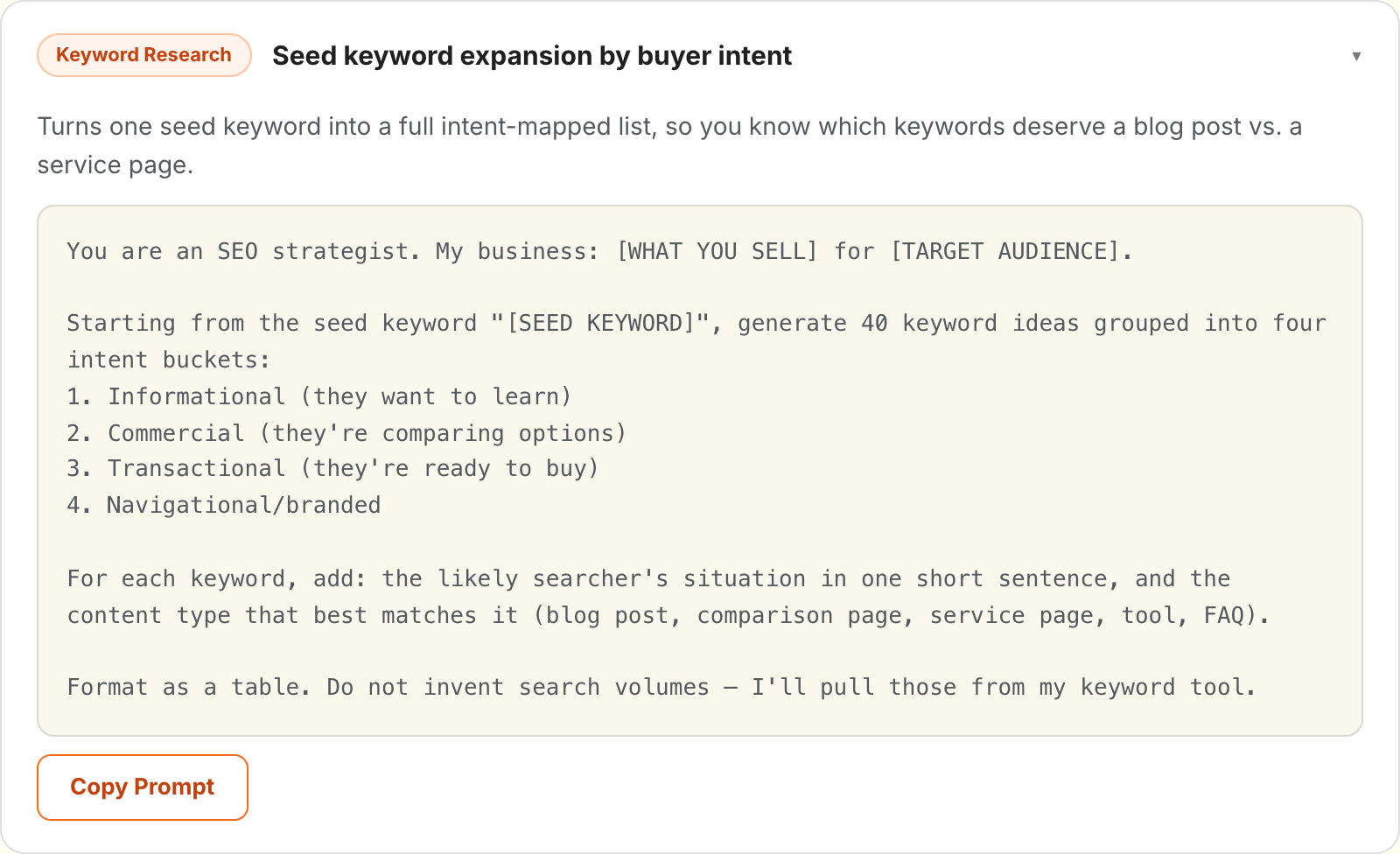
How to use ChatGPT prompts for SEO (the right way)
- Replace every [PLACEHOLDER] with real detail. Your niche, your audience, your numbers. The more specific your input, the less generic the output.
- Iterate instead of accepting the first draft. Follow up with "make section 2 more specific" or "rewrite this for someone who's never heard of X". The second and third passes are where quality happens.
- Verify before you publish. AI is a brilliant strategist and a confident liar. Check every fact and statistic: several prompts here are deliberately written to make the AI ask you for real data rather than invent it.
Generic prompts vs. structured prompts
| A generic prompt | Prompts in this library | |
|---|---|---|
| Input | “Write a blog post about X” | Role + your business context + constraints + output format |
| Output | Interchangeable AI filler anyone can generate | A draft shaped by your niche, audience and real data |
| Facts & numbers | Invented confidently | The AI is instructed to ask you for real data |
| Ranking potential | Low: Google has seen a million of these | Real: because your experience and specifics are baked in |
| Time to useful result | Fast to generate, slow to fix | A minute of setup, minutes of edits |
What's inside the library
25 prompts across nine categories covering the full SEO workflow:
| Category | Prompts | What they help you do |
|---|---|---|
| Keyword research | 3 | Expand seeds by intent, mine questions, fix cannibalization |
| Content briefs | 3 | Build writer-ready briefs, beat the current SERP, refresh decaying posts |
| On-page | 3 | Rewrite titles for CTR, audit drafts, generate snippet-ready FAQs |
| Schema & technical | 3 | Generate JSON-LD, triage crawl exports, write an llms.txt |
| Internal linking | 2 | Find link opportunities, plan hub-and-spoke topic clusters |
| Local SEO | 2 | Optimize a Google Business Profile, build honest city pages |
| E-E-A-T | 3 | Audit trust signals, write credible bios, turn client wins into case studies |
| AI search (GEO) | 3 | Get cited in AI answers, baseline your visibility, audit entity clarity |
| Analysis | 3 | Mine Search Console, map competitor gaps, write client reports |
Prompts are the start, not the strategy
A good prompt saves hours, but it can't tell you which keywords are worth chasing, which pages deserve the effort, or why a competitor outranks you with worse content. That's strategy, and it comes from data. Run your pages through the free SEO analyzer to find what to fix, check whether AI search engines can even see your site with the AI visibility checker, and if you want a plan built on real keyword data instead of guesswork, that's what I do.
Frequently asked questions
Which AI should I use these prompts with: ChatGPT or Claude?
Both work well, and so do Gemini and other capable models. The prompts are written to be model-agnostic: they give the AI a role, precise context and a defined output format, which matters far more than which model you pick.
Will AI-generated content rank on Google?
Google's own guidance is that it rewards helpful content regardless of how it's produced, and penalizes content created primarily to manipulate rankings. In practice: AI-assisted content ranks when a human adds real experience, verifies the facts and shapes it for a specific audience. That's exactly why these prompts force you to supply your own numbers, examples and point of view instead of letting the AI invent them.
Can I use these prompts for client work?
Yes: use them freely for your own projects or client work. They're the working versions of prompts I use in my own consulting.
Why do the prompts have [PLACEHOLDERS] instead of being ready to run?
Because generic input produces generic output. The placeholders force the two things that make AI output actually good: your specific business context and your real data. Filling them in takes a minute and is the difference between content that sounds like everyone else's and content that could only have come from you.
Do I need a paid ChatGPT or Claude plan to use these?
No. Every prompt works on the free tiers. Paid plans mainly buy you longer context windows and more usage, which helps for the bigger prompts like crawl triage or Search Console analysis, but nothing here requires them.