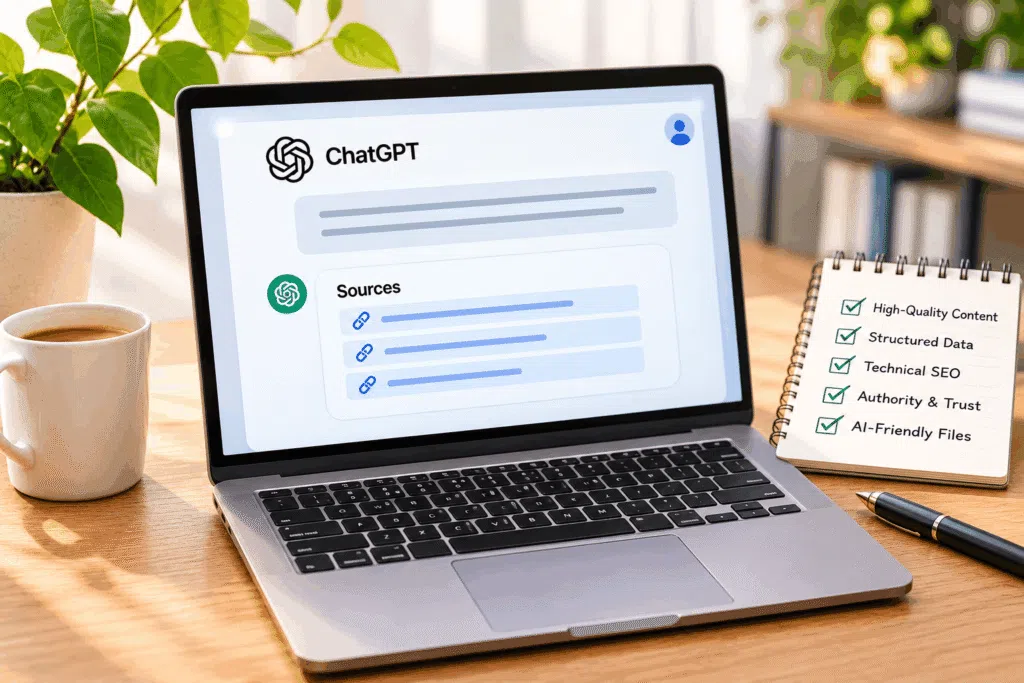
A plumber in Ohio asked ChatGPT, “Who does emergency drain cleaning near me?” and got three business names with links. None of them ran ads. One was a two-person shop that happened to have a clear, crawlable service page. That’s the whole game. Learning how to get cited by ChatGPT means you stop thinking about rankings and start thinking about retrieval: whether your page gets pulled into a live answer the moment someone asks. This playbook covers generative engine optimization (GEO), why most small business sites get skipped, and the concrete steps that change your odds. If you’re new to this space, it helps to start with AI search engine optimization and GEO fundamentals before diving into tactics.
What it means to get cited by ChatGPT (definitions and how citations appear)
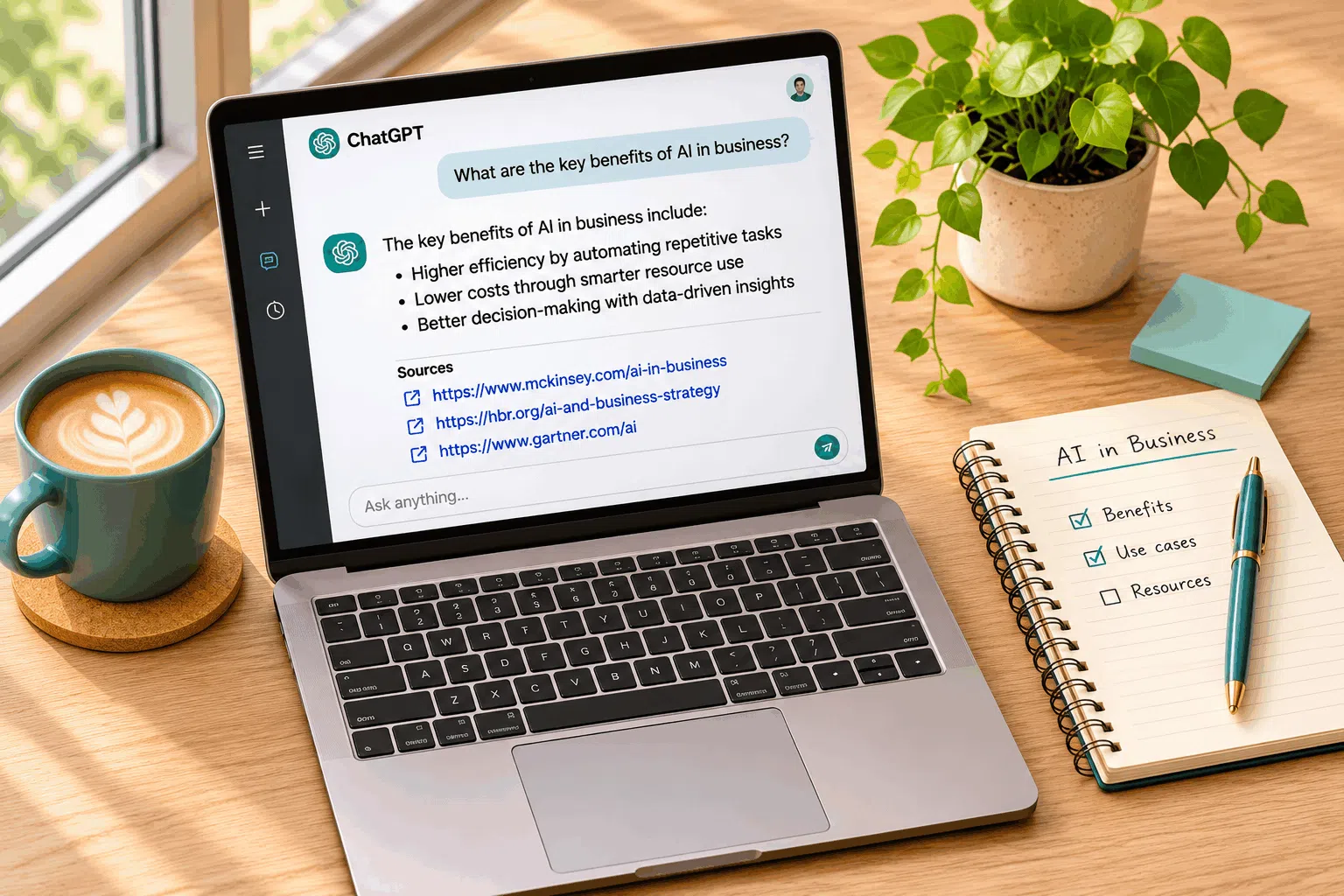
A citation is a clickable source link ChatGPT shows under or inside an answer, crediting a claim to a specific web page. It appears when ChatGPT runs a live search, pulls a handful of pages, and quotes or paraphrases one while linking to the URL. This is different from the model simply “knowing” something from memory. The citation is the part that sends a real visitor to your site.
ChatGPT citations overlap conceptually with Google’s AI Overviews and other AI answers, but the mechanics differ. Both reward clear, answer-first content that directly addresses a question. OpenAI describes how its search feature retrieves and links to third-party sites in its ChatGPT Search documentation, the closest thing to an official rulebook, and its own explanation of how ChatGPT search sources and surfaces information is worth reading directly. Getting cited means your page became a source ChatGPT trusted enough to name in front of the person who asked.
How ChatGPT sources and surfaces information (training data vs. live web browsing)
Two separate systems are at work here, and most people get it wrong by confusing them. Large language models like ChatGPT draw on training data, a fixed snapshot of text the model learned from, with no live links attached. When ChatGPT answers from memory, nothing on your site matters, because no retrieval happened. That is the mechanism: training data is frozen at a point in time, so a page published after that cutoff can only ever reach a user through live browsing, never through the model’s internal knowledge.
Citations come from the second system: web browsing. When a question is time-sensitive, local, or specific, ChatGPT triggers a search, fetches current pages, and builds an answer grounded in them, pulling external ChatGPT sources at query time instead of relying on memory. Search infrastructure powers much of this index, and how search crawlers work is covered in Google Search Central’s documentation. The practical takeaway: you influence ChatGPT citations through live web browsing, not by trying to get into the training data.
Why getting cited by ChatGPT matters for visibility and leads
This matters because of where the buyer is standing. Someone asking ChatGPT “best local accountant for a small restaurant” is deep in research mode, often closer to a decision than someone idly browsing. A citation puts your name in front of that person at the moment of intent, often with less competition than a crowded Google results page.
Many assume AI search visibility is a far-off concern. In reality, ChatGPT search and AI overviews are already intercepting some queries that used to end in a Google click. Consider a local accounting firm that ranks on page one of Google but has never configured its site for AI retrieval: a prospect asks ChatGPT for a restaurant accountant, gets three cited competitors, and books one of them before that firm ever enters the conversation.
If competitors get cited and you don’t, you risk losing the chance to earn qualified leads from a channel your customers already use. For service businesses chasing organic growth, GEO is a new front in search visibility that can reward clear content over ad budget, and reviewing current ways to improve your AI search mentions is a reasonable next step. The goal isn’t more clicks; it’s better business outcomes, and AI answers are becoming a potential source.

ChatGPT tends to favor pages that answer a question cleanly and quickly. Answer-first content tends to perform better: state the direct answer in the first sentence or two under a heading, then expand. The reason is mechanical: the retrieval system extracts short, self-contained statements it can quote verbatim, so content that buries the answer three paragraphs deep gives it less to work with. It tends to skip meandering paragraphs it has to untangle. If you want a shortcut to drafting this kind of content, an AI prompt library built for SEO tasks can speed up writing answer-first copy without losing structure.
Content structure does real work here. Use question-style headings, tight paragraphs, and lists where they fit the search intent. Beyond format, authority signals matter. Topical authority, built by covering a subject thoroughly across related pages, can tell retrieval systems your site is a credible match. Strong topical authority may also help answer engine optimization efforts succeed across more query variations.
E-E-A-T principles carry over here too: the same experience, expertise, authoritativeness, and trust signals Google weighs. E-E-A-T is part of what can separate a trustworthy page from a thin one. Content that shows real expertise and cites reputable sources tends to get surfaced more often; generic pages that could sit on any website are less likely to. For a data-backed look at this, Semrush research on what content AI search tools cite found that clarity and credibility outperform keyword stuffing.
Earning mentions and citations across the wider web
ChatGPT doesn’t only cite your site. It cites whatever page best answers the reformulated query, often a third party mentioning you. Brand mentions on directories, local news sites, trade association pages, and review platforms all feed the pool of sources ChatGPT can draw from. This works because retrieval pulls the best-matching page for a query regardless of who owns it, so a directory listing or a trade write-up naming your business can carry you into an answer your own site never would have triggered.
This is where traditional off-site work pays a second dividend. Backlinks from reputable sources can signal credibility and expand your footprint across pages AI systems crawl. For local businesses, consistent citations with matching name, address, and phone details across directories can reinforce that you’re a real, trustworthy entity. The wider your accurate presence across the web, the more chances a reformulated query has of landing on a page that names your business.
Technical steps: structured data, llms.txt, and crawlability for AI
Crawlability comes first. If OpenAI’s crawler can’t reach your pages, nothing else matters. Check your robots.txt and confirm you aren’t blocking OAI-SearchBot, a mistake that can quietly limit AI visibility on sites that inherited restrictive rules from a theme or a migration. Picture a service business that rebranded and migrated to a new theme last year: the staging-site robots.txt that blocked all bots carried over to production, and months of good content stayed invisible to ChatGPT because one line was never removed.
Structured data helps machines understand what a page is. Adding schema markup for your business, articles, FAQs, and reviews gives retrieval systems clean, labeled facts instead of raw text to guess from. Many treat schema markup as a ranking trick. In reality, it’s a clarity tool that can make your content easier to parse and quote, because labeled data removes some of the guesswork a machine otherwise has to do when it tries to figure out what a page actually says.
Then there’s llms.txt, an emerging convention: a plain-text file at your domain root that points AI systems to your most important content. Support is still early, and not every model reads it, but publishing one costs little and signals which pages you want surfaced in AI answers.

Measuring and tracking ChatGPT citations and AI visibility
You can’t improve what you don’t measure. The simplest signal is referral traffic: when ChatGPT links to you, it tags the URL with utm_source=chatgpt.com, so it shows up as a distinct source in Google Analytics. Filter for it, and you’ll see which pages are earning AI answers traffic.
Beyond analytics, AI citation tracking means periodically running the prompt queries your customers would type and noting whether you appear. This is manual but revealing. Several tools now offer an AI visibility checker that automates this across many queries and reports your citation rate over time. Track both referral traffic and raw citation appearances, since a citation without a click can still build brand awareness. Set a realistic baseline: for most small businesses, volume starts low, so watch the trend, not a single week. The point is confirming your technical and content work is actually moving search visibility.
A step-by-step practitioner checklist to improve citation odds
Here’s the procedure, in order. Work through it top to bottom rather than cherry-picking.
- Open your robots.txt file and confirm OAI-SearchBot and other AI crawlers are not blocked.
- Remove any login walls, paywalls, or email gates from pages you want cited.
- Rewrite your top pages as answer-first content, putting the direct answer in the first sentence under each heading.
- Convert vague headings into clear, question-style headings that match real search intent.
- Add schema markup for your organization, key articles, and FAQs.
- Publish an llms.txt file at your domain root pointing to your most important pages.
- Fix NAP consistency across directories and build citations on reputable sources.
- Earn backlinks and brand mentions from credible, crawlable third-party sites.
- Confirm pages render in server-side or static HTML, not solely heavy JavaScript.
- Set up a utm_source=chatgpt.com filter in analytics and begin AI citation tracking.
Using an AI search visibility checker and llms.txt generator to audit readiness
Before committing weeks to this, audit where you stand. An AI visibility checker runs your target prompt queries against ChatGPT and similar tools, then shows which pages, if any, already surface. That baseline keeps you honest about whether your strategy works or is just busy.
An llms.txt generator removes the guesswork from the file format, letting you list priority URLs without hand-writing syntax. Pair these with a standard site health audit: broken links, slow pages, and blocked crawlers can all drag down both small business SEO performance and AI readiness alike. Most sites fail on basics- crawlability and structure- long before any advanced GEO tactic comes into play. Figuring out how to get cited by ChatGPT almost always starts with cleaning up fundamentals, not chasing a clever hack. Run the audit first, then prioritize fixes by effort versus impact, or book a free SEO consultation if you’d rather have a second set of eyes on the results.
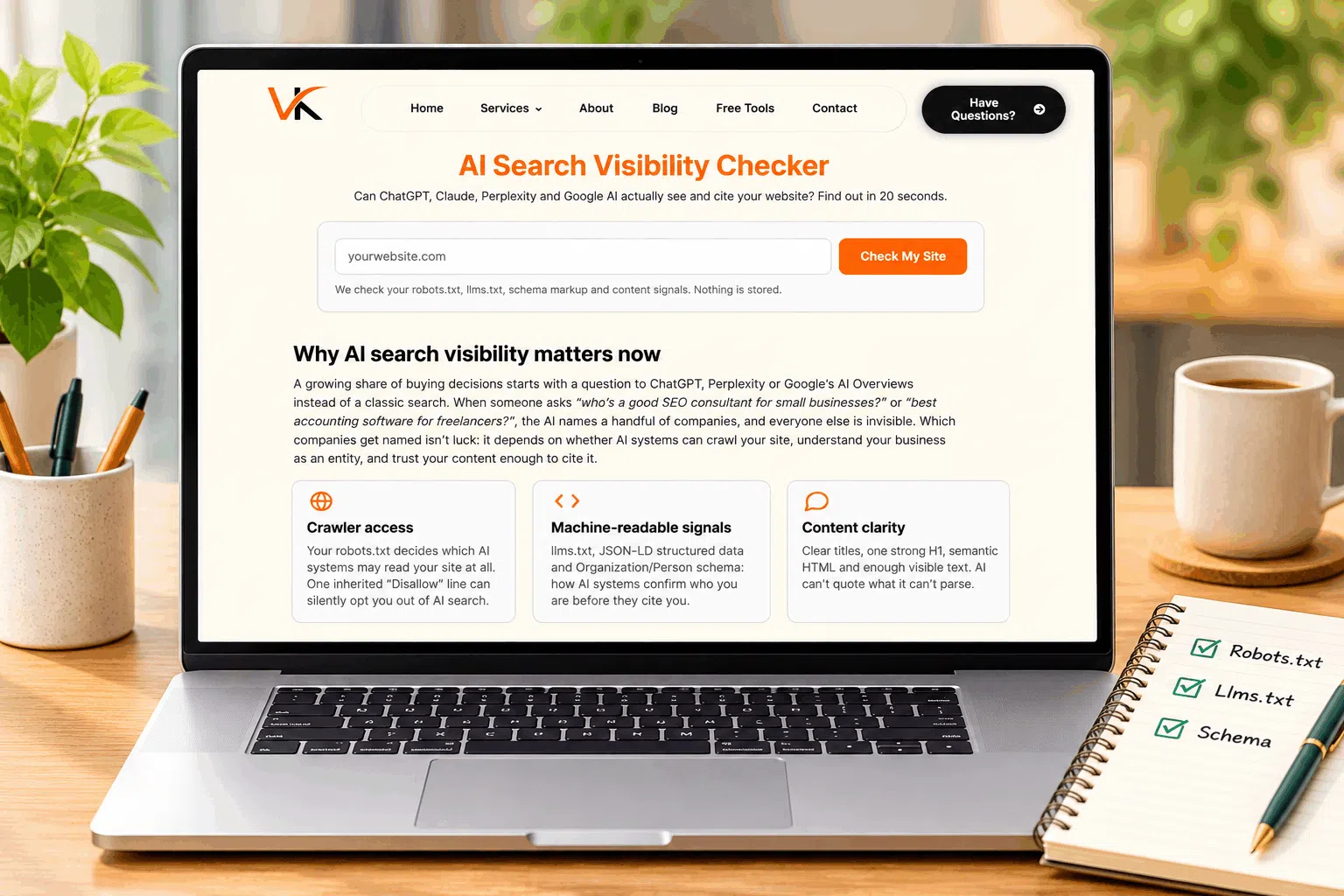
If your customers are starting to research local services through AI tools and your site isn’t showing up, a strategic SEO review can help pinpoint where crawlability, content structure, or local listings may be holding you back. Vineet Kukreti works directly with a limited number of small businesses on technical SEO, local search, and AI visibility, so you can book a strategy call to map your path to citations and qualified leads. Results vary based on competition, website condition, industry factors, and implementation.
FAQs
Q1. Does ChatGPT always pull citations from the web, or does it sometimes answer from memory?
A1.
ChatGPT only cites live sources when it triggers a web search, usually for time-sensitive or niche questions it can’t answer from training data. If it responds from memory, no new citation appears, which means your page has to be the kind of content that prompts a search in the first place.
Q2. What's the one technical mistake that blocks a site from ever being cited?
A2.
Blocking OAI-SearchBot in your robots.txt file removes your content from ChatGPT’s search and citation results entirely. Many small business sites inherit restrictive robots.txt rules from a theme or migration without realizing it, so checking that file is a five-minute fix with outsized impact.
Q3. Is chasing ChatGPT citations actually worth it for a small business, or is this a waste of time?
A3.
It depends on whether your customers are already using AI tools to research local services before calling; if they are, a citation can put you in front of a buyer at the exact moment they’re deciding. But if your leads still come almost entirely from Google Maps and phone calls, this is a secondary priority behind fixing your Google Business Profile and core local SEO.
Q4. What if my content ranks well on Google but ChatGPT still never cites it?
A4.
Google rankings and ChatGPT citations use different retrieval logic, so strong keyword rankings don’t guarantee a citation. ChatGPT’s query fan-out process rewrites a user’s question into several sub-queries, and if your page doesn’t directly answer one of those reformulated questions, it gets passed over even if it outranks competitors on Google.
Q5. Does gating content behind an email signup or login hurt my chances?
A5.
Yes, OpenAI’s retrieval systems can’t crawl or cite content sitting behind a paywall, login wall, or gated form. If a page you want cited requires any barrier to view, treat that as a direct block on AI visibility, separate from whether it hurts your regular SEO.
Q6. How do I structure a page so ChatGPT can actually quote it?
A6.
Use clear question-style headings and keep the direct answer in the first sentence or two after each heading, since AI systems tend to extract short, self-contained statements rather than long paragraphs. Server-rendered or static HTML also matters because crawlers have a harder time seeing content hidden behind heavy JavaScript rendering.
Q7. Can a small, low-authority site get cited, or is this only for big publishers?
A7.
Citation depends more on relevance to the specific query and crawlability than on domain size, since ChatGPT is matching retrieved pages to a reformulated question rather than ranking by overall site authority. A narrow, well-structured page from a small business can get cited for a specific local or niche question where larger sites haven’t written anything that directly answers it.
Q8. Will getting cited by ChatGPT actually send me traffic I can track?
A8.
When ChatGPT links to your site, it appends a utm_source=chatgpt.com parameter to the URL, so referral traffic is trackable in Google Analytics like any other campaign source. That said, citation volume is still typically much lower than organic search clicks, so don’t expect it to replace Google traffic in the near term.

Vineet Kukreti is an experienced SEO and project management expert with over 10 years of success helping small businesses grow. He has led SEO campaigns that improved Google rankings, increased website traffic, and strengthened local visibility. As a project manager, Vineet brings structure and efficiency to digital operations, ensuring smooth execution and measurable results. His combined expertise in SEO and business operations makes him a trusted partner for growth-focused businesses.