
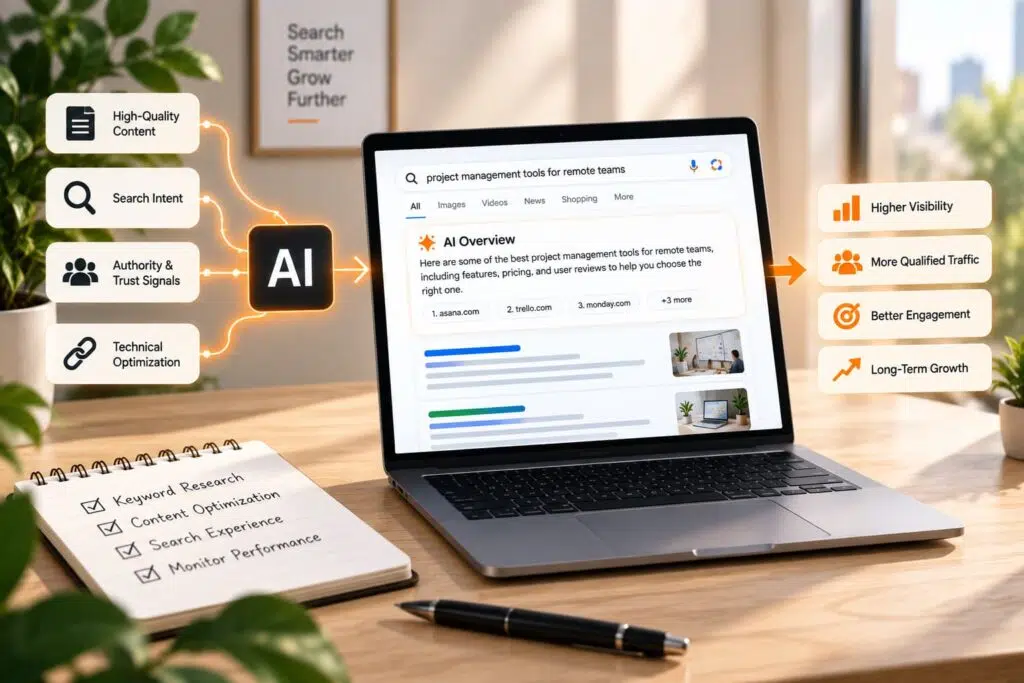
Picture a software company that discovers ChatGPT recommends a competitor by name to anyone asking for the “best tool for X.” Their own site ranks on page one of Google, yet it goes unmentioned. That gap is the whole story. Ranking in blue links no longer guarantees you show up where buyers actually ask questions. AI search engine optimization is about earning a spot inside those AI-generated answers, not just the traditional results page. This article explains what it is, how AI search engines choose sources, what still carries over from classic SEO, and how to check whether your content is eligible to be cited.

What AI search engine optimization is (and the different names for it)
AI search engine optimization is the practice of preparing your content so generative AI systems can read it, trust it, and quote it. Instead of only chasing a rank position, you are trying to become the source an AI cites. That happens when someone asks a question in ChatGPT, Perplexity, Gemini, or Google’s AI Overviews.
The field goes by several names, which causes confusion. You will see generative engine optimization (GEO), answer engine optimization (AEO), and LLM optimization used almost interchangeably. They describe the same core goal: getting large language models to surface your brand as a reliable answer.
The shift is real. Google’s own AI features and your website guidance confirm that the same crawling, indexing, and quality signals feed both standard results and AI experiences. In reality, AI SEO is not a separate universe. It is an extension of the search visibility work you may already be doing. The target is a new surface where users read answers instead of scanning ten links.
Why AI search optimization matters now and how search behavior is changing
People are asking full questions instead of typing three keywords. They are getting complete answers without clicking anything. That is the rise of zero-click search, and it is reshaping how organic traffic flows. When an AI Overview or a chatbot answers a query directly, the click you used to earn may never happen, unless you are the cited source inside that answer.
The adoption numbers are hard to ignore. According to Pew Research Center’s findings on Google AI Overviews, users click through to websites far less often when an AI summary appears. That zero-click search shift is why ai search visibility now sits alongside ranking as a priority. It aligns with Gartner’s forecast that search engine volume will drop 25% by 2026 as buyers lean on AI chatbots and virtual agents.
Generative ai search also changes how search intent is handled. A large language model interprets the meaning behind a prompt, then assembles an answer from multiple pages. Many businesses overlook that being invisible to these systems quietly erodes qualified leads over time. The mechanism is simple: if ChatGPT never mentions you, a buyer forms an opinion and often a shortlist before your website ever enters the conversation, and you never get the chance to make your case. That is the practical cost of treating AI search engine optimization as optional.
How AI search engines actually work (retrieval, synthesis, citations)
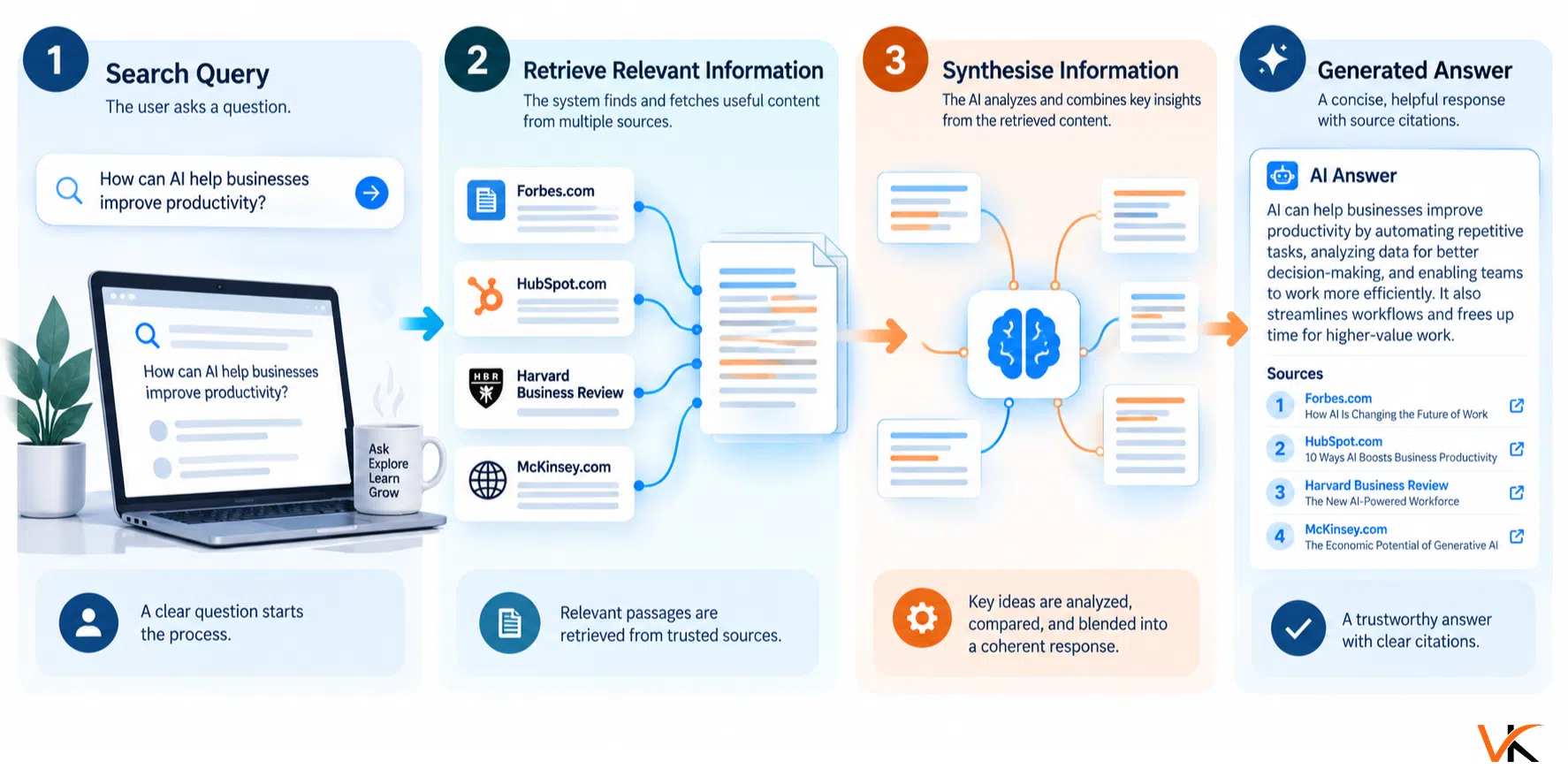
Under the hood, generative ai search runs in three stages: retrieval, synthesis, and citation. First, the system retrieves candidate pages. It often does this by running live queries against a traditional index like Google or Bing. Your page has to already be indexed to make that list.
Second, the large language models synthesize an answer. They pull relevant passages from those candidate pages and stitch them into readable prose. This is where structure matters. Content written as clear, self-contained answers gets extracted cleanly, while rambling paragraphs get skipped.
Third, the system attaches ai citations, linking back to the sources it leaned on. The reason this matters is mechanical. LLMs favor passages that directly and concisely answer the prompt, because an extraction system has to lift a coherent chunk of text without editing it. So a section that front-loads its answer is far easier to lift and attribute. Tools like Perplexity and Google’s AI Mode make these citations visible, which means being quotable is now a measurable outcome. Many assume AI models “just know” things from training data. In reality, most ai search engines retrieve fresh content at query time. That is exactly why your live, indexed pages still decide whether you appear.
AI search optimization vs traditional SEO: what stays the same, what changes
Most of your foundation carries straight over. Crawlability, indexing, backlinks, page speed, and content quality still matter. Ai search engines retrieve from the same indexes traditional SEO has always fed. If your page cannot be crawled and ranked, it rarely becomes an AI citation candidate.
What changes is the target. Traditional SEO optimizes for a ranking position and a click. Ai search engine optimization optimizes for extraction: getting a passage quoted inside an answer where the user may never see a blue link. That reframes success from “we rank third” to “we are the source the AI named.”
Formatting priorities shift too. In classic search, a keyword in your title tag carried weight. For generative engine optimization, a heading that mirrors the exact question a user asks does more work, followed by a direct answer. A model matches the user’s prompt against your headings before it reads your paragraphs, so a heading that echoes the question gets your section considered first. The skills overlap heavily, but the finish line moved. Think of AI SEO as an added layer on top of your existing SEO best practices, not a replacement for them.
Foundational SEO best practices that still power AI visibility
Before anything AI-specific, get the basics right. They are prerequisites. A page blocked in robots.txt, buried under a broken canonical, or missing from your sitemap never enters the candidate pool. Technical SEO is the entry ticket.
Focus on the fundamentals that carry the most weight:
- Indexing and crawlability: confirm important pages are indexed in Google Search Console, and fix anything returning errors or accidentally marked noindex.
- Site speed and user experience: slow, cluttered pages hurt both rankings and the odds an AI trusts your source.
- Internal linking: help crawlers and models understand which pages are authoritative on a topic.
- Backlinks and authority: existing domain authority helps pages get shortlisted for ai citations.
Keyword research still matters, but the lens changes. Instead of chasing exact-match phrases, map the real questions your audience asks. Those questions become the prompts AI systems answer. For local business optimization, an accurate Google Business Profile and consistent citations continue to feed both map results and AI answers about nearby providers. If you run a smaller operation, dedicated AI search visibility and GEO services for small businesses can help you compete on these local and AI surfaces at once. The root cause of most AI invisibility is not a missing trick. It is a shaky technical foundation, and no amount of clever formatting overrides a page a crawler cannot reach.
Creating valuable, non-commodity content AI engines want to cite
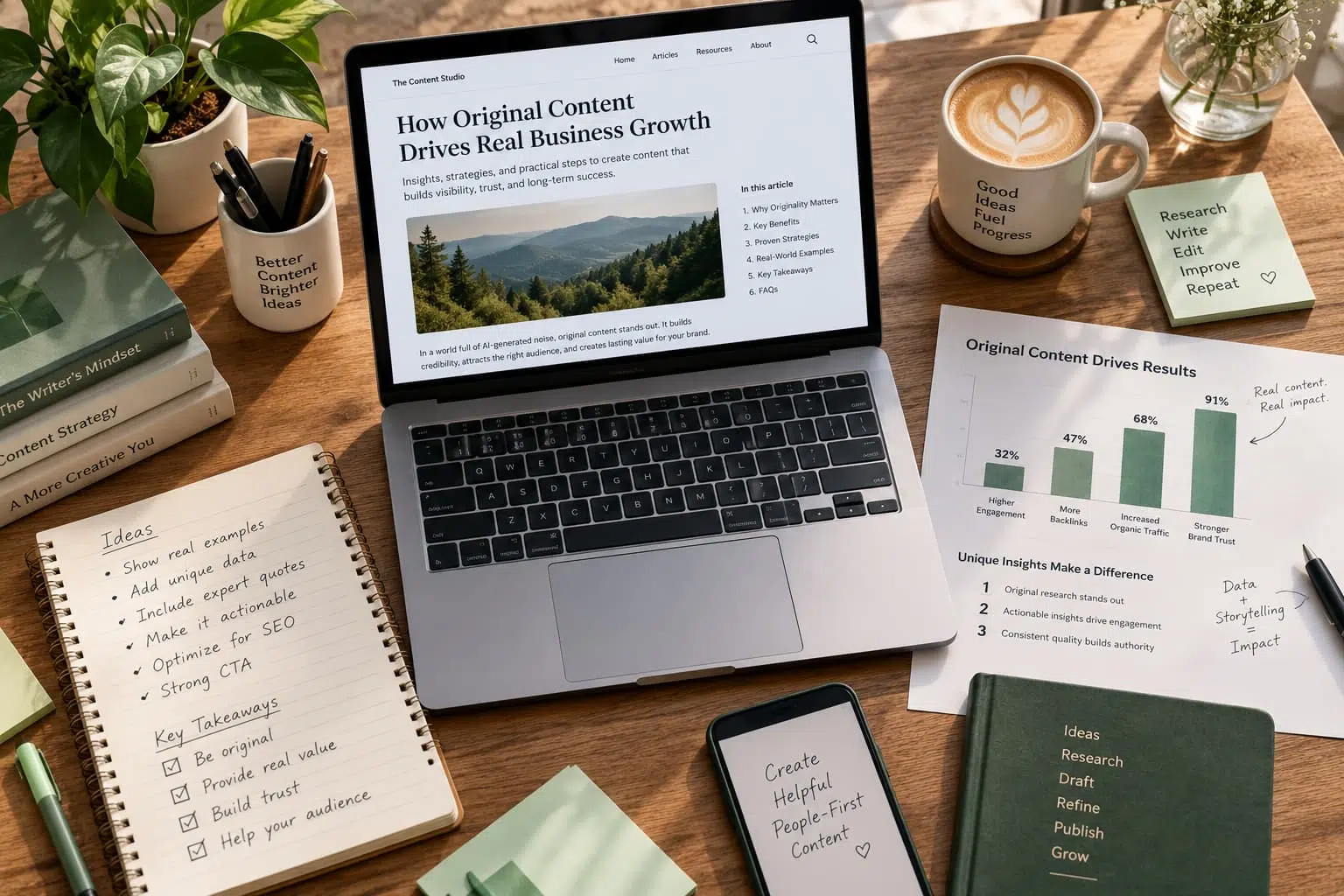
AI systems have infinite access to generic summaries. What they lack, and what they reward, is non-commodity content: original data, firsthand experience, specific examples, and a clear point of view. Google’s helpful content guidance pushes in the same direction. It favors people-first pages over recycled overviews of what everyone already published.
Consider a distribution company that publishes a plain “what is supply chain management” post identical to a thousand others. It gets ignored because an AI system has no reason to cite the hundredth copy of the same paragraph. Now picture the same company publishing real benchmark numbers from its own operations and a walkthrough of a problem it solved. That page becomes citable because nothing else says it, and the AI has a specific fact worth attributing to a source.
Your content strategy for generative AI search should aim to add something to the conversation, not restate it. Practical ways to do that:
- Include specific numbers, ranges, or timelines instead of vague claims.
- Answer the question directly in the first sentence of each section.
- Add original screenshots, examples, or step-by-step walkthroughs.
Traffic alone isn’t enough, and neither is content that merely exists. The goal is content genuinely worth quoting.
Technical structure, schema, and machine-readable signals for AI
Machines read structure before they read prose. Clean technical structure helps both crawlers and language models parse what your page actually says. Use a logical heading hierarchy where each H2 and H3 states a topic plainly, so a system can map the heading to a user prompt.
Structured data helps too. Adding schema markup like FAQ, Article, HowTo, and Organization gives AI systems explicit, labeled facts. They no longer have to infer meaning from layout. It does not guarantee a citation, but it removes ambiguity, which is exactly what an extraction system needs.
A newer signal is the llms.txt file. Placed at your site root, an llms.txt file offers AI crawlers a curated map of your most important, cleanest content. It is similar in spirit to a sitemap but aimed at language models. Adoption is still early, and no one should promise it moves rankings. Still, setting one up is low effort and forward-looking.
Keep the machine-readable basics tidy: descriptive title tags, meaningful alt text, semantic HTML, and fast-loading templates. These technical SEO signals do quiet, constant work in deciding whether you qualify for AI citations at all. The underlying rule is straightforward: the less an AI system has to guess about your page, the more confidently it can quote you.
AI search myths and what you don’t need to do
A lot of noise surrounds AI SEO right now, and some of it wastes your time and money. You do not need to buy every one of the new AI SEO tools that promise to “get you into ChatGPT.” Most citations come from disciplined content and technical work you can verify yourself.
Clearing up a few common myths:
- You do not need to stuff your page with AI-related keywords. Writing “AI, AI, AI” does nothing; answering questions clearly does.
- You do not need a separate website for AI. The same indexed pages serve both audiences.
- You cannot pay a large language model for placement. Citations come from retrieval and relevance, not ad spend.
- You do not need to chase every model individually. Improving crawlability, structure, and authority tends to lift AI search visibility across ChatGPT, Gemini, and Perplexity together.
Many assume AI optimization requires exotic new tactics. In reality, it rewards the same fundamentals done well, plus a few structural habits. Be skeptical of anyone selling guaranteed AI placement, because no AI SEO tools control what a model chooses to cite.
Why traffic alone isn’t enough: visibility, conversions, and business outcomes
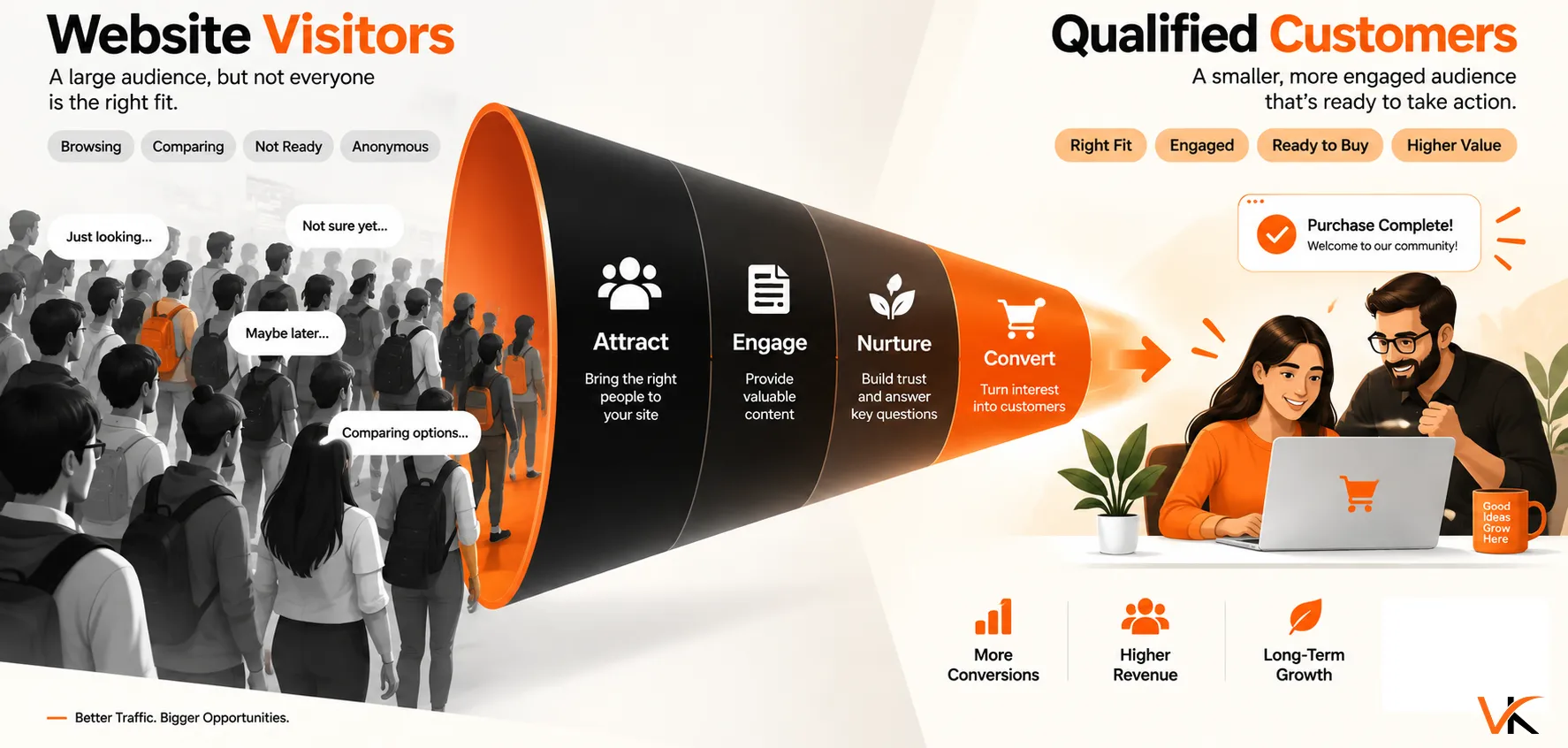
Getting cited feels like a win, but a mention that never turns into a customer changes nothing on your bottom line. Search visibility without conversions creates little value. The point of ai search engine optimization is not a vanity screenshot of ChatGPT naming your brand. It is qualified leads and revenue.
Here is the pattern that trips teams up. They celebrate appearing in AI overviews, then never ask whether that visibility reaches buyers with real search intent. They also skip whether the cited page guides those visitors toward an inquiry. This matters because not all citations sit at the same distance from a sale. A citation on an informational query may never convert. A citation on a comparison or “best tool for” prompt sits much closer to a purchase decision, so where you earn the mention often matters more than how many you collect.
Tie every effort back to business outcomes and a clear content strategy. Ask which prompts your buyers use, whether your cited pages answer commercial intent, and where visitors go next. Once you have diagnosed which pages sit on commercial-intent prompts and which leak buyers before an inquiry, the fix is structural. Vineet Kukreti approaches ai search visibility as a conversion problem first, aligning content and website structure so organic traffic and AI mentions turn into qualified leads, not just impressions. If you want tailored guidance on your own funnel, you can book a paid SEO consultation to map those commercial-intent gaps directly. The goal isn’t more mentions. It’s better business outcomes.
Getting started: llms.txt and free tools to check AI search visibility
Start by measuring where you stand today, then fix the foundation before chasing anything fancy. You cannot improve AI search visibility you cannot see, so AI visibility tracking is step one.
A practical starting sequence:
- Confirm you are indexed. Use Google Search Console to verify your key pages are crawlable and appearing in the index.
- Check whether AI engines cite you. Vineet Kukreti offers a free AI search visibility checker that shows whether generative AI search tools reference your content for relevant queries.
- Audit your on-page structure. A free on-page SEO analyzer flags weak headings, thin content, and technical structure issues that block extraction.
- Set up an llms.txt file. A free llms.txt generator lets you publish a clean, AI-readable map of your best pages in minutes.
Once you know your baseline, prioritize the highest-impact fixes: index errors first, then heading structure and answer front-loading, then schema markup. This mirrors traditional seo sequencing, because the same crawlable, well-structured pages feed both surfaces. Answer engine optimization is not a leap into the unknown. It is disciplined steps, measured with real tools. Consider a service business that fixes a handful of blocked pages and rewrites three headings to match how buyers phrase questions: those small, verifiable changes usually move a page from invisible to cited, not some proprietary AI tactic. Done well, AI search engine optimization comes down to making your best pages easy to find, easy to parse, and easy to quote.
If you are seeing traffic but not enough qualified leads from search, a focused review can pinpoint where AI and organic visibility are leaking before they reach your buyers. You can book a strategy call with Vineet Kukreti to explore your options and map your AI search visibility to real business outcomes, with direct expert involvement rather than a hand-off to account managers. Results vary based on competition, website condition, industry factors, and implementation.
FAQs
Q1. What is AI search engine optimization?
A1.
AI search engine optimization is the practice of structuring content so AI systems like ChatGPT, Gemini, Perplexity, and Google’s AI Overviews can understand and cite it in generated answers, rather than only ranking it in blue-link results. It’s also called Answer Engine Optimization (AEO), Generative Engine Optimization (GEO), and LLM Optimization (LLMO).
Q2. How is optimizing for AI search different from traditional SEO?
A2.
Both still require crawlable pages, solid content, backlinks, and good site performance, so the technical foundation overlaps heavily. The difference is the goal: traditional SEO aims for high SERP rankings and clicks, while AI SEO aims to get your content quoted inside AI-generated responses where users may never see a blue link.
Q3. How do I actually get ChatGPT or Perplexity to cite my content?
A3.
Use clear H2/H3 headings that mirror real user questions, and front-load each section with a direct answer or definition before adding supporting evidence, since LLMs extract front-loaded content more reliably. Bullets, numbered lists, and tables also make multi-part answers easier for AI systems to pull and cite.
Q4. Which factors decide whether AI search engines cite my page at all?
A4.
First, your page must be indexed and crawler-accessible, since content blocked by robots.txt is never even considered for the candidate pool. From there, traditional signals like domain authority, backlinks, and existing Google rankings help you get shortlisted, after which the system scores content for relevance and extractability.
Q5. Is SEO dead now that AI answers questions directly?
A5.
No, but the target has shifted. AI Overviews and answer boxes reduce clicks on standard listings, so the value moves from ranking a link to being the cited source inside the AI summary, which still depends on the same crawlability and authority signals SEO has always relied on.
Q6. Is AI search optimization actually worth the effort in 2026?
A6.
It’s worth it if your audience is already using ChatGPT, Gemini, or Perplexity to research your products or services, because those answers often appear above traditional results and shape decisions before a user clicks anything. If your niche audience still relies mostly on classic Google search, prioritize your existing SEO foundation first, since AI systems pull from indexed, well-ranked pages anyway.
Q7. What if I just publish generic, summarized content, will AI still use it?
A7.
Probably not, because Google’s own AI optimization guidance favors unique, people-first content with firsthand experience over material that simply restates what’s already widely available. AI systems increasingly reward content that genuinely satisfies a query rather than commodity summaries.
Q8. How do I start learning AI SEO as a beginner?
A8.
Start with the traditional SEO fundamentals: indexing, headings, content quality, and links, since AI SEO builds directly on top of them. Then layer in AI-specific practices like front-loading answers, structuring content for extraction, and referencing official guidance from Google and Bing on AI optimization.

Vineet Kukreti is an experienced SEO and project management expert with over 10 years of success helping small businesses grow. He has led SEO campaigns that improved Google rankings, increased website traffic, and strengthened local visibility. As a project manager, Vineet brings structure and efficiency to digital operations, ensuring smooth execution and measurable results. His combined expertise in SEO and business operations makes him a trusted partner for growth-focused businesses.