
A service business owner checks their Google Analytics and sees traffic holding steady, but the phone rings less. More buyers now get their answer directly from ChatGPT, Perplexity, or Google’s AI Overviews without ever clicking a link. Learning how to optimize content for AI search is no longer optional if you want your business named inside those answers instead of being skipped. This guide covers what AI search is, why it matters, and how AI search content optimization and AI search optimization make your pages the ones these systems quote.

What AI search is and how it differs from traditional search
AI search uses large language models to read your question, pull relevant passages from across the web, and write a single answer, often citing a handful of sources. Traditional search hands you ten blue links and lets you choose. In AI search, you compete to be the passage the model retrieves and quotes.
ChatGPT search and Perplexity use retrieval-augmented generation to ground their answers in real documents. Google’s own How Search Works documentation explains the crawling and indexing foundation these newer systems still depend on, and understanding how Google ranks and surfaces content gives useful context for why structure and relevance matter so much. No index entry, no citation.
Why optimizing content for AI search matters now
AI overviews and ai mode now sit above the organic results for a growing share of queries, pushing the old number-one spot further down the page. For a local service business, that can mean fewer map-pack calls even when rankings look unchanged. If the AI answers the question in full, the user has no reason to visit your site, and your organic traffic quietly erodes.
The flip side is the opportunity. Businesses that build their content strategy around AI search content optimization can get named inside answers their competitors never appear in. Google’s Search Central guidance on AI features confirms that the same quality and helpfulness principles drive both AI overviews and standard listings. That overlap is why AI search optimization protects your existing visibility while opening a new channel of referral traffic, especially paired with local SEO for area-based searches. If you want a structured approach to this shift, a dedicated AI search engine optimization and GEO strategy lays out how these two goals work together instead of competing for resources.
Understanding SEO, AEO, GEO, and LLM SEO terminology
The labels multiply fast, so here is the plain-English version. SEO is the broad practice of earning visibility in search. Answer engine optimization, or AEO, focuses on getting your content chosen as the direct answer to a question. Generative engine optimization, or GEO, targets the generative systems that write answers, like ChatGPT and Gemini. LLM SEO describes the same idea from the model’s angle: shaping content so large language models can read and reuse it.
Many assume these are competing strategies. In reality, answer engine optimization and generative engine optimization are layers built on solid SEO foundations, not replacements for it. Get the fundamentals right, and geo becomes an extension, not a rebuild.
How AI search engines find, retrieve, and cite content
AI answer engines work in three moves: they crawl pages, retrieve the most relevant passages for a query, then generate an answer that cites a few of them. Crawlability comes first. If bots like OpenAI’s crawler or Google’s can’t reach and parse your page, nothing downstream happens.
Retrieval-augmented generation is the engine underneath. The system pulls chunks of text that semantically match the question, so pages split into clear, self-contained sections tend to get retrieved more often than one long wall of text. Citations go to the sources the model judges most trustworthy and specific, which is why technical SEO fundamentals like structured data and schema markup matter. Following established structured data and schema markup guidelines labels your content so machines interpret it correctly instead of guessing. Content worth retrieving is content a model can lift cleanly and attribute without ambiguity.
What Google AI Mode and AI Overviews are
AI Overviews are the summarized answers Google generates at the top of many search results, pulling from multiple pages and linking out to some. AI Mode is a more conversational, chat-style experience inside Google Search where you can ask follow-up questions and the system builds on the thread.
Both change how your content gets seen. In an AI overview, a single clear sentence from your page can become the quoted answer, with your domain shown as a source. In ai mode, a conversation might touch several of your pages across a topic. The takeaway: content organized around tightly focused questions gives Google more clean passages to pull from, which is the core of ai search content optimization.
Query fan-out and how it changes keyword research
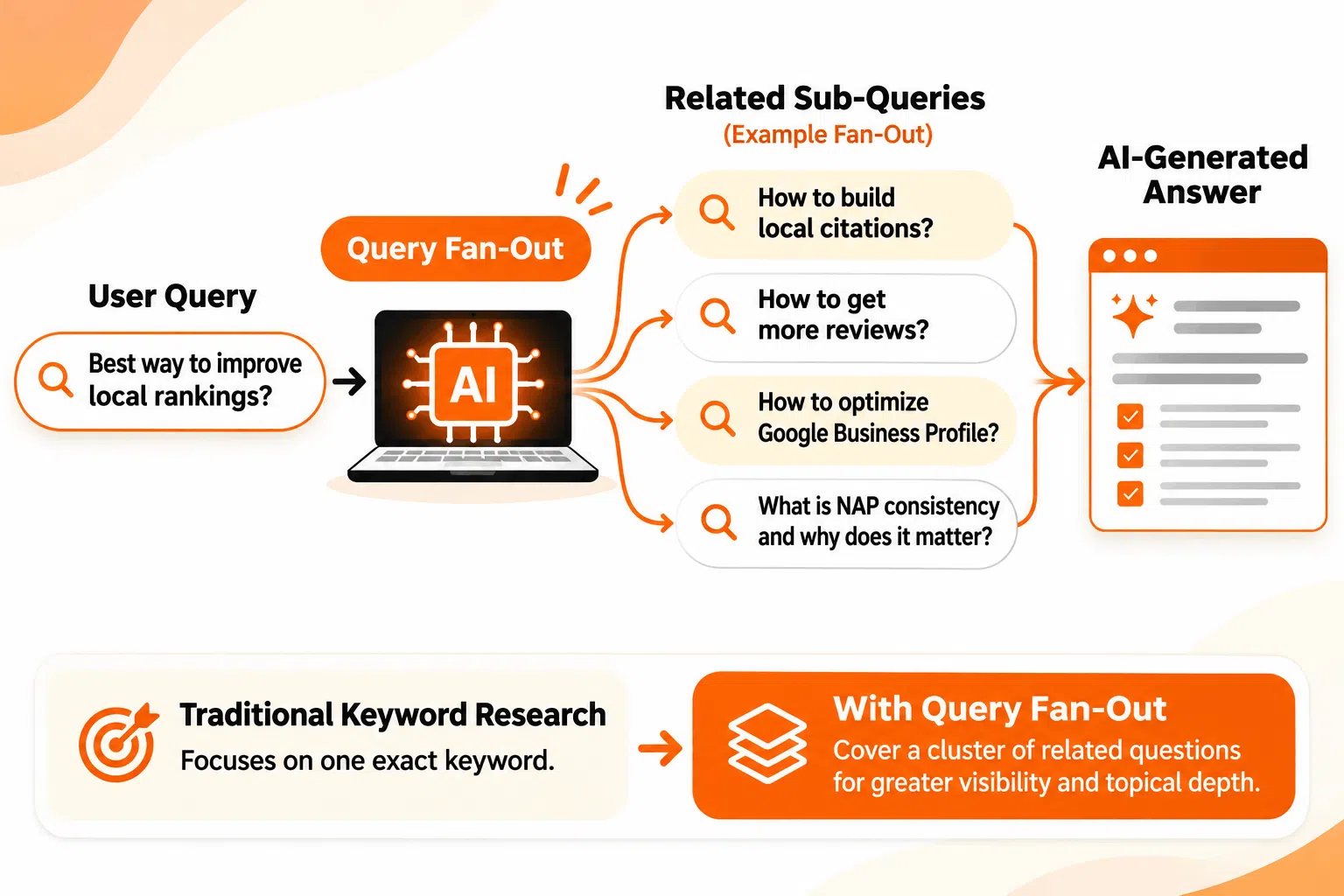
Query fan-out is the behind-the-scenes move where an AI system takes one question and silently expands it into several related sub-queries, then gathers answers for each. Ask “best way to improve local rankings,” and the system may also run searches for citations, reviews, Google Business Profile, and NAP consistency, then stitch the results together.
This reshapes keyword research. Instead of chasing one exact phrase, cover a cluster of related questions a single topic generates. A page that answers the main question plus the fan-out sub-questions earns more chances to be retrieved, because query fan-out rewards topical depth over keyword repetition.
Starting with audience and search intent instead of keywords
Begin with the person, not the phrase. Before touching a keyword tool, map out who is asking, what they need, and where they sit in the buying journey. A plumber searching “emergency pipe burst help” wants a phone number now; someone researching “how much does drain cleaning cost” is comparing options. Same industry, different search intent.
Many businesses overlook that AI systems match intent, not strings. They read the meaning of a question and retrieve the content that genuinely resolves it. So the practical steps:
- List the real questions your customers ask, in their own words.
- Group those questions by search intent: informational, commercial, or transactional.
- Match each group to a page purpose, so a buying-stage query lands on conversion-focused content designed to turn visits into qualified leads, not a general blog post.
Whether keyword research still matters in AI search
Yes, but its job changed. Keyword research used to tell you which exact string to repeat. Now it tells you which questions and topics to cover and how people phrase them conversationally, the same natural-language queries ChatGPT search and similar tools parse directly.
Keep using keyword research to size demand and spot gaps, then translate findings into question-based sections that shape your content strategy. Teams that abandon keyword research entirely lose their grip on what their audience actually searches for and end up writing content nobody wants. The tool stays; the output shifts from keyword lists to a map of search intent.
Creating content worth retrieving and citing
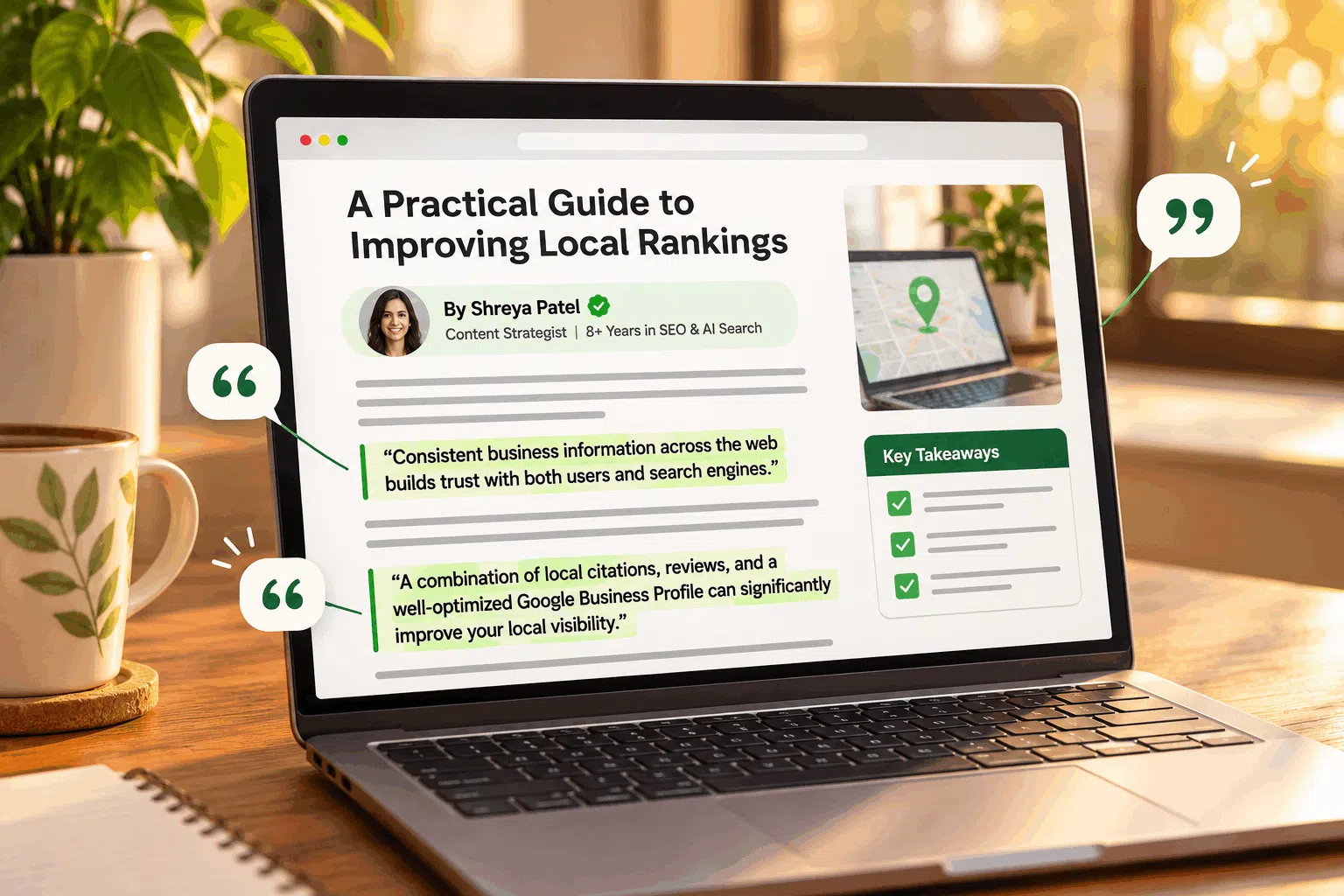
AI systems tend to cite sources they can trust and verify. That puts E-E-A-T at the center of AI search content optimization. Add a real author bio with credentials, keep your business name, address, and phone consistent everywhere, and back claims with specifics rather than vague assurances. These authority signals tell a model your page is safe to quote, and strengthening them is itself a form of AI search content optimization.
Depth helps too. A page that answers a question fully, with concrete numbers, examples, and clear reasoning, gives the model more usable material than a thin overview. Picture a landscaping company whose service page lists exact pricing, service areas, and seasonal timelines. An AI answer can lift and attribute that cleanly, while a competitor’s generic “we offer quality service” page may get passed over.
Structuring content for extractability (headings, chunks, answers)
Structure is where most pages win or lose their shot at a citation. Write so a machine can grab one clean, standalone answer without reading the whole page. The format that works:
- Use question-based H2 headings that mirror how people actually ask.
- Put the direct answer in the first one or two sentences under each heading.
- Keep sections short and self-contained, one idea per chunk.
- Add supporting detail, examples, or a short list after the answer.
- Apply schema markup and structured data so the content type is labeled clearly.
This matters because AI systems pull passages, not pages. A tightly chunked section is a ready-made answer. A 600-word unbroken block forces the model to guess where your point begins.
Measuring and tracking AI search visibility
Ranking reports won’t tell you if you’re being cited in an AI answer, so track two things separately. For traditional performance, Google Search Console still shows impressions, clicks, and the queries bringing organic traffic. For AI search visibility, the honest method today is manual: run your target questions in ChatGPT, Gemini, and Perplexity and note whether your brand appears.
Also check whether AI crawlers reach your site. Your server logs show hits from bots like OAI-SearchBot and Google-Extended, which signals your content is at least eligible for retrieval. Watch Google Search Console for AI referral traffic too. Measuring AI referral traffic alongside citation presence can show whether your efforts translate into real business outcomes, like qualified leads, rather than vanity metrics.
Free tools to check and improve AI search visibility
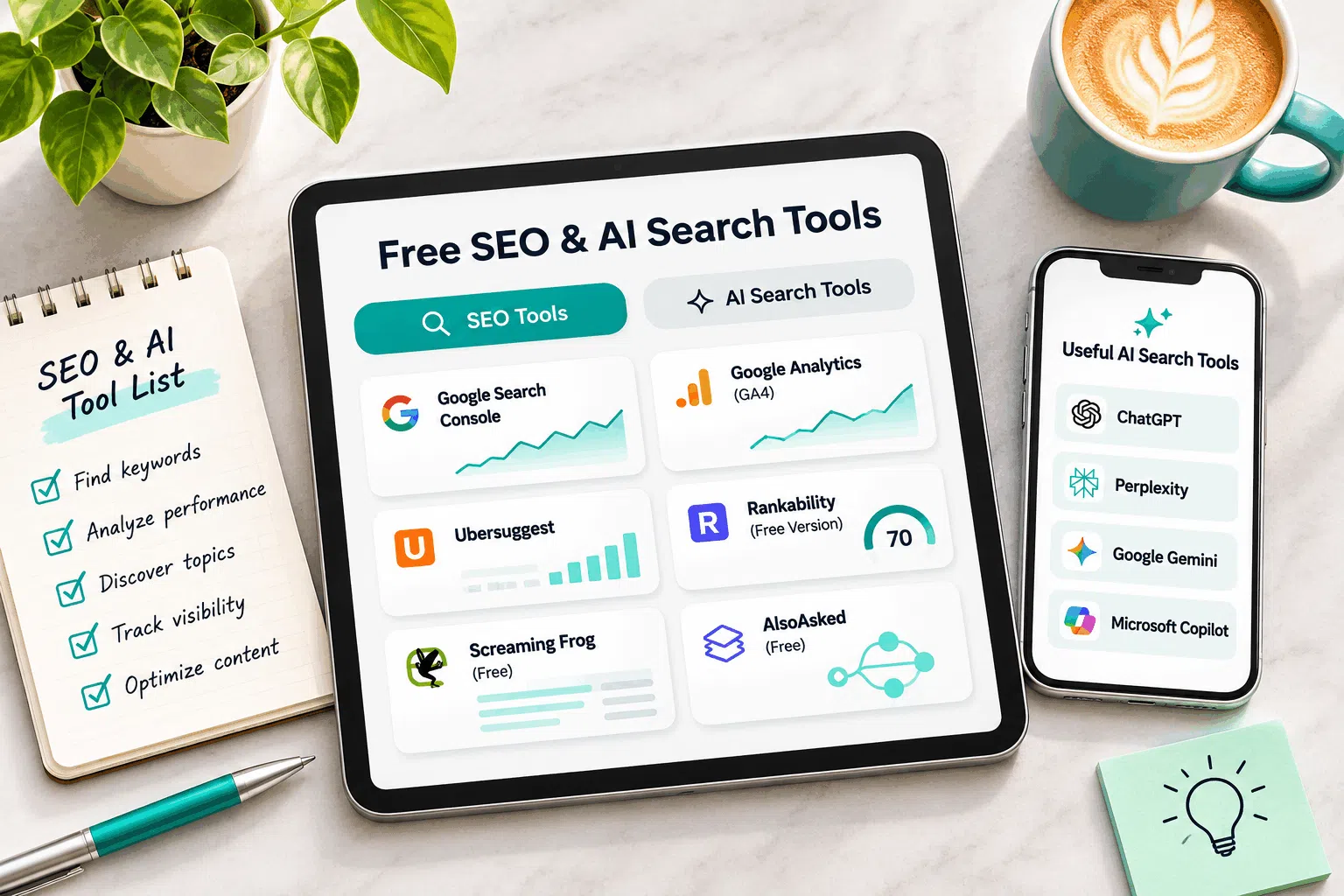
You don’t need an expensive stack to start. Google Search Console is free and tells you which queries already earn impressions, giving you a shortlist for how to optimize content for AI search. The AI tools themselves, ChatGPT, Gemini, and Perplexity, double as testing tools: ask your target questions and watch who gets cited.
An llms.txt file, a simple plain-text file at your domain root, is an emerging way to signal which content you want large language models to reference, similar in spirit to robots.txt and a growing piece of small business SEO toolkits. Adopting llms.txt early costs little and gives crawlers a clear map of what to index. A free on-page analyzer can flag structure and technical SEO issues that block crawlability. This free on-page SEO analyzer highlights where your pages fall short on the structure AI systems need.
If your website is holding steady in rankings but AI answers keep naming competitors instead of you, the gap is usually structure, trust signals, and intent coverage, not effort. A focused review, the kind of small business SEO audit that catches what generic checklists miss, can help pinpoint where your pages are being skipped and how to optimize content for ai search around those gaps. If you’d rather get a tailored diagnosis than guess, you can book a free SEO consultation to walk through your specific gaps. Book a strategy call with Vineet Kukreti to map out an AI search plan built around qualified leads, not vanity metrics. Results vary based on competition, website condition, industry factors, and implementation.
FAQs
Q1. How is optimizing for AI search different from regular SEO?
A1.
Traditional SEO aims to rank a page so someone clicks through to your site, while AI search optimization aims to get your content quoted or summarized directly inside an AI-generated answer. Both still depend on crawlability and topical relevance, but AI tools weigh clear structure and direct answers more heavily than backlink volume alone.
Q2. Does adding FAQs and schema markup actually help AI tools cite my content?
A2.
Yes, in the sense that structured Q&A format and semantic markup make it easier for AI systems to extract a clean, standalone answer instead of having to interpret paragraphs of context. Content organized with question-based H2s and a direct answer in the first sentence has reportedly been 60-70% more likely to get cited, according to Search Engine Land’s analysis.
Q3. Is it worth rewriting old blog posts just for AI search visibility?
A3.
It depends on whether that page already ranks or drives leads; if it has decent traffic or backlinks, restructuring the intro and adding clearer headings is usually a low-effort win. If the page gets no traffic at all, your time is better spent on content gap analysis to find topics worth creating first.
Q4. What if my business doesn't show up in ChatGPT or Perplexity answers at all?
A4.
This usually means your content either isn’t crawlable by bots like OpenAI’s OAI-SearchBot, or it lacks the entity clarity and trust signals AI systems look for, such as consistent business details and author credentials. Checking server logs for AI crawler activity and testing a few target queries directly in these tools is the fastest way to diagnose the gap.
Q5. Do I still need to do keyword research if I'm optimizing for AI search?
A5.
Yes, but the focus shifts from exact-match keywords to the actual questions and phrases people ask conversationally, since AI systems match intent rather than string-matching terms. Mapping content to those natural-language questions still starts with understanding search intent, just applied to longer, more conversational queries.
Q6. Can small businesses realistically compete for AI search citations against bigger brands?
A6.
Yes, AI answer engines prioritize clear, trustworthy, well-structured content over domain authority alone, which narrows the gap that usually favors larger sites in traditional rankings. A small business with a detailed, accurately cited local page can outrank a national brand’s vague content in an AI-generated answer.
Q7. Will optimizing for AI search hurt my regular Google rankings?
A7.
No, the practices overlap significantly; clear structure, author bios, and expert commentary that help AI systems extract answers also satisfy Google’s E-E-A-T signals for traditional rankings. The main shift is prioritizing upfront answers and semantic markup, which doesn’t conflict with standard on-page SEO.
Q8. How long does it take to see results from AI search optimization?
A8.
There’s no fixed timeline since AI answer engines don’t publish ranking update schedules the way Google does, but testing your target queries directly in tools like ChatGPT or Perplexity every few weeks shows whether structural changes are gaining citations. Most practitioners track this as a visibility signal, separate from organic traffic reports.

Vineet Kukreti is an experienced SEO and project management expert with over 10 years of success helping small businesses grow. He has led SEO campaigns that improved Google rankings, increased website traffic, and strengthened local visibility. As a project manager, Vineet brings structure and efficiency to digital operations, ensuring smooth execution and measurable results. His combined expertise in SEO and business operations makes him a trusted partner for growth-focused businesses.