

Six weeks into a website redesign, the owner of a three-location dental practice realized the new site still had no booking system, the developer had gone quiet, and the $8,000 deposit was already spent. This is the quiet way most small business websites fail: not in a dramatic blowup, but in a slow drift of missed expectations until someone calls it a loss. Understanding why small business websites fail starts with accepting that technology is rarely the real problem. The people, the planning, and the money usually are. That dental practice did not fail because WordPress was broken; it failed because nobody had written down, in plain language, that “the site must let patients book an appointment in under two minutes from a phone.”
When the core business outcomes are never named, the build wanders, and wandering is expensive. The practice had three receptionists fielding bookings at peak hours, and the point was to relieve that bottleneck, yet that need never reached the brief. The same pattern repeats across industries, from accountants to auto-repair shops, and the warning signs are almost always identical: vague goals, a budget that assumed the best case, and a partner who vanishes when the work gets hard.

Unclear Goals Sink the Project Before It Starts
Most failed builds were doomed at the kickoff meeting. When a business says “we just need a website,” nobody has defined what the site is supposed to do: sell products, book appointments, drive lead generation, or simply prove the business exists. Without measurable goals, every decision becomes a matter of taste, and taste-driven projects never end because there is no finish line. Consider a family-owned bakery that asked for “something modern and clean.”
Three rounds of revisions later, the owner and designer were still arguing over fonts and hero colors. Neither could point to a clear goal to settle the debate. The owner wanted the homepage to feel “warmer,” while the designer kept presenting cooler layouts. Without a shared objective, the discussion went in circles. If the brief had stated, “We want fifty online cake orders a month,” every decision – from the homepage to the order form and call to action – would have been clear. The option that made the order button easiest to find would have won.
Align Website Features With Your Business Objectives
The mechanism here is simple: a website is a tool built to produce a specific outcome, and a tool with no defined job cannot be judged complete. A plumber who wants twenty service calls a month needs a different conversion strategy than a boutique that wants online sales, yet both often get the same generic five-page template. The plumber needs a click-to-call button on every page, service-area pages, and a quote form that reaches the office in seconds, because an emergency customer will not wait for email.
The boutique needs product photography, a payment gateway, inventory syncing, and a returns page because a shopper whose mobile checkout requires more than 3 clicks abandons the cart. Handing both the same template guarantees one ends up frustrated, because the template serves as an average that neither of them actually is. An experienced small business marketing consultant will press for these distinctions before a single page is designed.
Great Design Should Support Conversions, Not Replace Them
Many assume a professional-looking design is the goal. In reality, design serves the goal, and a beautiful site with zero qualified leads has failed at the only thing that matters. A law firm once spent heavily on an elegant site with sweeping animations and beautiful photography, yet buried the phone number and contact form so far down that the user experience drove prospects away. The site looked successful but behaved like a failure; intake fell for two quarters before anyone connected the drop to the redesign.
The U.S. Small Business Administration recommends defining concrete business objectives before any spending begins, and that applies squarely to a website budget. Writing the goal as a single measurable sentence, the number of leads, bookings, or sales you expect per month, turns a vague wish into a target a builder can aim at.
Why Website Projects Fail for Small Business Budgets and Timelines
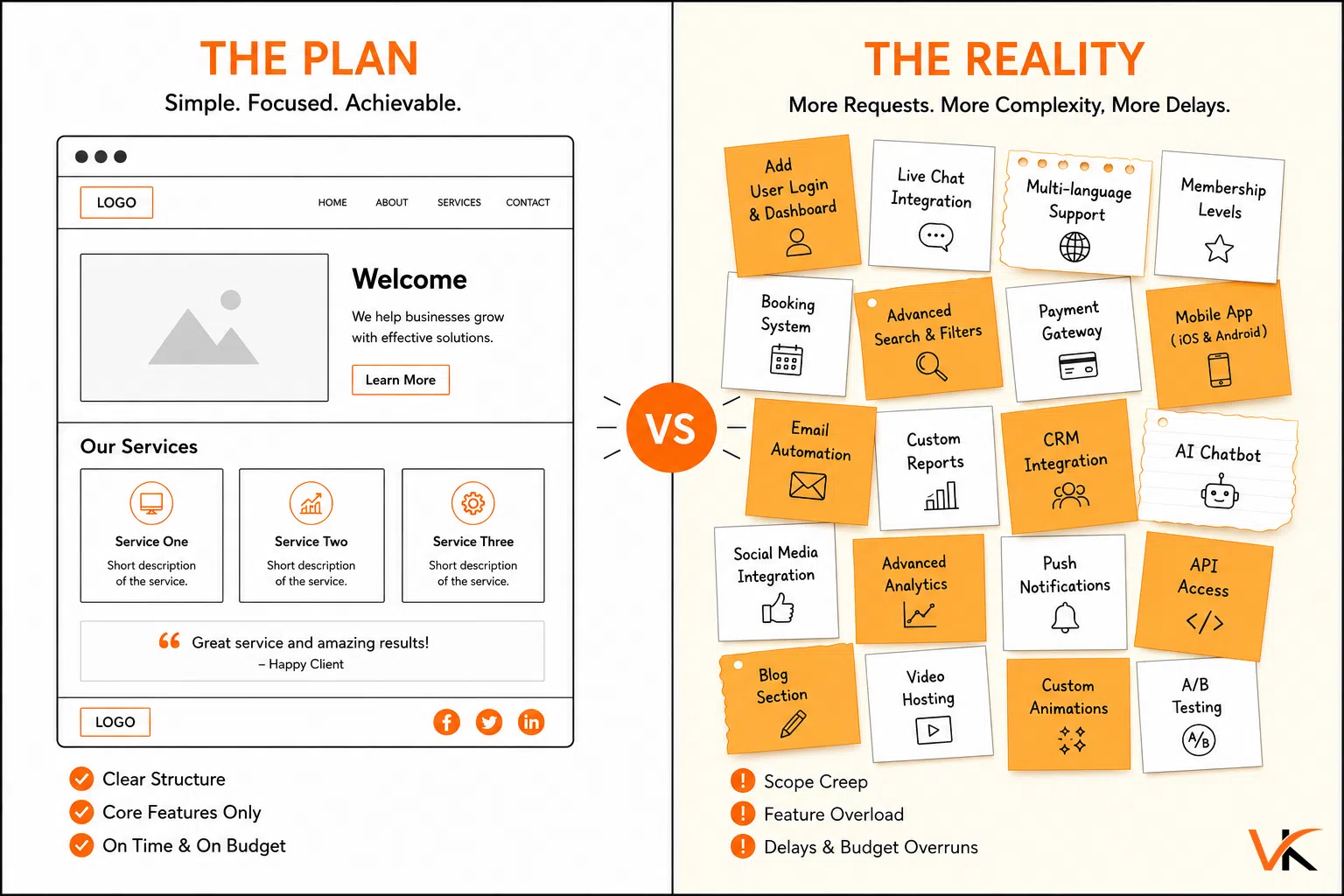
Money and time kill more builds than bad code ever will. Owners underestimate both because they price a website as a one-time purchase rather than as an ongoing asset that requires content, revisions, and maintenance. When the budget runs dry at 70% completion, the project stalls, and a stalled site is dead. The most visible costs, design and development hours, are often only half the total. Copywriting, photography, stock licensing, premium plugins, payment setup, and post-launch fixes all draw from the same pool, and unrealistic timelines plus unclear scope make it worse. A single e-commerce plugin license plus its add-ons can run several hundred dollars a year, and a half-day photo shoot to make products look credible can cost as much as a chunk of development itself.
A practitioner scenario makes this concrete: a regional landscaping company signed off on a $4,000 build, then requested a gallery, a quote form, and seasonal pages midway through. None of these shifting requirements were in the original scope; the budget could not stretch, and the half-built site sat unlaunched for nine months until the busy season passed. Scope creep arrives one “small request” at a time. The gallery alone meant editing forty photos, building a filterable layout, and optimizing site speed so the page still loaded quickly, easily a week of unfunded work. The seasonal pages then needed copy for spring, summer, and autumn, tripling the writing load and stalling lead generation. By the time spring arrived, the company had missed a season of inquiries, and that lost revenue dwarfed the original quote.
Align Website Features With Your Business Objectives
The mechanism is cash flow against scope. Every unplanned addition consumes hours that were never funded, so quality drops, the timeline slips, or the project stops. This is a core reason small-business websites fail: owners treat the quote as a ceiling rather than an estimate of the original plan. A disciplined approach treats every request as a change order with its own cost, so the owner can decide whether the gallery is worth pushing the launch back two weeks. This kind of structured oversight is exactly what a dedicated website project manager provides. These warning signs matter: without that discipline, additions pile up invisibly, technical debt accrues, and the money is gone before the site is live.
The Wrong Partner Makes Everything Harder
A cheap developer who disappears mid-project costs more than a fair-priced one who finishes. Communication breakdown and weak project management are the most common reasons web development projects fail: the freelancer stops replying, the agency reassigns the account, or nobody translates decisions into plain language. A café owner who hired a developer on a low-cost marketplace learned this: work started fast, then messages went unanswered for weeks, and eventually the profile vanished, taking the login credentials and unfinished files. The café had already printed menus pointing customers to a half-built page. That same weak project management and vendor underperformance meant that rebuilding from scratch cost more than twice the original quote and resulted in three months of lost time, turning the job into a full-blown website rescue.
Vetting matters because the gap between a portfolio screenshot and a working relationship is enormous. Ask any builder how they handle revisions, what happens when scope changes, and who owns the files if it ends. The answers separate professionals from people who leave you stranded. A builder who says “you own everything, here is the contract, and here is how I document every change” is telling you something different from one who shrugs. Ask for two references from clients whose projects finished over a year ago, because anyone looks good early, and a client still happy a year later has watched the site survive real use; reviewing a vendor’s client results and testimonials is a fast way to gauge this.
Why Website Project Management Makes the Difference
Working with a consultant who documents scope, communicates clearly, and keeps stakeholders aligned helps prevent the communication gaps that derail website projects. My approach emphasizes transparency, structured planning, and collaboration. You’ll always know the project’s status and the reasoning behind every decision. Weekly check-ins identify issues early, before a missing booking feature turns into a six-week delay or a costly website rescue. If you need someone to guide your project from planning to launch while keeping developers, designers, and business goals aligned, my Website Project Management service is built for exactly that.
Ignoring What Happens After Launch
Launch day is the start, not the finish. A site with no plan for updates, security patches, or content refreshes degrades within months. Search visibility erodes, plugins break, and website performance collapses while the business wonders why the expensive new site produces nothing. Working through a pre-launch SEO checklist before going live catches many of these issues early. Picture a fitness studio that launched a polished site and touched nothing for a year: the schedule went stale, members showed up for sessions that no longer ran, an outdated plugin opened a security hole, and Google demoted the pages because the content never changed while competitors kept publishing. Weak technical SEO and stale content sank its search visibility from the top of local results to the second page, and the phone stopped ringing while a newer studio absorbed the traffic.
Build a Website Maintenance Plan for Long-Term Performance
Roughly half of small businesses close within five years, and a neglected, underperforming website mirrors that decline: without attention, it quietly stops working. The fix is treating the site as a living asset with a maintenance routine. That routine is not glamorous: monthly plugin updates, security scans, broken-link checks, backup verification, and a quarterly content review that protects technical SEO, but it is the difference between a site that compounds in value and one that decays into a liability, repelling customers with slow load times. Following Google’s web.dev performance guidance on speed and Core Web Vitals helps keep those load times in check. A single corrupted update with no backup can wipe out months of work in an afternoon.
This is where ongoing support and long-term growth earn their keep. I’ve worked with businesses whose websites stalled after launch simply because there was no ongoing strategy behind them. A website performs best when it’s treated as a long-term marketing asset—regularly reviewed, improved, and aligned with changing business goals rather than left untouched after launch. The studios, shops, and service businesses that treat maintenance as a recurring line item are the ones whose website performance still drives long-term growth and qualified leads three years later, while the “set it and forget it” crowd quietly pays a developer to rebuild what neglect destroyed. If you’re unsure whether your website is helping your business grow, an SEO consultation can help identify what’s working, what’s holding it back, and where the biggest opportunities lie.
FAQs
Q1. Why do website projects fail for small businesses?
A1.
Most website projects fail because they begin without clear business objectives, a well-defined scope, or a plan for measuring success. When these foundations are missing, the project quickly loses direction.
Q2. What are the most common reasons a small business website underperforms after launch?
A2.
The usual culprits are unclear goals, generic templates, and bloated page builders that slow the site down, and weak technical SEO so the pages never rank for searches that matter. Traffic alone isn’t enough; without conversion-focused design, even a good-looking site fails to produce inquiries.
Q3. How can I stop my website project from going off the rails?
A3.
Start with clear objectives, a written scope, a realistic budget, and a single decision-maker. Review new feature requests carefully so they don’t unnecessarily increase costs or delay the project.
Q4. Why do website redesigns so often go over budget or never get finished?
A4.
Redesigns get treated as a cosmetic exercise, focused on how it looks rather than what it needs to achieve, so the strategy never gets defined and the real complexity gets underestimated. That gap between assumed and actual cost is where overruns and stalled projects come from.
Q5. Is hiring a single freelance consultant actually safer than going with an agency?
A5.
For many small businesses, working directly with an experienced consultant offers greater transparency and faster communication because you’re collaborating with the person responsible for the strategy. The right choice ultimately depends on your needs, but clear communication, documented processes, and measurable goals are more important than choosing a consultant or agency.
Q6. What should I sort out before starting a website project to avoid failure?
A6.
Define specific, measurable goals (leads, sales, or visibility), understand who your audience is and how they search, and pick a platform that fits your actual needs rather than the trendiest option. Getting these three things settled first prevents the disorganized builds that fail to serve the business.

Vineet Kukreti is an experienced SEO and project management expert with over 10 years of success helping small businesses grow. He has led SEO campaigns that improved Google rankings, increased website traffic, and strengthened local visibility. As a project manager, Vineet brings structure and efficiency to digital operations, ensuring smooth execution and measurable results. His combined expertise in SEO and business operations makes him a trusted partner for growth-focused businesses.