

A plumber in Austin spends $2,000 a month on Google Ads, then watches the phone go quiet the day the budget runs out. That’s the trap most owners fall into. It’s exactly why SEO for small businesses matters: organic visibility keeps working after ad spend stops. This guide walks through the practical steps, from keyword research to your Google Business Profile, that help a small business get found without renting attention forever.

What SEO is and how it works
Search engine optimization is the practice of making your website easy for search engines to find, understand, and trust. That way it appears when people search for what you offer. If you’ve ever asked how SEO works, the short version is this: Google crawls pages, indexes them, and then ranks them based on relevance, quality, and authority.
Three things do most of the heavy lifting. Content that matches what people are searching for. A technically sound site that loads fast and works on phones. And signals of trust, mainly links and reviews, that tell Google you’re credible.
What actually happens is that Google tries to answer a user’s question with the best possible result. If your page answers it better than the alternatives, you rank higher. That’s the whole game, and it explains how SEO works at its core. If you’re curious about the mechanics behind this, Google’s guide to ranking systems explains how the search engine weighs relevance and quality.
Keyword research and targeting the right keywords
Keyword research is where most small business owners either win or waste months. Chasing broad terms like “accountant” puts you against national firms with huge budgets. You lose. Targeting “small business accountant in Denver” puts you in front of people ready to hire.
Start by listing the services you sell, then think about how a customer would type them into a search engine. Free tools help here. Google Keyword Planner shows search volume, and Ubersuggest surfaces long-tail variations you’d never guess on your own.
The reason this matters is that long-tail keywords reflect clearer search intent. Someone searching “emergency water heater repair” is closer to buying than someone searching “water heater”. Fewer searches, but far more qualified leads.
Many assume more traffic is always better. In reality, ranking for the right keywords beats ranking for popular ones that never convert, and this focus is central to small-business SEO. Ahrefs publishes a solid primer if you want to go deeper. Their beginner’s guide to keyword research breaks down how to assess difficulty relative to opportunity.
Map each keyword to a page. One primary term per page keeps your seo strategy focused and your content clear. Search intent falls into rough buckets: informational, comparison, and transactional. A page trying to serve all three at once serves none of them well, which is why one term per page ranks more reliably. If your pages aren’t appearing at all, it’s worth understanding why your business isn’t showing up on Google before you pour more effort into new keywords.
Local SEO and Google Business Profile setup
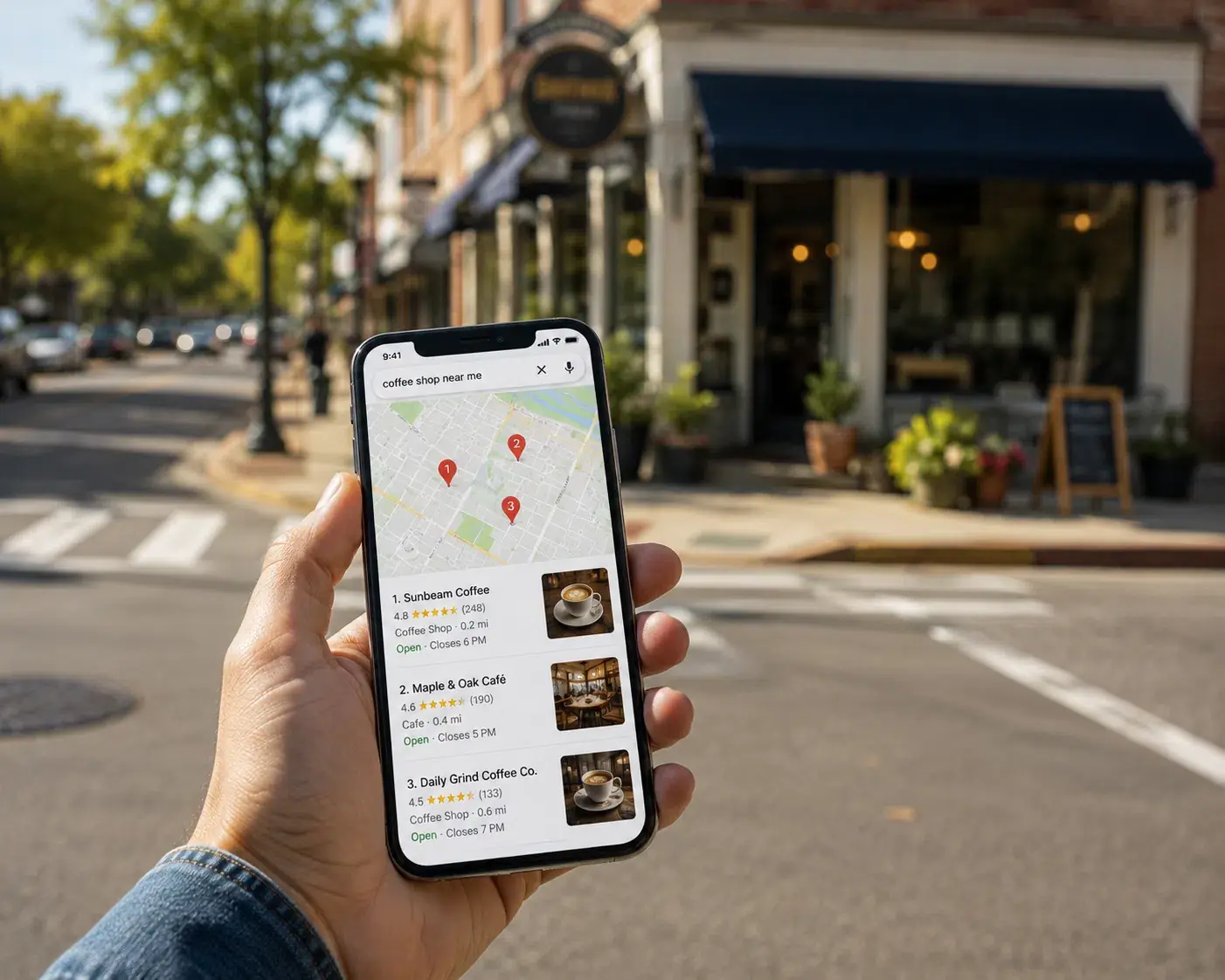
If you serve a specific area, local SEO is your fastest route to visibility. When someone searches “dentist near me”, Google shows the Map Pack: three businesses with reviews, hours, and directions. Getting into that pack drives phone calls, not just clicks.
Your Google Business Profile is the foundation. Claim it, verify it, and fill in everything: accurate hours, address, phone number, service categories, and photos. Inconsistent details across the web confuse Google and hurt your local search ranking. The reason consistency matters so much is that Google cross-checks your business details across directories, review sites, and your own site; when the numbers disagree, it reduces confidence in your listing’s legitimacy and ranks it accordingly.
A few things move the needle most for local search:
- Consistent name, address, and phone number everywhere online
- Regular posts and updated photos on your Google Business Profile
- Steady, genuine customer reviews with owner responses
- Location-based keywords in your page titles and content
Customer reviews deserve real attention. They influence both rankings and the decision a searcher makes when comparing you to the business listed above you. For a deeper walkthrough, these local maps optimization tips for small businesses cover the details that push you into the Map Pack.
Managing all this consistently is where owners run short on time. This is the kind of ongoing seo for small businesses that Vineet Kukreti handles through local SEO and Google Business Profile optimization, keeping listings accurate and reviews flowing so nearby customers actually find you. There are also practical ways to increase Google Business Profile traffic without paid ads once your listing is fully set up.
Creating high-quality, human-first content
Google’s job is to serve the most useful answer. So your content has to genuinely help the person reading it, not just stuff in keywords and hope. Rich content that answers real questions ranks and, more importantly, converts.
Write for the customer first. If a homeowner asks “how much does a roof replacement cost”, give them a straight, useful answer with ranges, factors, and next steps. That builds trust before they ever call you.
A practical content strategy for a small business looks like this:
- Service pages that clearly explain what you do and who you help
- Answer pages that address the questions customers ask before buying
- Local pages if you serve multiple towns or neighborhoods
Match every piece to search intent. Someone comparing options needs different content from someone ready to book. A content strategy that respects that difference earns better organic traffic and stronger rankings over time.
Thin, generic pages no longer rank, and AI-generated filler ranks even less. The businesses winning search visibility are those publishing content only a real practitioner could write, drawn from actual jobs, real pricing, and honest answers.
Backlinks are still one of the strongest ranking signals. When another site links to yours, Google reads it as a vote of confidence. Authoritative links from trusted sites carry far more weight than dozens of low-quality ones, because Google weighs the credibility of the linking site, not just the number of links pointing at you.
The root cause of most link-building failures is treating it as a numbers game. Buying cheap links or spamming directories can trigger penalties and set you back months. Quality beats quantity every time.
Realistic ways a small business earns authoritative links:
- Get listed in reputable local and industry directories
- Partner with local organizations, suppliers, or charities you already work with
- Publish genuinely useful content other sites want to reference
- Ask satisfied business partners for a mention or link
I once worked with a home services company that had ignored links entirely. A single feature in a regional business association’s supplier directory, plus three local partner links, helped lift their key service page from page three toward the top of page one over about four months. No tricks, just relevant, authoritative links.
Link building is slow and unglamorous, but sustainable. It’s the part of small-business SEO that compounds, building credibility that paid advertising simply can’t buy.
Website optimization and mobile friendliness
More than half of local searches happen on a phone, so mobile friendliness isn’t optional. If your site is slow, cramped, or hard to tap through on a small screen, visitors leave and Google notices.
Website performance directly affects rankings and conversions. A page that takes five seconds to load can lose a large share of visitors before they see anything. Google’s Core Web Vitals measure this website performance. A poorly optimized website will struggle no matter how good the content is. The mechanism is straightforward: when visitors bounce off a slow page and return to the search results, Google reads that as a sign the page didn’t satisfy the query, and rankings slip over time.
The essentials of technical SEO for a small business:
- Fast loading on both mobile and desktop
- A clean, tappable mobile layout
- Secure HTTPS connection
- Clear navigation and logical site structure
- Proper page titles, headings, and image descriptions
User experience and search visibility move together. When a site is easy to use, people stay longer, view more pages, and convert more often. All of these signals support better rankings.
For owners on WordPress, this is where things often stall. A common pattern is a site built around a bloated theme with a dozen plugins, each adding scripts that push load times past four seconds; the content is fine, but the page never gets a fair chance to rank. Vineet Kukreti provides WordPress SEO consultancy and technical SEO fixes, tackling crawl issues, speed problems, and structural gaps that quietly drag an otherwise good site down.

SEO is a long-term strategy, not instant results
Here’s the honest truth owners rarely want to hear: SEO takes time. Anyone promising first-page rankings in two weeks is selling something that won’t last. Search engine optimization builds momentum. It doesn’t flip a switch.
The reason is structural. Google needs time to crawl your changes, reassess your site, and watch how users respond. Trust and authority build up over months, not days. New content, fresh links, and steady reviews all feed a slow, compounding process.
A rough timeline for most small businesses:
- Months 1 to 2: technical fixes, keyword research, content planning, little visible movement
- Months 3 to 4: early rankings for lower-competition keywords
- Months 6 to 12: stronger gains, growing organic traffic, more qualified leads
Results vary based on competition, website condition, industry factors, and implementation. A brand-new site in a crowded market moves slower than an established one in a quiet niche. Given how many companies compete for attention, the U.S. Census Bureau Statistics of U.S. Businesses shows just how crowded most local markets have become.
The payoff is that organic growth tends to stick. Paid ads stop the moment you stop paying. Search engine optimization can keep generating leads long after the work is done. That’s the case for treating it as long-term growth rather than a quick campaign.
How small businesses should get started with SEO
Getting started with SEO doesn’t require a big budget, just a sensible order of operations. Most owners overcomplicate it. Do the fundamentals first.
Here’s a practical sequence:
- Claim and complete your Google Business Profile with accurate details and photos
- Do keyword research and target low-competition, long-tail terms first
- Fix the basics: mobile friendliness, page speed, and clear navigation
- Write clear service and answer pages built around search intent
- Gather customer reviews and build a handful of authoritative links
- Track progress in Google Search Console and Google Analytics, both free
You don’t need paid tools on day one. Free tools cover the essentials, and getting started with seo this way lets you learn what moves the needle before spending money.
One warning: don’t skip measurement. Owners who never check Search Console have no idea which keywords bring qualified leads versus which pages get ignored. Data turns guesswork into real SEO for small businesses, and it’s the difference between busywork and business outcomes. If the whole process feels overwhelming, working with an experienced SEO consultant for small businesses can shortcut the learning curve.
EEAT and search quality signals
Google evaluates content through a framework it calls EEAT: Experience, Expertise, Authoritativeness, and Trustworthiness. For a small business, this isn’t abstract theory. It’s how Google decides whether to trust your pages over a competitor’s.
In practice, it means showing you actually know your field. A dentist writing about a procedure they perform, with real detail, signals experience that a generic content mill can’t fake. Consider a local accountant whose blog posts read like they were pulled from any tax website: no client examples, no specifics, no author bio. Google has no way to tell that a qualified professional wrote them, so those pages sit far below those of competitors who show their work, and the leads go elsewhere.
Ways small business owners can strengthen these signals:
- Publish content written by real practitioners with genuine expertise
- Add clear author information and business credentials
- Keep NAP details and contact information consistent and visible
- Earn authoritative links and steady customer reviews
- Show real photos, case examples, and honest pricing where you can
Trust signals matter more as AI search grows. AI-generated answers and generative engine optimization draw on sources they consider credible, so businesses with strong EEAT are more likely to be cited in both traditional search results and AI summaries. If this is new territory, learning how to get featured in AI search results is fast becoming as important as ranking in traditional results.
The businesses winning search visibility in 2026 are the ones proving they’re real, experienced, and trustworthy. That’s harder to fake than a keyword, which is exactly why it works.

When to hire a freelance SEO consultant versus doing it yourself
Plenty of owners handle the basics themselves, and that’s fine. Claiming a Google Business Profile and writing a few honest service pages don’t require an expert, even if the SEO terms sound intimidating at first. The question is where your time is best spent.
Signs it’s time to bring in an SEO consultant:
- Organic traffic has stalled or dropped, and you don’t know why
- A previous agency delivered reports but no qualified leads
- Technical issues, crawl errors, or speed problems keep recurring
- You’re spending more time on SEO than on running the business
The advantage of a freelance SEO consultant over a large agency is direct involvement. You work with the person actually doing the work, not an account manager passing your site between juniors. That means faster answers and a strategy built around your business, not a template. If you’d rather talk it through, you can book a free SEO consultation to weigh up whether DIY or expert help is right for your situation.
The honest calculus: if SEO is costing you months of trial and error, expert help often pays for itself in saved time and better business outcomes.
If your optimized website is getting traffic but not turning it into qualified leads, a strategic SEO review can pinpoint where the opportunities are being missed. Vineet Kukreti works directly with a limited number of owners on exactly this kind of conversion-focused seo for small business, and you can book a free discovery session to talk through your growth options.
FAQs
Q1. Is SEO actually worth it for a small business, or is it a waste of money?
A1.
SEO is worth it when your customers use search to find businesses like yours, since organic results build long-term visibility without paying per click. Unlike paid ads that stop the moment you stop spending, well-executed SEO keeps attracting qualified leads for months, though you should expect to invest 6 to 12 months before seeing meaningful returns.
Q2. Is SEO dead in 2026 now that AI answers everything?
A2.
SEO isn’t dead; it’s shifting. People still search to find products, services, and answers, but visibility now spans both traditional search results and AI-generated answers. Businesses that treat SEO as part of a wider digital presence, rather than a one-off tactic, are the ones still winning organic traffic.
Q3. How long before SEO starts working for a small business?
A3.
Most small businesses see measurable results in 3 to 6 months, with stronger gains between 6 and 12 months. The first two months usually go into technical fixes and content planning with little visible movement, while early rankings for lower-competition keywords tend to appear around months 3 to 4.
Q4. Can I do SEO myself without hiring anyone?
A4.
You can handle the basics yourself using free tools like Google Keyword Planner and by claiming your Google Business Profile. The limitation is time and technical depth, as areas like site audits, fixing crawl issues, and backlink strategy often stall without experience, which is where a consultant saves months of trial and error.
Q5. Can ChatGPT do my SEO for me?
A5.
ChatGPT can help with keyword ideas, content drafts, and explaining concepts, but it can’t audit your site, fix technical problems, or execute a strategy tied to your business goals. Treat it as an assistant that speeds up parts of the work, not a replacement for a proper SEO strategy.
Q6. What's the difference between local SEO and regular SEO?
A6.
Local SEO focuses on being found within a specific geographic area through your Google Business Profile, location-based keywords like ‘plumber in Austin’, and appearing in the Map Pack. General SEO targets rankings regardless of location, which suits e-commerce or businesses serving customers nationally rather than from physical premises.
Q7. Should I just run paid ads instead of investing in SEO?
A7.
Paid ads deliver instant visibility but stop generating leads the moment your budget runs out, while SEO builds compounding, credible visibility that lasts. For most small businesses, the smart approach is using ads for quick wins while building SEO for sustainable, lower-cost lead generation over time.
Q8. How does a small business start SEO on a tight budget?
A8.
Start by completing your Google Business Profile with accurate hours, address, and phone number, then use free tools like Google Keyword Planner and Ubersuggest to target low-competition, long-tail keywords. Prioritize a mobile-friendly, fast-loading site with clear navigation, since these fundamentals cost time rather than money.

Vineet Kukreti is an experienced SEO and project management expert with over 10 years of success helping small businesses grow. He has led SEO campaigns that improved Google rankings, increased website traffic, and strengthened local visibility. As a project manager, Vineet brings structure and efficiency to digital operations, ensuring smooth execution and measurable results. His combined expertise in SEO and business operations makes him a trusted partner for growth-focused businesses.