

A founder hires a designer, a developer, and a copywriter for a website redesign. Then they assume the three will sort the timeline out among themselves. Eight weeks later, the homepage is half-built, the copy doesn’t fit the layout, and nobody can say when the site will go live. That gap, the one where nobody owns the whole picture, is exactly what a website project manager does for a living. This article breaks down the role, the responsibilities, the methods, and why skipping it tends to cost more than hiring for it.

What a website project manager is (definition and core function)
A website project manager gets a website built and launched on time and within budget. They make sure nobody on the project loses track of what they’re supposed to be doing. They don’t write code or design layouts. Their job is to organize the people who do, define the project scope, set realistic project timelines, and keep the work moving toward a clear finish line.
Think of the role as the connective tissue of website project management services. The web project manager turns a client’s goals into tasks, assigns those tasks to the right people, and removes obstacles before they stall the build.
Many assume a project manager is just an extra layer of overhead. In reality, the role exists because web projects have too many moving parts. No single contributor can coordinate them all while also doing their own work. The reason this matters is simple. A designer focused on visual polish has no incentive to chase a developer about a broken contact form, and neither has time to manage client feedback. Someone has to own the whole thing. Understanding why website projects fail for small businesses often comes down to this: a lack of ownership.
Key roles and responsibilities of a website project manager
The roles and responsibilities of a website project manager cluster around a few core areas. Most of them come down to communication and control. The project manager defines the scope, builds the schedule, manages the budget, coordinates team members, and reports progress. They run stakeholder communication so the client always knows where things stand. They also shield the team from constant interruptions.
On a typical build at a web design agency, the responsibilities look like this:
- Gathering requirements and documenting the project scope
- Building project timelines with clear milestones
- Assigning work to designers, developers, and a content strategist
- Running status reports and client check-ins
- Handling quality assurance before launch
- Managing risk and flagging problems early
According to Search Engine Journal, website redesigns frequently lose organic traffic when SEO is treated as an afterthought. That’s why a capable web project manager focuses on integrating SEO into website development from day one, not at the end. That habit separates a project manager who understands web development from one who only schedules meetings.
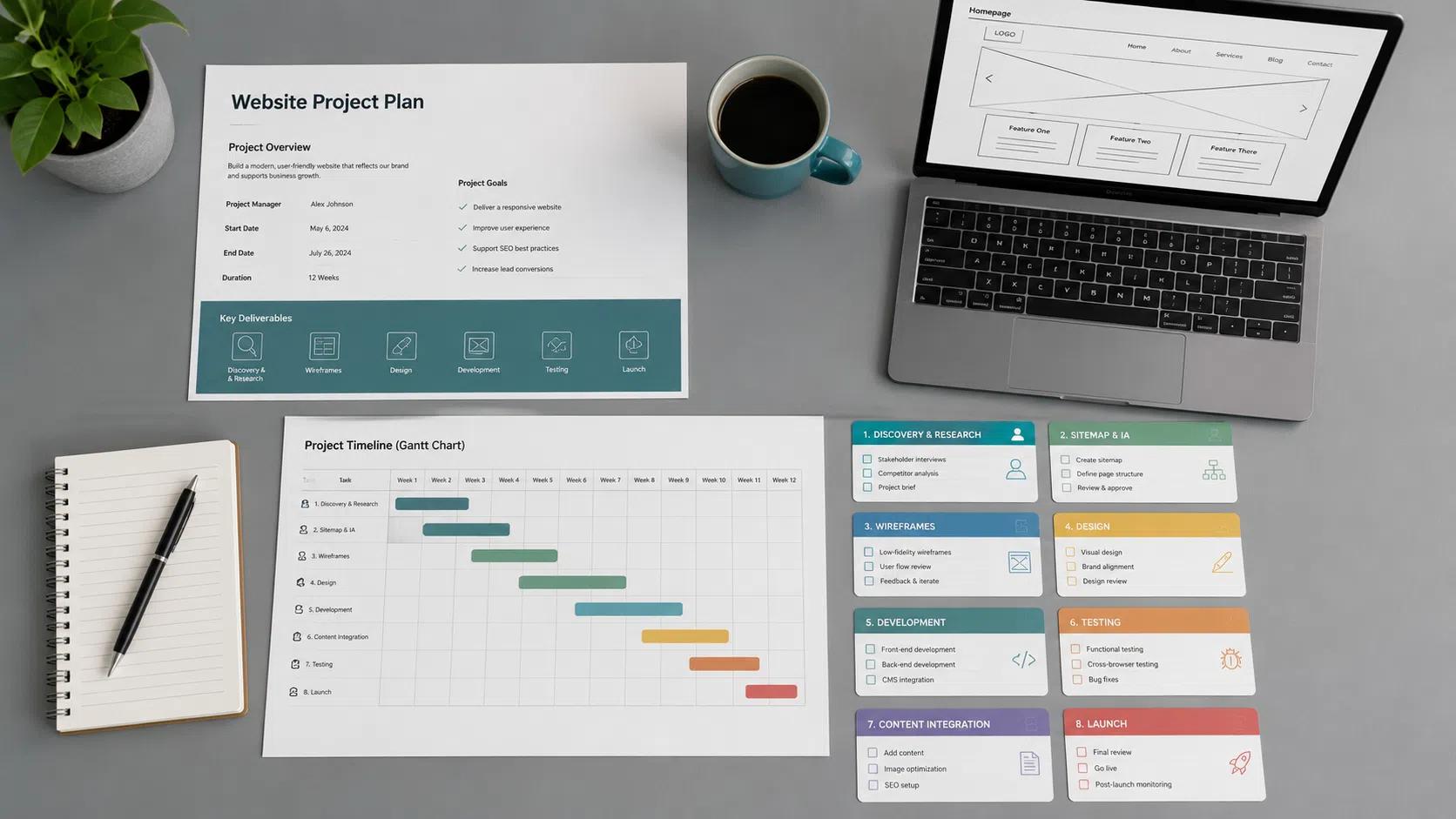
Planning, scope, timelines, and milestones
Project planning is where most website failures are either prevented or guaranteed. The web project manager starts by pinning down what the site actually needs to do: how many pages, which features, what integrations, and what counts as “done.” That documented project scope becomes the reference point everyone returns to when someone asks for “just one more thing.”
From the scope comes the schedule. Good project planning breaks the build into phases: discovery, design, development, content, and then testing. Each phase gets a realistic slice of the project timelines. Milestones matter here because they create checkpoints. A milestone like “design approved” gives the client a concrete moment to weigh in. That beats dumping all their feedback the week before a planned website launch.
What happens without milestones is predictable. Feedback arrives late, changes pile up, and the launch date slips by weeks. I’ve seen a five-page service site for a local contractor balloon from a four-week build into a three-month ordeal. The cause was simple: nobody locked the scope or set review checkpoints. The contractor lost a full season of lead generation waiting for a site that should have shipped in a month. Milestones are not bureaucracy.
Budget management and resource allocation
Budget management on a web project rarely fails due to a single major expense. It fails through a hundred small, unbudgeted changes that nobody tracked. The project manager maps the budget against the scope at the start. Then they watch every change request to see whether it eats into the margin. When a client asks for a custom booking system halfway through the project, the web project manager prices it, explains the trade-offs, and gets a decision before work begins.
Resource allocation is the other half. The project manager decides who works on what and when. That way, the developer isn’t sitting idle waiting on design, and the content strategist isn’t writing pages for features that got cut. Sound resource allocation keeps people productive and keeps the project on time and within budget.
The root cause of most budget overruns is poor sequencing, not poor estimating. If content arrives after development is finished, the team rebuilds pages to fit the words. For small business owners who don’t have time to police this, Vineet Kukreti handles website project management directly at a flat hourly rate. This kind of project management for time-poor small business owners keeps scope, budget, and sequencing under one person’s control rather than spread across an account team.

Project management methodologies (Agile, Scrum, Kanban, Waterfall)
Different projects call for different project management methodologies. A good project manager picks the one that fits rather than forcing a favorite onto every job.
Waterfall runs the project in fixed sequential phases: plan everything, then design, then build, then launch. It works well for small, well-defined sites where the scope won’t change. The downside is that it handles surprises badly, since going back a phase is expensive.
The agile methodology takes the opposite stance. Work happens in short cycles, and the plan adapts as the client sees real progress. Two common frameworks fall under this umbrella. Scrum organizes work into fixed sprints, usually one or two weeks, with a defined set of tasks committed up front. Kanban is a visual board where tasks flow from “to do” to “done” with no fixed sprint length. That suits ongoing work and steady website redesign efforts.
In practice, many websites blend these. A project manager might use Waterfall-style phases for the overall structure and a Kanban board for day-to-day task flow. Most teams run this through project management software like Asana, Trello, or Jira, which gives every team member visibility into the same board. The methodology matters less than the discipline behind it.
Common challenges in website projects (scope creep, deadlines, feedback)
Scope creep is the most common killer of web projects. It starts small: an extra page here, a new animation there, a “quick” integration. Each request feels reasonable in isolation, and that’s exactly why it’s dangerous. The web project manager controls scope creep by routing every change through a documented process. Additions get priced and scheduled instead of quietly absorbed.
Missed deadlines usually trace back to feedback, not coding. Clients sit on design reviews for days, then send conflicting notes from three people at once. Strong stakeholder communication prevents this. The project manager sets feedback deadlines and consolidates input into a single, clear set of revisions. That alone prevents most slippage.
The third challenge is a risk that nobody planned for. A third-party plugin breaks, a domain transfer stalls, a key developer goes on leave. Risk mitigation means naming these threats early and having a fallback ready. None of this is glamorous, but it’s the difference between a project that ships and one that drags. Problem-solving here is constant and quiet, the kind of work that’s invisible when it’s done well and very visible when it isn’t.

Why a website project manager matters for project success
A website touches design, development, content, and technical SEO, and those disciplines pull in different directions. Without someone owning the whole picture and the clear roles and responsibilities that go with it, the SEO integration gets skipped, the content arrives late, and the launch slips. What does a website project manager do that justifies the cost? They prevent the expensive failures that nobody notices until the rework invoice arrives.
The payoff shows up in client satisfaction. When a build ships on schedule, on budget, and ranks because technical SEO was baked in, that’s not luck. It’s the result of disciplined website project management, careful budget control, and consistently applied clear communication skills. This is where dedicated SEO project management earns its keep: strong communication skills are arguably the single most valuable trait a web project manager can have, since most failures are communication failures in disguise.
For multi-person builds, redesigns, or any project where organic visibility matters, the role usually pays for itself in avoided delays alone. The specifics of contracts, liability, and scope of work agreements vary by jurisdiction, so confirm the terms with a qualified professional before signing.
If your website redesign keeps stalling or you’re worried about losing rankings during a rebuild, Vineet Kukreti manages website projects and folds SEO into the build from the start. You can book a free discovery session to talk through where your current project is getting stuck and what it would take to ship it cleanly.
FAQs
Q1. What does a website project manager actually do?
A1.
A website project manager oversees a web build from planning to launch, defining the scope, timelines, and budget while coordinating designers, developers, and content teams. They act as the central point of contact between the client and the people doing the work, keeping the project on schedule and at a high standard of quality.
Q2. How is a website project manager different from a web developer?
A2.
A web developer writes the code and builds the site’s functionality, while a website project manager organizes the people, deadlines, and budget around that work. The developer focuses on technical execution; the project manager focuses on scope, communication, and delivery.
Q3. Why can't I just manage the website project myself?
A3.
You can, but most small business owners are time-poor and end up firefighting scope creep, missed deadlines, and mismatched expectations between designers and developers. A dedicated project manager keeps everyone aligned so the build doesn’t stall or balloon in cost.
Q4. What if my project manager doesn't understand the technical side?
A4.
A good website project manager has working knowledge of HTML, CSS, CMS platforms like WordPress, and SEO basics, even if they don’t code daily. That technical literacy is what lets them spot problems early and translate between clients and developers.
Q5. What's the 80/20 rule in project management?
A5.
The 80/20 rule (Pareto principle) suggests roughly 80% of a project’s results come from 20% of the effort or tasks. A project manager uses it to prioritize the high-impact work first rather than spreading attention evenly across everything.

Vineet Kukreti is an experienced SEO and project management expert with over 10 years of success helping small businesses grow. He has led SEO campaigns that improved Google rankings, increased website traffic, and strengthened local visibility. As a project manager, Vineet brings structure and efficiency to digital operations, ensuring smooth execution and measurable results. His combined expertise in SEO and business operations makes him a trusted partner for growth-focused businesses.