

A plumber in Leeds ranks below three competitors in the map pack. He has more reviews and a better rating than all of them. The reason isn’t luck or Google punishing him. His primary category was set to “Contractor” instead of “Plumber,” and his profile hadn’t been touched in eight months. That single mismatch is enough to keep a business out of the results that matter most. A proper GMB optimization service exists to fix exactly this quiet, expensive gap. This article walks through what the work involves, how Google decides local rankings, and how to tell whether your money is turning into real customers instead of dashboard numbers.
What is a Google Business Profile (formerly GMB) and why it matters for local visibility
Your Google Business Profile is the free listing that shows up when someone searches your business name, or a service near them, on Google Search and Maps. It used to be called Google My Business, and most people still say GMB out of habit. The name changed. The importance didn’t.
Here is what many small business owners overlook. For local, high-intent searches, the profile often does more heavy lifting than the website itself. Someone searching “emergency electrician near me” rarely scrolls past the map pack. They tap a listing, see the hours and reviews, and call. Your website may never enter the picture. This behavior is well documented in Google research on local search behavior, which shows how “near me” searches translate directly into store visits and purchases.
Google’s own Business Profile Help documentation explains how listings surface across Search and Maps. It’s worth reading before you assume a listing runs itself. It doesn’t.
Search visibility here isn’t about ranking for one keyword. It’s about appearing at the exact moment someone in your area wants what you sell. A weak or neglected profile means those moments go to competitors. That’s why google business profile optimization sits at the center of any serious local SEO effort. This matters most for service businesses that depend on nearby customers finding them first.
What GMB optimization actually means and what a service includes
GMB optimization is the ongoing work of making your profile match what people search for and what Google trusts. It is not a checklist you complete once. A real GMB optimization service treats the profile as a living asset that needs attention every month.
In my 11+ years working across project management and SEO, the pattern I see most often is a profile that was set up well on day one and then abandoned. Take a common case: an electrician with a fully completed listing, but no fresh posts, no new reviews in nine months, and a primary category that didn’t match his highest-margin service. He wasn’t missing from Google. He was just being quietly outranked by shops doing the boring maintenance he’d stopped doing.
A typical engagement covers:
- Category selection, both primary and secondary, tied to how customers actually describe your service
- Accurate NAP consistency, meaning your name, address, and phone match everywhere online
- Service and product listings written for search intent, not internal jargon
- Photo management and regular google business profile posts
- Review generation and reputation management
- Performance reporting tied to calls and leads
The reason ongoing work matters is simple. Google rewards profiles that show fresh activity because recent posts, reviews, and photos signal that a business is open and operating, which is exactly what Google wants to serve a searcher. A listing set up in January and ignored by March slowly loses ground to competitors who keep posting and replying. Before you begin, it’s worth reviewing the official Google Business Profile guidelines for representing your business, since these rules shape what you can and can’t do with a listing.
Many providers stop at “profile setup.” In reality, setup is the easy part. Semrush’s guidance on local SEO makes the same point. Your google my business listing is one signal in a wider system. Business profile optimization only pays off when you maintain it alongside a coherent SEO strategy.
Want this done for you?
I run local SEO for small businesses in the US, UK and Canada: Google Business Profile, citations, location pages and reviews, with a plain-English report every month.
How Google ranks local businesses: proximity, relevance, and prominence signals
Google uses three main factors to decide local search ranking: proximity, relevance, and prominence. Understanding these three explains almost every ranking outcome you’ll see. Google’s own explanation of how Google ranks local search results breaks down exactly how these signals combine.
Proximity is distance. How close is the searcher to your business? You cannot change your location, but you can define your service area accurately so Google understands where you operate. A searcher three miles away and one thirty miles away see very different results.
Relevance is how well your profile matches the search. This is where categories, services, and descriptions do their work. Say someone searches “wedding photographer” and your primary category is “photographer.” You’re less relevant than a competitor who set theirs precisely.
Prominence is how well-known and trusted you appear. Review volume, review quality, response activity, and mentions across the web all feed this. Google treats a steady stream of recent, well-answered customer reviews as evidence you’re active and reliable.
These signals work together, which is why a business slightly further away can still outrank a closer competitor: a strong showing on relevance and prominence can offset a proximity disadvantage. You can win on relevance and prominence to make up for distance you cannot change. This is the core mechanic behind google maps visibility and every local pack placement.
Why local SEO differs from traditional website SEO
Traditional website SEO chases rankings on the standard blue-link results. You optimize pages, build content, earn links, and compete nationally or globally. Local SEO plays a different game with a different scoreboard.
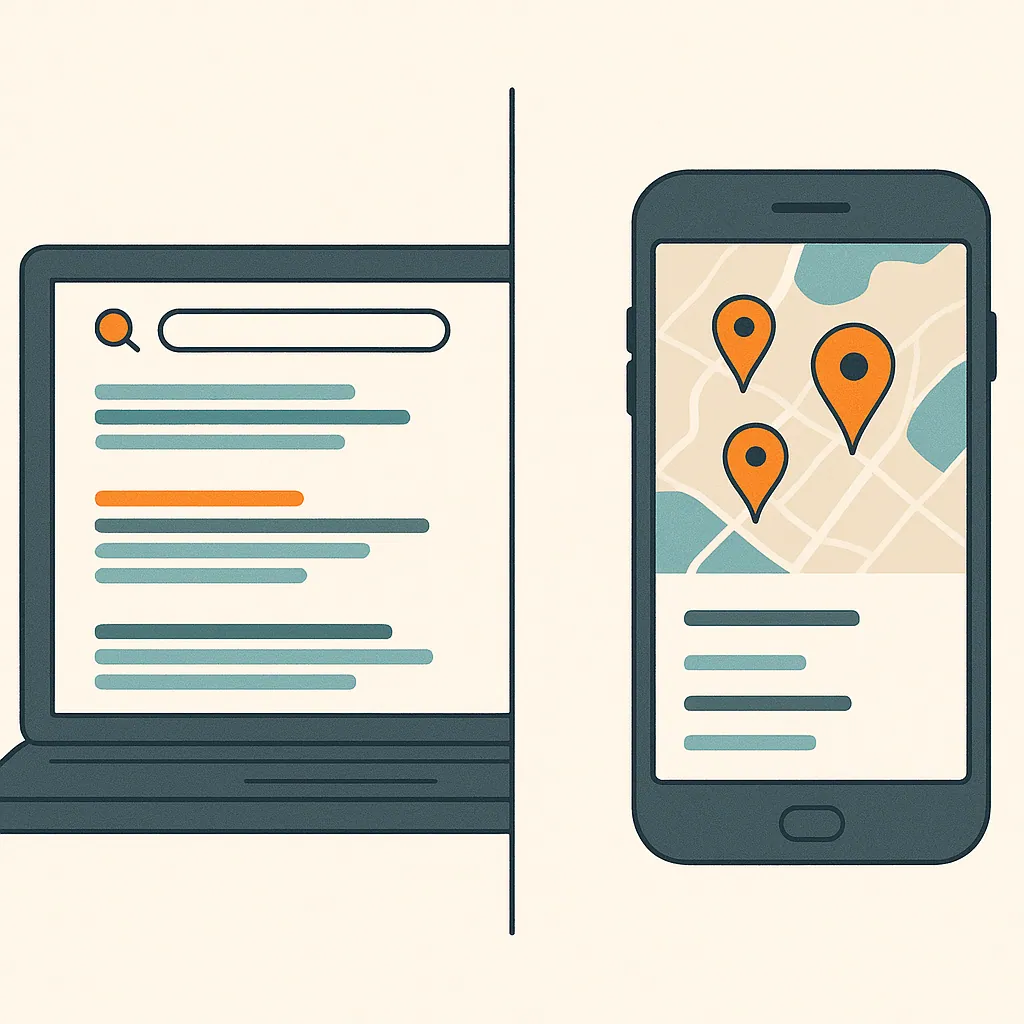
The first difference is the map pack. Local searches trigger a boxed set of three listings above the organic results, pulled from Google Business Profiles, not websites. You can rank first organically and still be invisible in the local pack if your profile is weak.
The second difference is proximity. No amount of great website content moves you closer to a searcher. Distance is baked into local ranking in a way it never is for informational queries.
The third is the signals themselves. Website SEO leans on backlinks, technical health, and content depth. Local SEO leans on profile accuracy, customer reviews, NAP consistency, and engagement.
Many assume a strong website automatically wins local searches. In reality, the two run on parallel tracks. A business can have an excellent site and terrible google maps visibility, or the reverse. Both deserve attention. Treating gbp optimization as a byproduct of website work is a mistake that costs local leads every month.
Core profile elements to optimize: categories, services, descriptions, and NAP accuracy
If you fix only a few things, fix these. They carry the most weight in google business profile optimization.
Business categories are the single strongest relevance lever. Your primary category should describe your core service exactly, and secondary categories should cover the rest. The Leeds plumber I mentioned earlier jumped into the map pack within weeks purely by switching his primary from “Contractor” to “Plumber.” Nothing else changed, because the primary category is the field Google weighs most heavily when deciding which searches your profile is eligible to appear for.
Services let you list what you offer with descriptions. Write these the way customers search, not the way your invoices read. “Boiler repair” beats “heating system diagnostics.”
Descriptions give context. Use plain language that matches search intent and includes the services and area you cover.
NAP accuracy is quieter but critical. Your name, address, and phone must be identical across your profile, website, and directory listings. Inconsistent details confuse Google and erode trust, which drags down local search ranking.
Profile accuracy across all of these separates a listing that ranks from one that just exists. Get the business categories right first, then tighten everything else around them.
The role of photos, posts, and profile content in building visibility
A profile with no photos and no recent activity reads as abandoned, both to Google and to the customer deciding whether to call you. Fresh content signals that you’re open and active.
Profile photos matter more than most owners think. Listings with quality images of the storefront, team, and completed work tend to earn more clicks and calls than bare ones. Real profile photos beat stock every time. Customers are checking whether you look legitimate before they trust you with money.
Google business profile posts are short updates you publish directly to your listing: offers, events, news, service highlights. They keep the profile looking active and give Google fresh signals to read. Posting weekly is far more useful than a burst of activity once a quarter. There are plenty of practical ways to get more traffic from your profile once you keep it consistently active.
The reason this matters is behavioral, not just algorithmic. When two similar businesses sit side by side in the local pack, the one with recent photos and posts wins the tap. Visibility gets you seen. Profile content earns the click.
Consistent photo updates and posting also feed the prominence signal over time. This quietly supports organic growth in local search ranking without any paid spend.
How reviews and reputation influence local rankings and trust
Customer reviews are the most visible trust signal on your profile, and they pull double duty. They influence rankings through the prominence signal, and they influence conversions by reassuring the person deciding whether to call.
Three things matter: volume, recency, and responses. A business with more recent reviews generally outranks and outconverts one with fewer, older ones. Recency signals you’re still active. Responding to reviews, both positive and negative, tells Google and customers that you’re engaged.
Here’s a point owners get wrong. Many assume a perfect five-star rating is the goal. In reality, a rating around 4.5 to 4.8 with a healthy volume often converts better. A flawless score reads as suspicious to wary customers.
Reputation management means actively requesting reviews from happy customers and handling negative ones calmly and publicly. A thoughtful reply to a complaint can win more trust than the original review lost.
Reviews cannot be faked or bought without risking a violation of google guidelines. The sustainable path is a simple, repeatable process for asking real customers. That is exactly what a good gmb optimization service builds into the monthly workflow.
Appearing in the Local Pack, Google Maps, and AI Overviews
The local pack is the prize. It’s the boxed group of three business listings that sits at the top of local search results, above the organic links. Most local clicks happen here. If you’re not in it, you’re competing for scraps.
Getting there comes back to proximity, relevance, and prominence working in your favor. There’s no shortcut and no toggle to flip. It’s the accumulated result of accurate categories, strong reviews, consistent NAP data, and steady activity.
Google Maps is the other half. Many searches, especially on mobile, happen directly inside Maps. A profile optimized for search visibility generally performs in both places at once, since they draw from the same profile data.
AI overviews are the newer factor. Google increasingly surfaces AI-generated summaries that pull from Business Profiles, reviews, and structured data to answer local questions directly. A well-maintained profile with accurate information and strong reviews is more likely to be cited in these ai overviews, because these summaries lean on the same trust and relevance signals that decide local pack placement. It’s worth understanding the top ways to get your brand mentioned in AI search, since the same optimization work now feeds multiple surfaces at once. Neglect the profile and you lose ground across all three.

Single-location vs multi-location and franchise optimization
Optimization changes shape depending on how many locations you run. The sheer scale of the local market is worth keeping in mind here: U.S. Census Bureau small business data shows just how many local businesses are competing for the same map pack visibility.
For a single location, the work is focused. One profile, one address, one set of categories and reviews. The advantage is that every effort compounds on a single listing, so results tend to show faster and cleaner.
Multi-location businesses face a harder problem. Each location needs its own optimized profile with unique, accurate NAP data, location-specific reviews, and locally relevant content. The common mistake is treating all locations identically, which flattens their local relevance. A restaurant group with six branches needs six well-tended profiles, not one template copied across the board. I’ve watched a regional chain lose map pack placement at three of its sites simply because head office duplicated the flagship’s description across every listing, and Google read the near-identical profiles as thin and interchangeable.
Franchise operations add another layer. Ownership and management are often split between the brand and individual operators, and google guidelines are strict about who controls each listing. Duplicate or unmanaged franchise profiles are a frequent source of suspensions and ranking damage.
The scale of the work is why pricing rises with location count. A single-location business needs steady maintenance. Multi-location businesses need coordination, consistency checks, and per-location reporting. The underlying principles of gbp optimization stay the same, but the execution gets more demanding as you grow.
Staying compliant with Google’s guidelines to avoid suspensions
A suspended profile disappears from Search and Maps instantly. No warning, no gradual decline. One day your listing is generating calls. The next it’s gone, and reinstatement can take weeks. This is the risk that makes compliance non-negotiable.
Most suspensions trace back to a handful of violations of google guidelines:
- Keyword-stuffing the business name (adding “Best Cheap Plumber London” when your name is just your name)
- Using a fake, virtual, or PO Box address for a business that needs a physical location
- Creating duplicate listings for the same location
- Buying or incentivizing fake customer reviews
- Frequently changing core details in ways that look manipulative
The root cause of most suspensions is trying to game a signal instead of earning it. Google’s systems are built to detect shortcuts. The penalty for getting caught is far more expensive than doing it properly.
Guidelines also shift over time, and enforcement varies by category and region. What passed two years ago may trigger a flag now. This is where a service that follows current rules protects you. The point of google business profile optimization is durable search visibility, and nothing undoes that faster than a preventable suspension.
How to measure results: calls, website traffic, and qualified leads
If you can’t tie the work to outcomes, you can’t judge whether it’s working. This is where a lot of businesses lose the thread.
Google’s Business Profile performance insights show the metrics that matter most: calls placed from the listing, direction requests, website clicks, and how many searches surfaced your profile. These map directly to real customer actions, not abstractions.
Website traffic from the profile is worth tracking separately. Tagging the profile’s website link lets you see how much website traffic and how many inquiries come from local search specifically, rather than lumping it in with everything else.
But the number that counts is qualified local leads. Ten calls from people ready to book beat a hundred profile views that go nowhere. What matters is whether the profile produces enquiries you can actually convert into customers.
Results vary based on competition, business condition, industry factors, and implementation. Honest measurement means comparing against your own baseline, not a promised figure. Track calls and leads month over month. A profile doing its job shows a steady climb in qualified local leads. That is the real proof that the lead generation engine is working.
Connecting GBP optimization to real business outcomes, not vanity metrics
Profile views feel good. They don’t pay wages. This is the trap many owners fall into: celebrating impressions and search appearances while the phone stays quiet.
The goal isn’t more clicks. It’s better business outcomes. A gmb optimization service that reports rising views without rising calls is reporting activity, not value. Visibility without conversions creates little value.
The chain that matters runs like this. Search visibility leads to profile clicks. Clicks lead to calls and direction requests. Those lead to booked jobs and revenue. Every stage should connect to the next. If views climb but calls don’t, something in the profile is failing to convert interest into action, usually reviews, photos, or the offer itself.
This is why the work has to stay conversion-focused. Categories and posts get you seen, but reviews, clear service listings, and strong photos turn a viewer into a customer. A conversion-focused setup treats both halves as equally vital to lead generation.
For small business owners, the honest test is your bank account, not your dashboard. Real business outcomes mean more qualified local leads and steady organic growth in customers. That is the only reason any of this optimization work is worth doing.

Why local leads convert: search intent and the customer journey on a profile
Local leads convert well because the search intent behind them is strong. Someone typing “24 hour locksmith near me” isn’t researching. They’re locked out and ready to pay. That urgency is the whole reason gbp optimization delivers such a high return compared to broader marketing.
The customer journey on a profile is short and decisive. It usually goes: search, scan the local pack, tap a listing, check reviews and photos, then call or get directions. The entire path can take under a minute. Your profile has seconds to earn the tap and seconds more to earn the call.
Every element you optimize maps to a moment in that journey. Categories and NAP data win the initial appearance. Reviews and photos win the trust check. Hours, services, and the call button win the final action.
This is why profile content and reviews matter so much for conversion, not just ranking. A visitor arrives at the exact moment they need you, so the friction to becoming a customer is already low. Optimization removes the remaining friction. That’s what makes local leads some of the most valuable qualified local leads any business can generate.
Signs your profile is underperforming and where DIY optimization falls short
A few clear signals tell you the profile isn’t pulling its weight:
- You rank well organically but never appear in the local pack
- Competitors with worse reviews sit above you on Maps
- Profile views exist but calls and direction requests are flat
- Your listing hasn’t been updated in months
- Your NAP details differ between your website and directories
Any of these means visibility, conversion, or accuracy is leaking somewhere. If your business isn’t appearing at all, it’s worth diagnosing why your business might not be showing up on Google before anything else.
DIY optimization can absolutely work, and for some owners it’s the right call. But it falls short in predictable ways. Managing your google my business categories is subtle and easy to get wrong. Review generation needs a consistent process, not good intentions. Posting weekly and monitoring performance takes hours most owners don’t have. And the underlying rules keep shifting, including how google local services listings interact with your profile.
What usually happens is the profile gets set up well, then drifts. Three months of no activity, no new reviews, no posts, and the ranking quietly slides. This drift happens because local ranking rewards recent signals, so a profile that stops producing them steadily loses ground to competitors that don’t. Consistency is exactly what a busy owner struggles to sustain.
That’s the honest line between doing it yourself and bringing in help. The setup is learnable. The relentless, ongoing maintenance that actually drives local leads is where most DIY efforts stall.
This is the work I focus on with a small number of clients at a time, and it is exactly why I keep the roster lean: a gmb optimization service only produces results when someone is genuinely tending the profile every month, not filing it away after setup. If your profile is visible but not producing calls, or you’re watching competitors outrank you despite doing everything “right,” a focused local SEO audit can pinpoint where the ranking and conversion signals are being missed. I’m Vineet Kukreti, and if you’d like to explore your options, book a free Google Business Profile audit and we’ll look at what’s holding the profile back before you commit to anything ongoing.
Want this done for you?
I run local SEO for small businesses in the US, UK and Canada: Google Business Profile, citations, location pages and reviews, with a plain-English report every month.
FAQs
Q1. What exactly does a GMB optimization service do?
A1.
It refines your Google Business Profile across Search and Maps by completing your NAP details, selecting accurate primary and secondary categories, adding keyword-relevant descriptions, uploading photos, and managing reviews. The goal is to strengthen the three ranking signals Google uses locally: relevance, proximity, and prominence.
Q2. How much should I expect to pay for GMB optimization?
A2.
Managed plans typically run from $149 per month up to $799 per month, depending on business size and scope. Higher tiers usually add ongoing review management, posting, and reporting rather than a one-time setup.
Q3. Is hiring a GMB optimization service actually worth it, or can I just do it myself?
A3.
DIY is cheaper and gives you full control, but it takes real time to learn category selection, descriptions, and consistent posting. A service is worth it when the profile isn’t producing local leads and the owner lacks hours to test and maintain it, since missed ranking factors quietly cost visibility.
Q4. What happens if my profile is already set up but still isn't getting calls or leads?
A4.
A completed profile isn’t the same as an optimized one; missing categories, thin descriptions, few reviews, or inconsistent NAP data all limit placement in the Local Pack. Traffic alone isn’t enough, so the fix usually targets relevance signals and conversion elements like photos and review responses.
Q5. How does optimizing my Google Business Profile actually improve local rankings?
A5.
Optimization improves relevance by matching your categories, services, and keywords to search intent, and prominence through reviews and engagement. Proximity you can’t change, but accurate address and service-area data help Google understand where you serve customers.
Q6. Should a good service include more than just filling out my profile?
A6.
Yes—a complete service covers profile setup and verification, NAP consistency across platforms, category and service optimization, visual content, and ongoing review management. Ongoing work matters more than a single setup, since local rankings shift with fresh activity.
Q7. Do I even need a Business Profile if I'm mainly running Google Ads?
A7.
Not always—online-only sellers or lead-gen sites that route traffic to landing pages can run Ads without one. But if you depend on local visibility or in-person customers, a Business Profile supports the searches Ads alone won’t cover.
Q8. Can I delete my Business Profile later if I stop needing it?
A8.
Yes—you can remove its content and managers from your Google account. Once removed, you can no longer manage the profile on Search and Maps, so treat deletion as a deliberate decision.

Vineet Kukreti is an experienced SEO and project management expert with over 10 years of success helping small businesses grow. He has led SEO campaigns that improved Google rankings, increased website traffic, and strengthened local visibility. As a project manager, Vineet brings structure and efficiency to digital operations, ensuring smooth execution and measurable results. His combined expertise in SEO and business operations makes him a trusted partner for growth-focused businesses.