
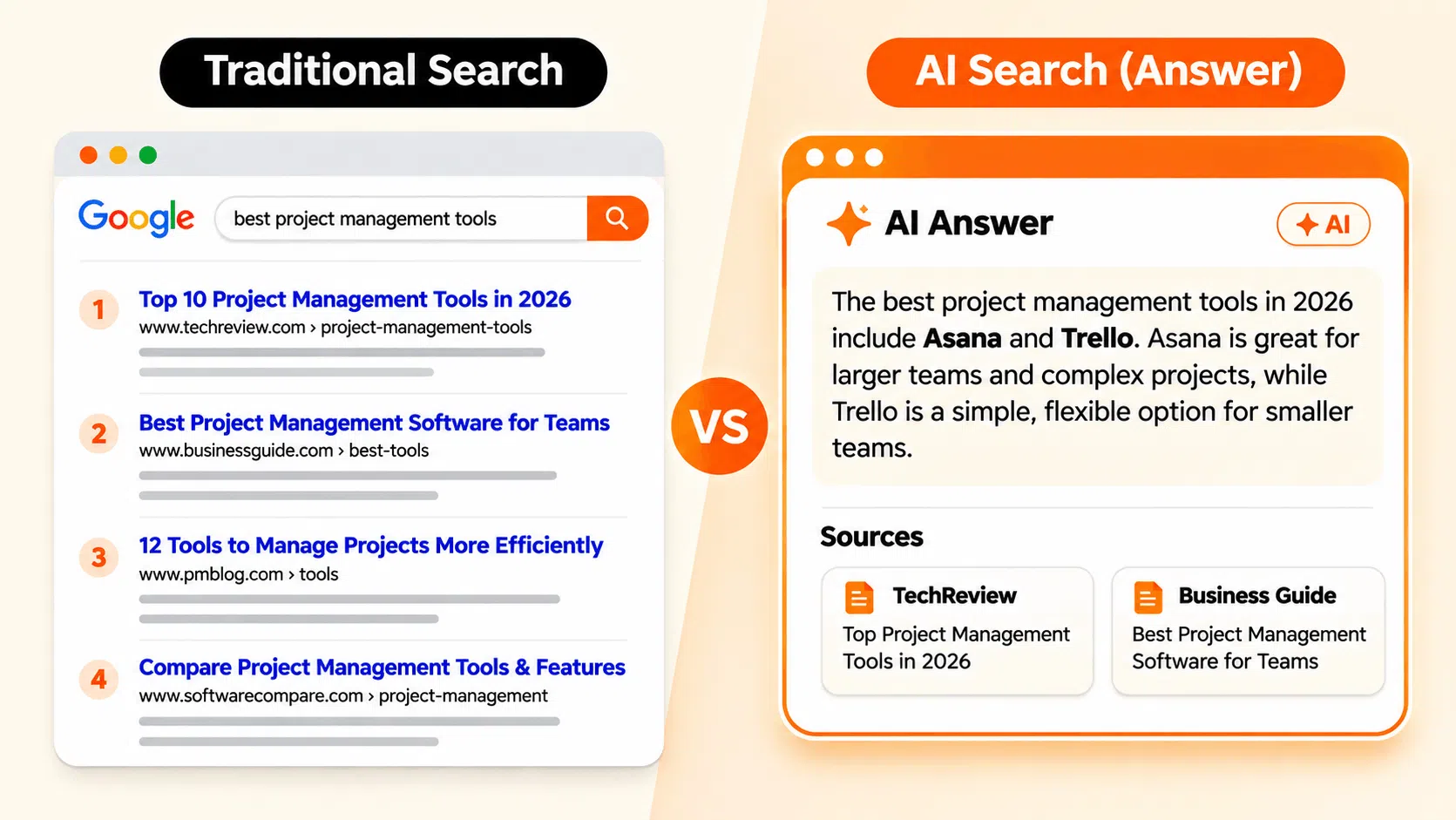
A plumber in Denver ranks third on Google for “emergency pipe repair.” That’s a solid position. But when a homeowner asks ChatGPT the same question, the AI names three competitors and skips him entirely.
That gap points to a core problem with answer engine optimization: your site can rank well in traditional search and still be invisible the moment a buyer asks an AI instead. This happens because AI systems retrieve and synthesize answers from only a handful of sources rather than returning a full list of ranked links, so a page that isn’t structured for extraction gets passed over regardless of its search ranking. The consequence is a quiet loss of leads: buyers who would have clicked through on Google never see the business at all when an AI answers instead.
This article walks through what AEO is, why AI systems ignore most sites, how to measure whether you show up in AI answers, and the concrete steps that get your content cited. Before diving in, it helps to understand what AI search engine optimization actually means for your business, since the term gets used loosely across the industry.

What is answer engine optimization (AEO)
Answer engine optimization is the work of shaping your content so AI tools can read it, trust it, and repeat it as the answer to a user’s question. Traditional search hands back ten blue links and lets the user choose. Answer engines like ChatGPT, Perplexity, and Google AI Overviews skip that step. They read dozens of sources, synthesize one response, and often name only a handful of brands inside it. Part of why this shift matters so much is scale: ChatGPT’s visitor traffic has grown rapidly since launch, putting millions of buying decisions in front of an AI-generated answer instead of a search results page.
The reason this matters is simple. If an AI system writes the answer, the question becomes whether your business is part of that answer or absent from it. Ranking fifth no longer guarantees a mention, because the model may only cite two or three sources. Google’s own rollout reflects this shift too, as Google’s AI Overviews now appear across a large share of search results, inserting a synthesized answer above the traditional listings many businesses have spent years optimizing for.
AEO sits inside a broader shift Google itself has documented in its guidance on AI features and your website, which explains how its systems select and surface content for AI-generated answers. The practical takeaway: showing up in classic search and managing to get cited in AI answers are now separate outcomes. You have to earn both.
How answer engines surface and name brands in AI answers
Answer engines don’t “look up” a ranking. They retrieve relevant passages, weigh them for clarity and authority, then generate a response that may quote or paraphrase a few sources. Brand mentions happen when your content answers the exact question cleanly, and your site is trusted enough to be pulled into the synthesis.
Three things drive whether you get named. First, retrievability: can the crawler actually read your page? Many sites hide core content behind JavaScript, which AI crawlers often skip. Second, clarity: a passage that answers the question in one or two sentences is far easier to lift than a 300-word wind-up. Third, corroboration: when your claim is echoed across directories, reviews, and citations, the model treats it as reliable. This corroboration step matters because answer engines are designed to limit the risk of repeating a wrong or unverifiable claim, so a single unconfirmed source is a weaker candidate for citation than one backed by consistent outside mentions.
Perplexity makes this visible by showing numbered sources beside its answers, a useful window into how answer engines pick what to cite. The Nielsen Norman Group on AI chatbots and search describes how users increasingly accept synthesized answers without clicking through. That’s exactly why getting cited, not just ranked, now decides who gets the lead.
How AEO differs from traditional SEO
Traditional SEO chases position. You want to sit at the top of the results page so the user clicks your link. The entire model assumes a click is the prize. Answer engine optimization assumes the opposite: the AI may answer the question completely, and the “win” is being the named source behind that answer, click or no click.
That changes the daily work. In traditional SEO, you optimize titles, build backlinks, and fight for the top three positions. With AEO, you structure content so a machine can extract a clean answer: question-style headings, a direct response up top, supporting lists and tables underneath.
Many assume AEO replaces SEO. In reality, it builds on it. A page that can’t be crawled or trusted won’t get cited either, so technical SEO and content quality still carry the load. The SEO vs. AEO distinction is less about rival tactics and more about a second scoreboard. You now compete for ranking positions and for a slot inside AI-generated answers, often with the same underlying content.
AEO vs GEO vs AIO: how the terms relate
The vocabulary is messy because the field is young. Three labels get thrown around: AEO, GEO, and AIO. They overlap heavily, and most practitioners use them loosely.
- Answer engine optimization (AEO) focuses on getting your content extracted as the direct, cited answer to a specific question.
- Generative engine optimization (GEO) is broader: optimizing so generative engines mention, reference, or recommend your brand inside any AI-generated response, not only direct answers.
- AIO (AI optimization) is the loosest umbrella term, covering everything from AI visibility to how AI tools interpret your whole site.
In day-to-day work, the distinctions rarely change what you do. Whether you call it aeo, geo, or generative engine optimization, the actions are the same: clean crawlable code, answers written as answers, structured data, and corroborating citations. The root cause of visibility in all three is identical: an AI system has to find your content, understand it quickly, and trust it enough to repeat it. Pick whichever term your audience uses and focus on the mechanics. If you’d rather not untangle the terminology yourself, Vineet Kukreti’s AI SEO and GEO optimization services cover all three under one practical framework.
Why your site gets no citations, or AI leads
Picture a dental clinic that ranks on page one for “teeth whitening cost” but never appears in a single AI answer. The pattern is common, and the causes are boringly consistent.
Usually it comes down to a few failures:
- The crawler can’t read the page. Content loaded by JavaScript often doesn’t make it into what AI crawlers see, so your best answer is invisible.
- No direct answer exists. The page buries the response three paragraphs deep, and the model can’t extract a clean passage.
- No structured signals. Missing schema markup and no corroborating citations across the web leave the AI with nothing to verify.
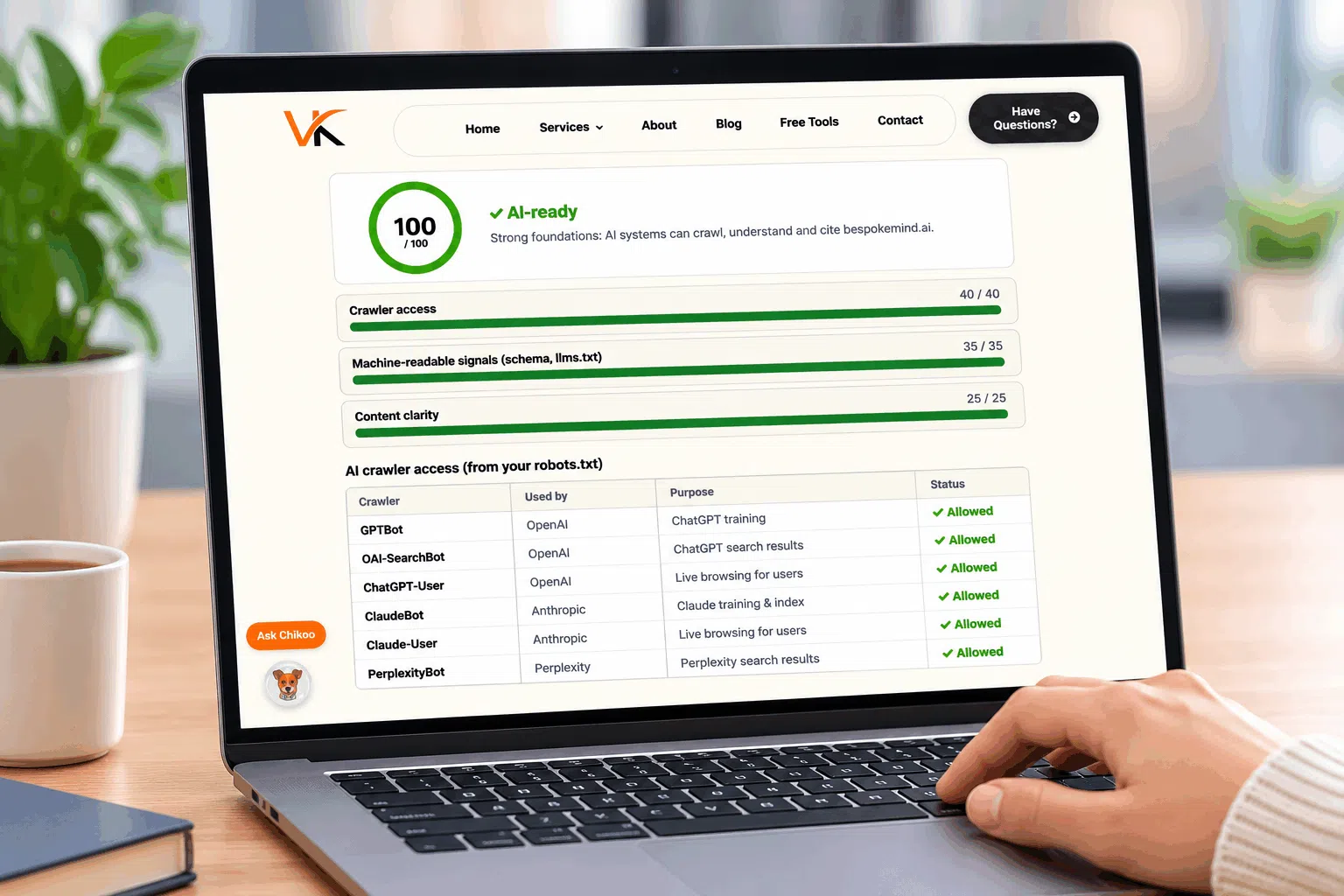
- Blocked access. Some sites accidentally block AI crawlers in robots directives or lack an llms.txt file telling engines what to read.
What actually happens is that answer engines favor the source that makes their job easiest. If your competitor answers the question in one tidy sentence with supporting structure and you don’t, they get cited, and you don’t. The consequence compounds over time: every missed citation is a buyer handed to a competitor before they ever reach your site. Consider a local HVAC company that rewrites its pricing page as a direct answer while a competitor’s page still buries the number in a paragraph of marketing copy; the rewritten page becomes the one an AI tool quotes, and the competitor’s otherwise solid content never gets picked up at all. Vineet Kukreti runs an AI visibility audit that checks crawler access, schema markup, and citation gaps so you can see exactly why answer engines are skipping you.
How to measure AI search visibility
You can’t improve what you don’t track, and AI visibility is harder to measure than rankings because there’s no single results page to check. The first honest answer: measurement here is fuzzier than classic SEO, and no tool gives perfect coverage yet.
Start with manual testing. Ask ChatGPT, Gemini, and Perplexity the exact questions your customers ask, then record whether your brand shows up and how it’s described. Do this across a fixed list of prompts so you can repeat it monthly and spot movement.
Then layer in harder signals:
- Referral traffic from AI sources in your analytics, which shows real ai leads arriving from these tools.
- Brand mentions in AI answers tracked through dedicated AI visibility tools.
- Citation presence in Perplexity’s numbered source lists.
If you want to measure ai visibility properly, treat it like a scorecard tracked over time, not a one-off check. If you want a quick baseline before building out that scorecard, you can check your AI search visibility for free to see whether a specific page is already showing up, a practical place to begin before investing in deeper monitoring.
Where to start with answer engine optimization
Don’t boil the ocean. Start with the handful of questions that actually drive your business, usually the ones tied to buying intent: pricing, “near me” service queries, comparisons, and “how do I fix X” problems.
A sensible first sequence:
- List your money questions. Write down the 10 to 20 questions a ready-to-buy customer asks before contacting you.
- Test current visibility. Run each question through ChatGPT and Perplexity and note whether you appear.
- Fix crawler access first. Confirm AI crawlers can reach your pages and that core content isn’t locked behind JavaScript.
- Rewrite your best pages as answers. Lead with the answer, then support it.
The reason to sequence it this way comes down to order of impact. Crawler access is binary: if engines can’t read the page, every other improvement is wasted. Any small business owner juggling limited time is better off fixing access and rewriting a few high-intent pages than chasing a sprawling content plan. This is also where a focused content strategy around search intent pays off, because matching the buyer’s actual question is what makes a page quotable in the first place. If you’d rather get expert eyes on your specific pages before committing time to a full rewrite, you can book a one-time SEO consultation to prioritize the sequence for your site.
Foundational steps to make content answer-engine friendly
The mechanics of being answer-engine friendly are not exotic. They reward clarity.
- Headings as questions. Turn section headings into the literal question a customer types or speaks.
- Answer-first paragraphs. Put the direct answer in the opening sentence, then expand with detail.
- Lists and tables. Structured formats are easy for a model to lift, which is why a short comparison table often gets cited verbatim.
- Schema markup. Add FAQ, how-to, and organization schema markup so engines understand the page’s role and your business facts.
- llms.txt and crawler access. Publish an llms.txt file and verify robots rules allow AI crawlers in.
- Citation building. Earn consistent mentions across directories, reviews, and reputable sites so your claims get corroborated.
What actually happens when you do this: you reduce the effort an answer engine spends to understand you, and lower effort tends to be rewarded with citations. None of it guarantees a mention, and results vary based on competition, industry, and how established your site is. But each step can raise the odds that your brand is the one AI recommends instead of a competitor.
Why AI leads matter for small local businesses
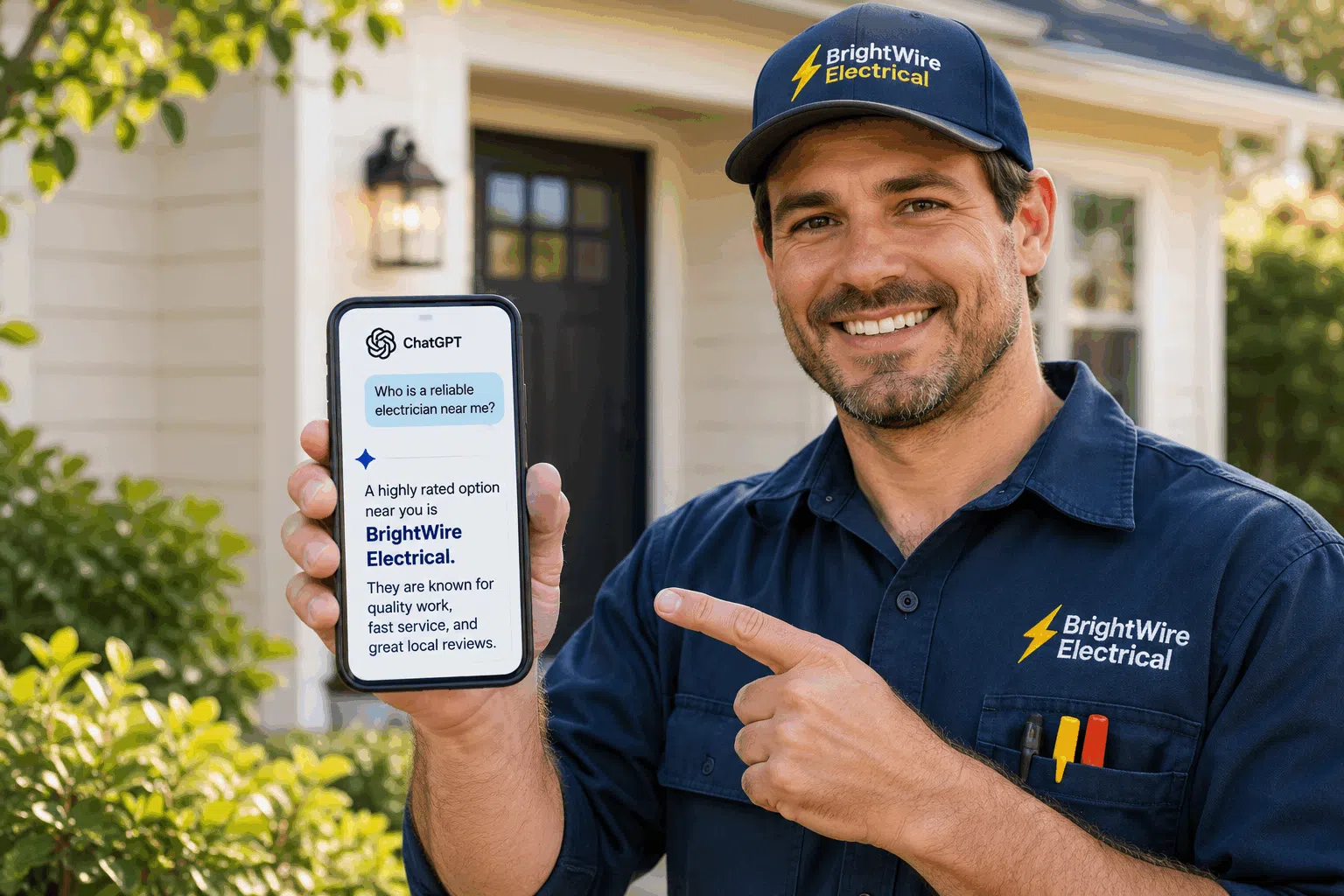
A local business feels AI search differently than a national brand does. When someone asks ChatGPT for “a reliable HVAC company in my area,” the AI returns a short list, not ten pages of options. If your business isn’t on that list, you’re not losing position 11. You’re losing the entire conversation.
The quality side matters even more than the volume. HubSpot data puts AI-referred conversion around 11.4% against roughly 5.3% for standard organic search, suggesting these visitors arrive closer to a decision. For a service business where a single job is worth hundreds or thousands of dollars, a handful of qualified leads sourced from AI answers can outweigh a flood of low-intent clicks.
This is also why becoming a brand recommended by AI builds a moat. Once you’re the business an answer engine names, you capture demand before competitors even enter the picture. For small local operators, the work to get cited in ai answers is less about traffic totals and more about owning the exact moment a buyer asks for help. Getting cited in ai answers consistently is what keeps that moment yours. Keep in mind that AI engines regenerate answers each time, so citation is a position you maintain, not a trophy you keep.
If you’re ready to act on this, a structured starting point helps: confirm your crawler access, rewrite your highest-intent pages as direct answers, and track your citation presence monthly so you can see whether the changes are working.
How Small Businesses Can Improve Their AI Visibility
If your website ranks on Google but never shows up when customers ask AI tools for a recommendation, a focused review can pinpoint exactly where answer engine optimization is breaking down for you. Vineet Kukreti works with a limited number of small businesses on AI search visibility and the technical fixes behind it, so if you want a clear read on where you stand, you can get a straight answer on your AI visibility and a practical plan to improve it.
FAQs
Q1. What exactly does answer engine optimization mean?
A1.
Answer engine optimization is the practice of structuring your website content so AI tools like ChatGPT, Gemini, Perplexity, and Google AI Overviews can pull it directly into their answers. Instead of ranking a page for someone to click, the goal is to have your content quoted or cited as the source behind the response.
Q2. How do I actually start doing AEO on my site?
A2.
Start by turning your page headings into the actual questions your customers ask, then answer each one in the first sentence or two before adding supporting detail. Use lists, tables, and plain HTML (AI crawlers often skip JavaScript-rendered content), since that structure is what gets lifted and cited.
Q3. What's the difference between AEO and GEO?
A3.
The terms are mostly used interchangeably, GEO (generative engine optimization) typically refers to optimizing for AI-generated answers broadly, while AEO focuses more specifically on getting your content extracted as the cited answer. In practice, both involve the same work: clean structure, direct answers, and crawlable content.
Q4. Is AEO actually worth doing, or is it another SEO trend?
A4.
HubSpot data shows AI-referred visitors convert at roughly 11.4%, compared to about 5.3% for regular organic search traffic, which suggests the leads that do arrive are further along in their decision. That said, AEO won’t replace the click volume SEO provides, it’s a complement, not a swap.
Q5. Can I use AI tools to help with my SEO and AEO work?
A5.
Yes, AI tools can help draft FAQ content, generate schema markup, and identify the question phrasing your audience uses, but the underlying work (clear structure, accurate answers, crawlable HTML) still needs human review. Relying on AI output without editing for accuracy is a common way businesses end up with content that answer engines ignore.
Q6. What if my content never gets cited by any AI tool, did I waste the effort?
A6.
Even without a citation, answer-first formatting, headings-as-questions, and clean markup tend to improve how Google and users scan your page, so the structural work isn’t wasted. Citations also aren’t permanent or guaranteed for any given query, since AI engines regenerate answers each time rather than holding a fixed ranking.
Q7. How is AEO different from traditional SEO?
A7.
Traditional SEO optimizes for ranking position on a results page, where a click is the measure of success. AEO optimizes for being the source an AI system quotes directly in its answer, which can happen with or without a click back to your site.
Q8. What is SEO, in plain terms, for someone who's never done it?
A8.
SEO is the practice of making your website easier for Google (and now AI tools) to find, understand, and recommend for the searches your customers run. It covers technical setup, content relevance, and the signals, like backlinks and page speed, that establish your site as a trustworthy answer.

Vineet Kukreti is an experienced SEO and project management expert with over 10 years of success helping small businesses grow. He has led SEO campaigns that improved Google rankings, increased website traffic, and strengthened local visibility. As a project manager, Vineet brings structure and efficiency to digital operations, ensuring smooth execution and measurable results. His combined expertise in SEO and business operations makes him a trusted partner for growth-focused businesses.